
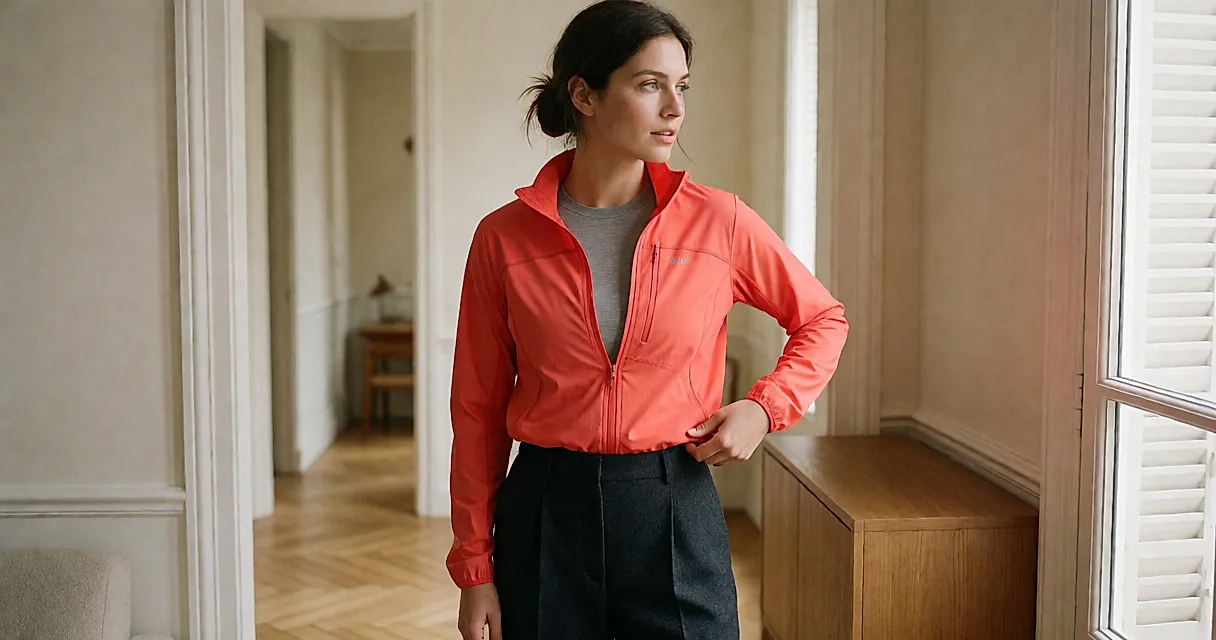
It's there, slung over the back of the chair, fluorescent as a telling-off: the jacket from Sunday's run. Then it's Monday, 8.12am, you're standing at the wardrobe, and you catch yourself layering it over wool trousers and deciding it actually works. Is the humble windbreaker quietly taking over from the mid-season jacket?
The armhole detail the fitting room never shows you
A jacket built for running starts from a body in motion: shoulders that rotate, a back hem cut a little longer to cover the kidneys, a raised armhole so the arm can swing without the fabric pulling. In town the movement changes but the demand doesn't — you reach up for the Tube handrail, you cycle, you carry a box of shopping home. That freedom shows immediately in how the thing looks on you.

And yet it's the armhole that decides whether the jacket ever leaves the house. On a running piece it's often high and close-fitting, cut for a swinging arm rather than a chunky knit underneath. Three moves are enough to tell: raise your arms, squeeze your shoulder blades together, then pretend to run for a bus. If the jacket rides up to your navel, it's too neat; if it cuts into the top of your arm, it won't layer. Going up a size usually sorts it.
The back hem decides how it hangs
A jacket that's too short stops above your jeans and slices the silhouette in two, like a badly punctuated sentence. One that falls to mid-hip, by contrast, works with high-waisted trousers or straight-leg jeans. At the front, the length should land at the top of the hip; at the back, the jacket needs to cover your kidneys if you're cycling.

And you judge it from behind, not facing the mirror. Take three steps, sit down, lift one arm: if the fabric rides up or gapes at the waist, the piece won't do its job. One last detail: a flat hood slips under a coat, a bulky one forces you to rethink the whole outfit. Only you know whether you're the layering type.
If the fabric can't breathe, it stays on the hanger
A running jacket is built to shift heat away, not hold on to it. Hence the very light fabrics, often unlined, that weigh nothing in the hand. That's an asset between 10 and 15°C, a comfort on the morning bike ride, a good piece for skies that can't make up their mind — but no further than that: it won't do a coat's work.
So what should you look at? Keep an eye on the composition: plenty of windbreakers are mostly synthetic. One word of caution is enough — check the label and the fibre content. For the warm layer underneath, merino wool remains a safe bet, and brands such as Icebreaker have made it their speciality. Before you buy, look at what's already hanging in the hallway: last half-marathon's jacket does the job perfectly well.
What it's good for, and what it isn't
The piece plays the role of a mid-season jacket in a fairly specific life: the commute, the bike ride, the Sunday walk, a chilly pub terrace, the 9pm cinema trip. A bit of fine drizzle? It copes. A relaxed office? Yes, if the colour is sober and the cut clean.

On the other hand, it's no defence in proper rain, it doesn't replace a jacket for a client meeting, and it hates a strong wind. If your arms are cold the moment the sun drops, if the sound of the fabric irritates you, or if you're after a piece you'll keep for ten years, walk away without regret. A running jacket is a seasonal piece, not an investment.
How much to spend, and what you get for it
At a sports retailer, expect to pay around £30 to £55 for a simple, light, non-waterproof windbreaker. Running brands push that to roughly £75 to £150: you're paying for the cut, the finishing, sometimes a hood. Between £170 and £280 you're into technical territory with a waterproof membrane, which is only worth it if you genuinely cycle in the rain. Second-hand, around £15 to £45 depending on condition.
What moves the price: the membrane, the hood, the brand, the colourway. End of season is often the moment to pick up less sober shades at a friendlier price. Where to look: a sports retailer (Decathlon, for instance), a specialist running shop, the brand's own website, resale platforms and local charity shops.
Three moves before you commit: arms up, three running steps, a short sit. If the jacket rides up, pulls or gapes, it stays in the wardrobe. Between two sizes, take the larger to layer over a jumper, the smaller to wear alone over a T-shirt.
Which leaves the question that matters: is it worth it? If the jacket is already asleep in a cupboard, yes — as long as you check the armhole, the back hem and how the fabric behaves over a jumper. If you're buying one, get it roomy enough to layer, in a colour that can cope with Monday morning, and leave the fluorescent one at the park. A jacket that asks nothing of you and that you pull on without thinking: maybe that's the real luxury of November.
Sources
- Decathlon — Decathlon, clothing and sports equipment, consulted 2 November 2026.
- Icebreaker — Icebreaker, merino wool clothing, consulted 2 November 2026.


Comments
Your opinion matters: rate the article, react and reply to comments.
Comments are moderated; AI-assisted comments are flagged. Text emoticons (8-), :-), <3…) are automatically shown as images.