
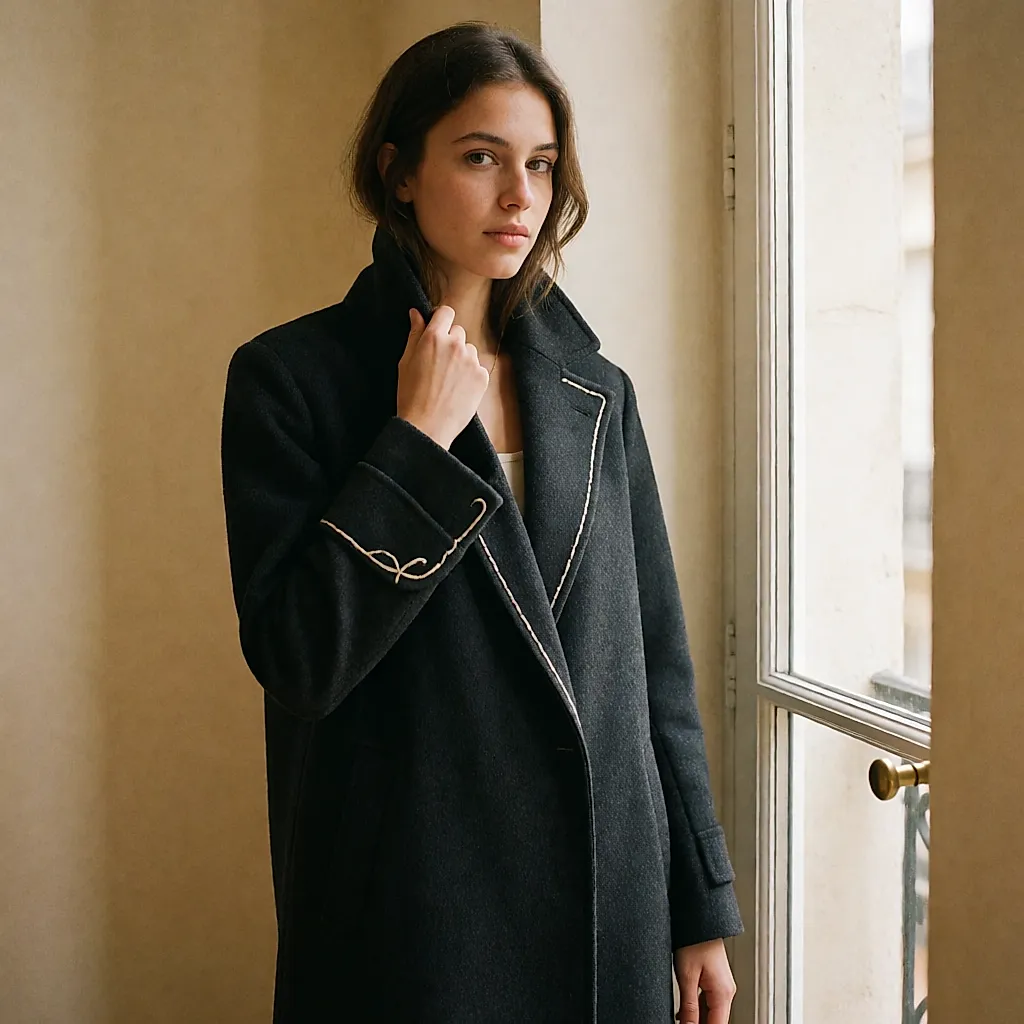
Your black wool jacket has seen three winters, a full life, and that small bit of wear at the cuff that gives it the look of an old campaigner. Are you wondering whether to have it altered, demote it to weekends or replace it? This is exactly the moment when an embroidered detail tips the balance: a line of light thread on a lapel, three tiny flowers at the collar. The piece does not look younger — it changes rank.
The detail you notice first in store
This is not just a shop-window impression: autumn collections are putting textured surfaces centre stage. Embroidery, eyelet details, contrasting threads on wool: you spot them first on jackets, cardigans and shirts, often in modest places — a cuff, a collar, a chest pocket. Where the hand rests, where the eye lingers.
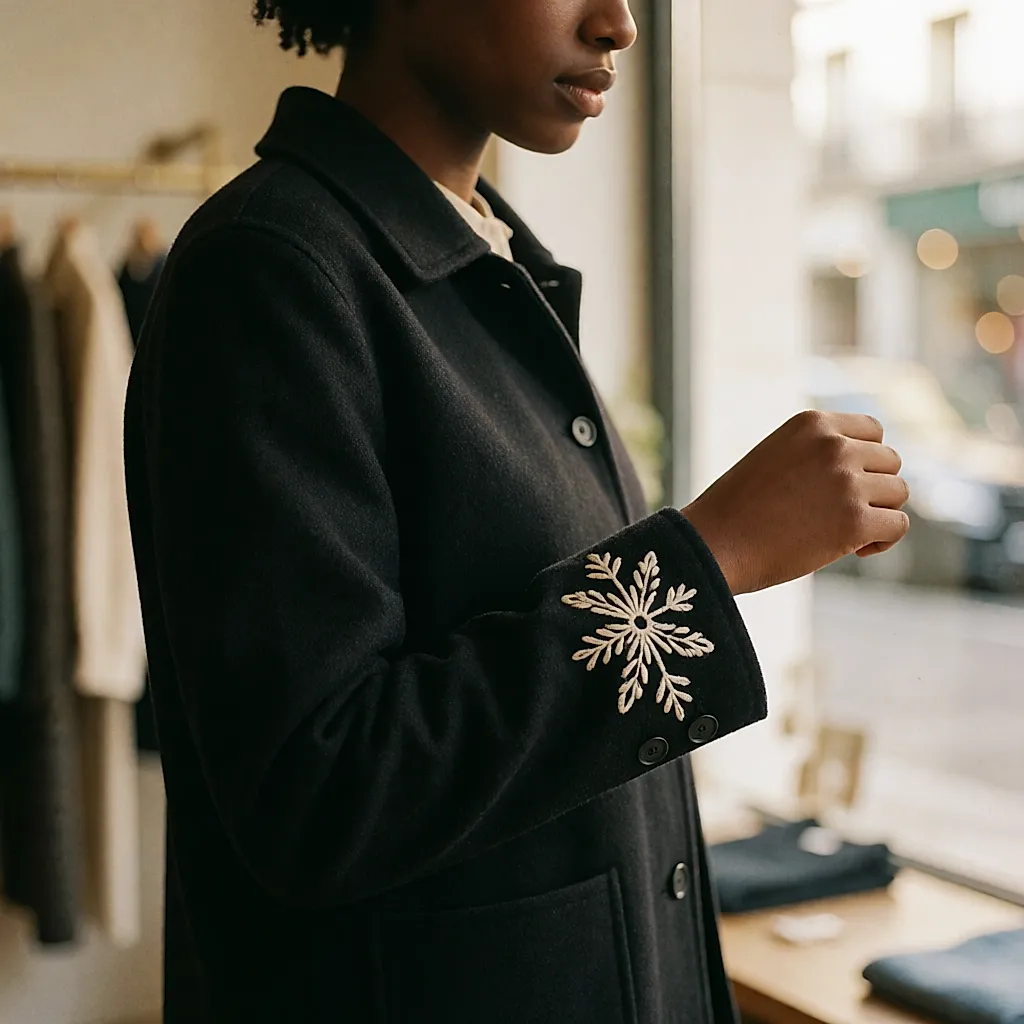
The idea isn't to buy the 2026 version of that jacket, but to have the same kind of detail added to the one already hanging in your wardrobe. You keep the drape you love, the cut you know, the colour that goes with everything — and add that extra bit of style that sets a basic piece apart. In wardrobe terms, it's the season's most understated move: nothing new needs to be made.
Wool: a surface that forgives almost anything
Lucky: wool loves texture. Its slightly matte surface and gently curled grain catch the light and give depth to the thread. That's what makes embroidery readable from a distance — where a smooth, shiny fabric often only offers a surface effect.
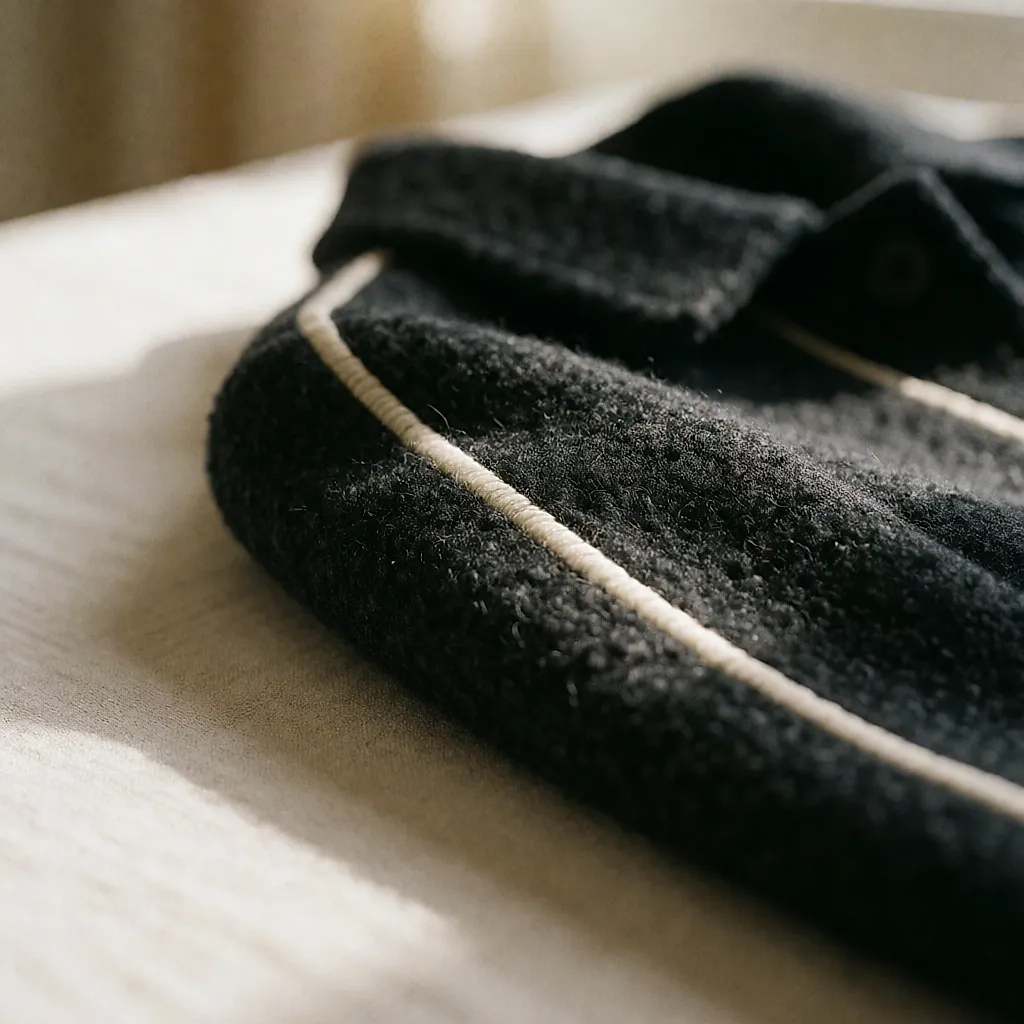
A caveat, though. The finer the weave, the lighter the motif should stay: on fluid cashmere, a dense design pulls at the fabric and distorts the drape. Save busy motifs for compact woollens, lined jackets and thick cardigans. And five minutes chatting with whoever will do the embroidery can save a lot of regret.
Hand or machine: the stitch that shows
By hand, embroidery has life: stem stitch is rarely perfectly even, and that's what gives it its relief and slightly living charm. By machine, the result is crisp, even, more graphic — brilliant on a repeating motif, if a little less warm. Neither is the right answer: it all depends on the design.
The real difference happens on the inside. Successful embroidery means thread pulled taut, neither slack nor crushed, and no knots running under the lining. Turn the piece inside out before you approve it: the threads should be neatly finished. A test on an inside hem, a few stitches, one wash — and you'll know.
Threads that last, and how to get the balance right
First criterion: how it holds up in the wash. Mercerised cotton is the safest bet — strong, with a slight satin sheen, and it takes repeated washing. Embroidery wool blends into the piece, perfect for a subtle finish. Silk gives the most beautiful drape but is more fragile: keep it for a collar or lapel that is rarely washed.
Then comes the balance — and that's where everything is decided. Tone-on-tone on a grey jacket is very chic, almost a secret — provided you accept that it will only be visible from a couple of metres away. A contrasting thread, more graphic, demands restraint: a few centimetres are enough, on a cuff, a collar, along a pocket. Three embroidered areas on the same piece are often one too many. Think about placement: on a shoulder, the thread catches the light; at the bottom of a jacket, it lengthens the silhouette.
Budget: a few centimetres, not a new piece
At a workshop, for a small motif a few centimetres across in one or two colours, expect to pay in the region of £15–£40: the price rises quickly with the area covered and the number of shades, and a large design can easily exceed £80. Set against the price of a new jacket, the maths is simple.
To do it yourself, the local haberdashery is still unbeatable: a few pounds a reel, an embroidery hoop for £5–£15, an embroidery needle, and you have enough to fill three rainy November Sundays. In textile recycling centres and second-hand shops, you regularly find pieces that are already embroidered and just need a little attention — a thread to redo, a colour to revive — often for under £30.
Where to get embroidery done, and how to look after it
Haberdasheries first, for supplies and often for recommendations; alterations shops, which can add simple embroidery just as easily as they shorten trousers; independent embroiderers, whose appointment books often fill up before the festive season; and textile recycling centres, where you can find both the base piece and the piece to rescue.
Once the embroidery is done, your routine barely changes. Hand-wash or use a wool cycle, in a mesh bag, with a gentle spin. When ironing, work on the reverse, over a cloth, and never press the iron directly onto the raised stitches: vertical steam is enough to smarten the piece up.
Before your first stitch: sketch your motif onto a photo of the jacket, test it on an inside hem, and keep the reel — a repair three winters later will need the same shade.
Then comes the loveliest part. That jacket you thought was tired, you'll wear it differently — like rereading a book you thought you knew, only to find its flavour has changed. A few centimetres of thread, and your autumn wardrobe has shifted without opening a single parcel!

Comments
Your opinion matters: rate the article, react and reply to comments.
Comments are moderated; AI-assisted comments are flagged. Text emoticons (8-), :-), <3…) are automatically shown as images.