
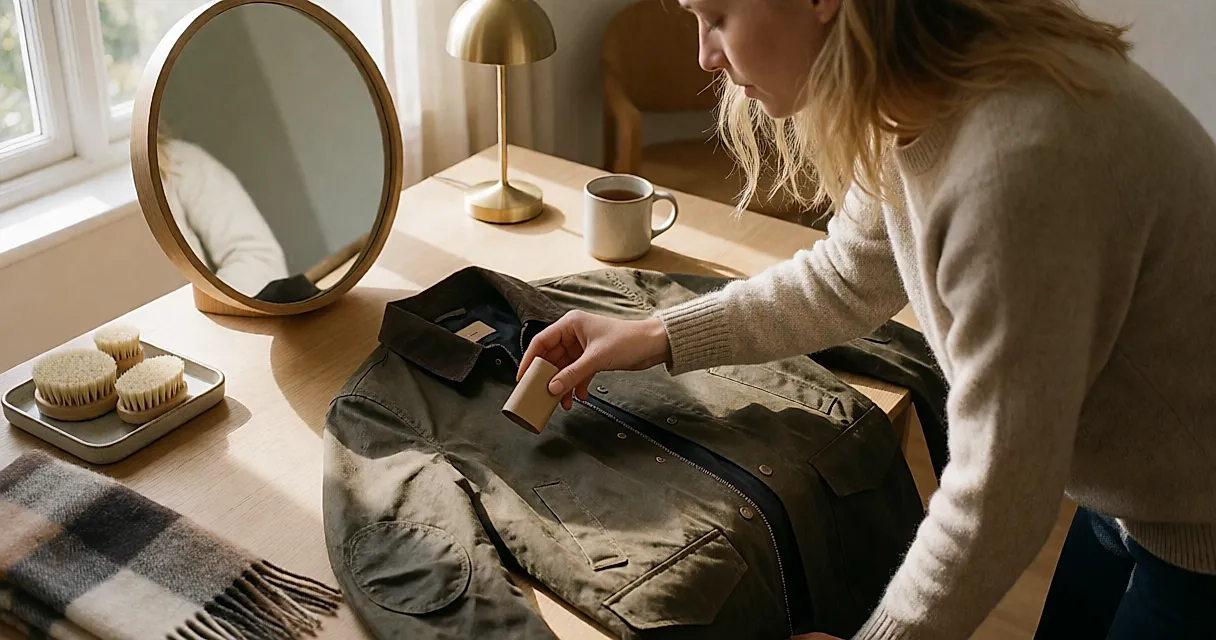
A waxed cotton jacket that has seen three winters will eventually stop beading: water no longer slides off, it soaks in. The fabric turns dull and slightly cardboardy, with whitish cracks at the elbow crease. Take a breath: this is not the end of its life.
The water-drop test
The check takes ten seconds and costs nothing. Put a few drops on a sleeve, in an area that gets some wear — the elbow crease, the top of the shoulder. If they bead and roll, the protection is still doing its job. If they soak in and the fabric darkens there, the wax has retired.

Now for the two families. Waxed cotton is fabric impregnated with wax, a little stiff at first, developing a patina and smelling faintly of candle wax. Its protection sits on the surface, wears away, and the wax can be reapplied — that is the whole point. Against that, jackets with factory coatings and finishes: a coating applied inside, or a surface water repellency, often invisible to the eye. When the coating peels or cracks, it cannot be stuck back on; when a DWR finish tires, washing and drying can reactivate it. Read the label before you buy, not after.
The giveaway? The seams. On waxed cotton, it is the stitching itself that drinks water, and the wax is what seals it. On a technical jacket, a heat-sealed tape seals them — look inside, it is immediately obvious.
Wax bar or spray
The bar — a cake of wax that melts on contact with heat — remains the benchmark for waxed cotton. It sinks into the fibre, develops a patina with use and can last several weeks. The downside? Time, elbow grease and a darker shade on first application. On a light-coloured jacket, test discreetly under the collar before you commit.

The spray is the tempting shortcut: quick, even, ideal for shoulders and hoods, and there are now wax-based formulas made for coated cotton. But the layer sits on the surface and rubs off. Verdict: bar for the base, spray for touch-ups.
Clean before you wax. A dusty jacket keeps the wax on the surface and makes it clump. Brush it dry, blot stains with warm water and a little mild soap, and let it dry in the air — never on a radiator!
What the washing machine really does to it
It is everyone's instinct: the jacket smells of rain and wet dog, so in it goes at 30 °C. But with waxed cotton, it is better to avoid the machine: water, detergent and spinning can strip the wax, often unevenly. The result: a jacket that drinks water on one side, keeps a sticky film on the other, and has seams that turn white. The tumble dryer does not help either: it can reactivate a chemical DWR, but on wax, heat redistributes the material unevenly.

Instead, use a damp sponge for marks, a little mild soap on the spot, and dry it on a wide hanger, away from the radiator. For a full clean, look for a dry cleaner who knows waxed cotton — not all will take it on, and a refusal is often a good sign.
The method, step by step
The jacket is clean and dry. Warm the fabric with a hairdryer to soften it, then apply a pea-sized amount of wax in a thin layer, without pressing it in like buttering an over-generous slice of toast. Work it into the seams, shoulders, inside the cuffs and the elbow creases. Warm it again: the wax melts and penetrates when it turns shiny. Wipe off any excess with a clean cloth and leave it to rest overnight in the air.

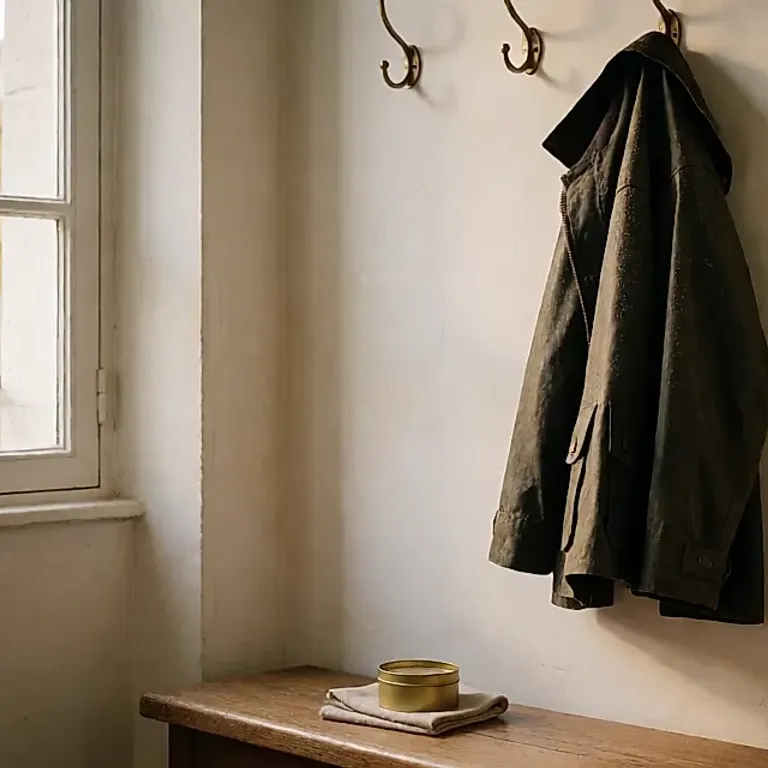
How often? In practice, many people advise once a season, depending on use. Too much wax attracts dust and eventually cracks. Store the jacket on a wide hanger, without a plastic cover: waxed cotton needs to breathe, like us after three hours on a train.
Budget
Allow roughly £15–£30 for a branded wax bar, a little less from a haberdashery or outdoor shop; £20–£35 for a spray made for waxed cotton. Heritage brands sell their own bars — Barbour, for example, does a classic one for its jackets. If you would rather hand the piece over, a full rewax at a specialist workshop usually sits between £50 and £90, more if there is a lining to repair.
Compared with the price of a new jacket, the sums are easy. One hour on a Sunday afternoon, a bar of wax that can serve several seasons, and the jacket is good to go again — not new, better: patinated at the elbows, shaped by your habits, by that pocket where you always shove your keys. Maybe that is the real luxury: a piece that feels enough like you that you want to repair it.


Comments
Your opinion matters: rate the article, react and reply to comments.
Comments are moderated; AI-assisted comments are flagged. Text emoticons (8-), :-), <3…) are automatically shown as images.