

The parcel arrived on Monday, the label says ‘55% recycled wool’, and your brain immediately spun the loveliest story imaginable: this jumper used to be someone else’s jumper, and now it’s yours. Spoiler: rarely. The yarn keeping you warm this morning is far more likely to come from factory knitting waste than from a wardrobe emptied on a Sunday night. Shall we follow the bobbin back and see?
‘Recycled’ is the most elastic word in knitwear
Two families of raw material feed so-called recycled yarn, and they have nothing in common. The first, pre-consumer, comes out of factories: knitting waste, end-of-roll scraps, jumpers that failed before they ever saw a hanger. Clean, already sorted, a known colour, no buttons or zips to remove — the dream of any workshop. The second, post-consumer, is the contents of the textile bank at the end of your street: worn clothes, odd pairs, sometimes tired, which have to be taken apart before you can hope to get anything out of them.
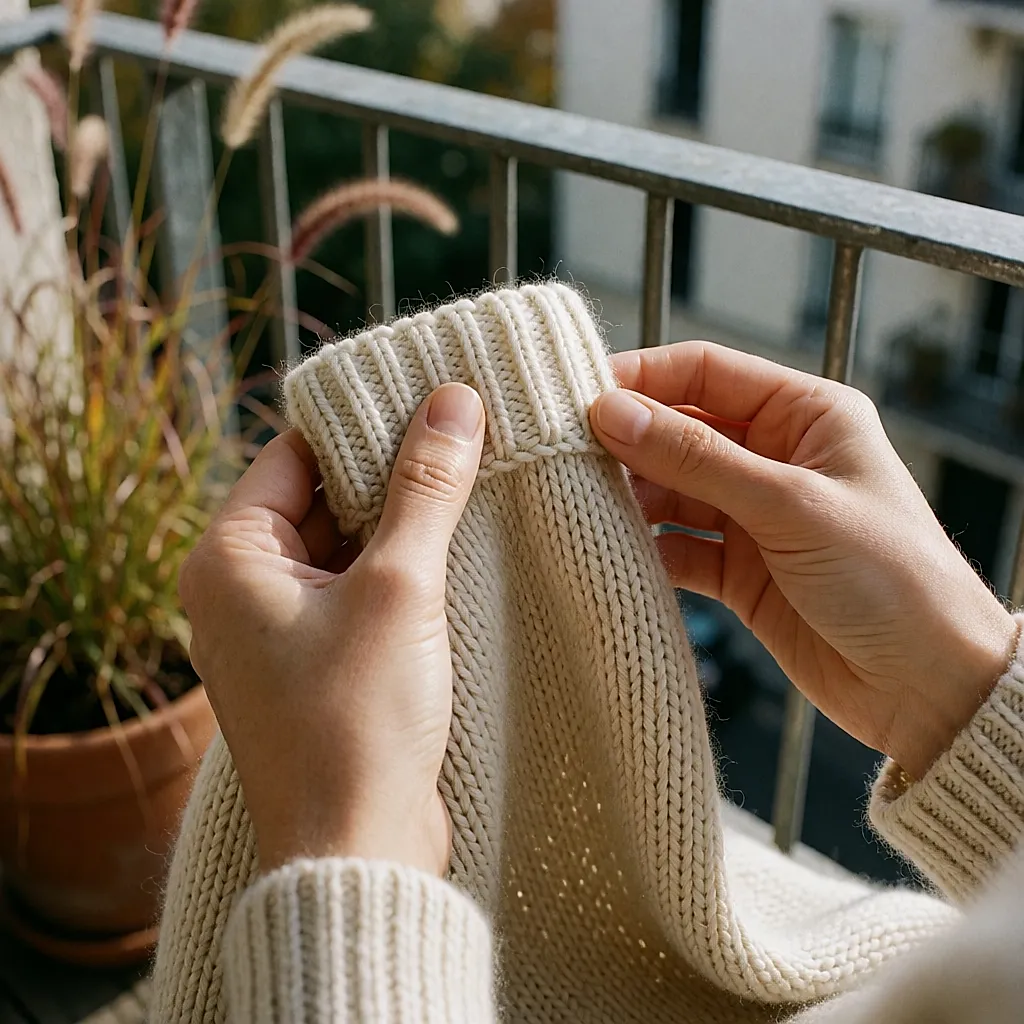
Shredding — garnetting, in the trade — is where things get physical: machines unravel the knit and tease the fibre apart, and it comes out shorter with every pass. Shorter means less strong, so it is blended with virgin wool to give it length again, sometimes with an additional fibre. In plain English: a ‘recycled’ jumper can contain a sizeable share of new material. That isn’t a scandal; it’s mechanics — but it changes everything about how you read the label.
From textile bank to bobbin, the route takes a detour
A full textile bank is not a jumper factory, and that is probably the most useful thing to know before paying more for a piece. In the UK, textile collection runs through charity shops, textile banks and local kerbside schemes; a large share of what is collected is reportedly sorted for reuse — resale, charity retail, export — because a garment that can still be worn is worth more than a reworked fibre. Recycling into new material concerns what can no longer be worn.

Then comes sorting, the real bottleneck. You have to recognise composition, separate colours, remove linings and trims. A knit that is more or less pure wool can be taken apart; a wool-synthetic blend much less so. So what actually happens to that overflowing bank? Recyclable lots in far smaller quantities than it looks — a nuance that marketing campaigns happily step over.
Spinning is the bottleneck nobody talks about
Second limit, much less photogenic: spinning capacity. Recycling a fibre is one thing; turning it into a consistent yarn is a trade, with carding lines adapted to short fibres, specific settings and hands that know how to handle the fibre. These facilities are not plentiful, and the Prato district in Tuscany is a historic hub for regenerated wool, where this fibre has been regenerated for generations.

Which gives an easy imbalance to remember: catalogues can announce ten times more recycled fibre tomorrow than spinning can absorb. Lead times lengthen, minimum volumes climb, yarn prices follow. That is how a ‘recycled’ jumper promised for November slips to February, when half the collection has already gone. Knitwear moves at the speed of bobbins, not press releases.
What a spinner-recycler partnership changes (and what it doesn't)
When a spinner partners with a recycler, the benefit is first logistical: secure a steady supply, know where lots come from, get consistent quality season after season, and be able to trace the finished jumper back to the bale of material. For a brand, that is what makes a percentage credible rather than merely displayed. For you, it is what should, in principle, let you answer the question that matters: where did this yarn come from?

What the partnership doesn’t change is the composition. It doesn’t make the virgin wool in the blend disappear, nor the supporting fibre, nor the spinning bottleneck. Nor does it make the piece virtuous by magic: a recycled knit made on the other side of the world and worn three times hasn’t gained much. So the right question remains composition, not the word ‘recycled’ — and what you plan to do with that jumper in five years.
Before you pay, three lines to decode: the full composition (share of recycled, share of virgin wool, share of something else), the origin of the yarn where stated — yarn spun in Europe and yarn spun on the other side of the world do not tell the same story — and the hand of the knit. A tight, dense knit will see you through winters and washes better than an airy knit that bobbles by December.
Budget
On price, expect roughly £60 to £120 for a wool jumper with some recycled content from a high-street label, and more like £150 to £250 when the brand documents its spinning mill and lot traceability: the premium pays for collection, sorting and a spinning sector under pressure, not just the word on the label. Below £40, be wary of the composition — the wool content is often largely symbolic.
Second-hand remains the cheapest and most coherent alternative with the subject: £15 to £60 for a good wool knit that has already been worn, with the advantage of a fibre that has proved itself and the drawback of unpredictable choice. And if money is tight this month, a repair at a local alterations shop often costs £10 to £25 — far less than a new piece.
Ultimately, recycled yarn tells less the story of an old jumper than the story of an industry relearning how to sort, shred and spin at a different scale. You don’t need to know the whole chain to buy well: look at the composition, ask where the yarn comes from, and keep the piece long enough for it to deserve its label. The most durable knit in your wardrobe is probably already on a shelf, a little bobbled at the elbow — and that is very much as it should be.

Comments
Your opinion matters: rate the article, react and reply to comments.
Comments are moderated; AI-assisted comments are flagged. Text emoticons (8-), :-), <3…) are automatically shown as images.