
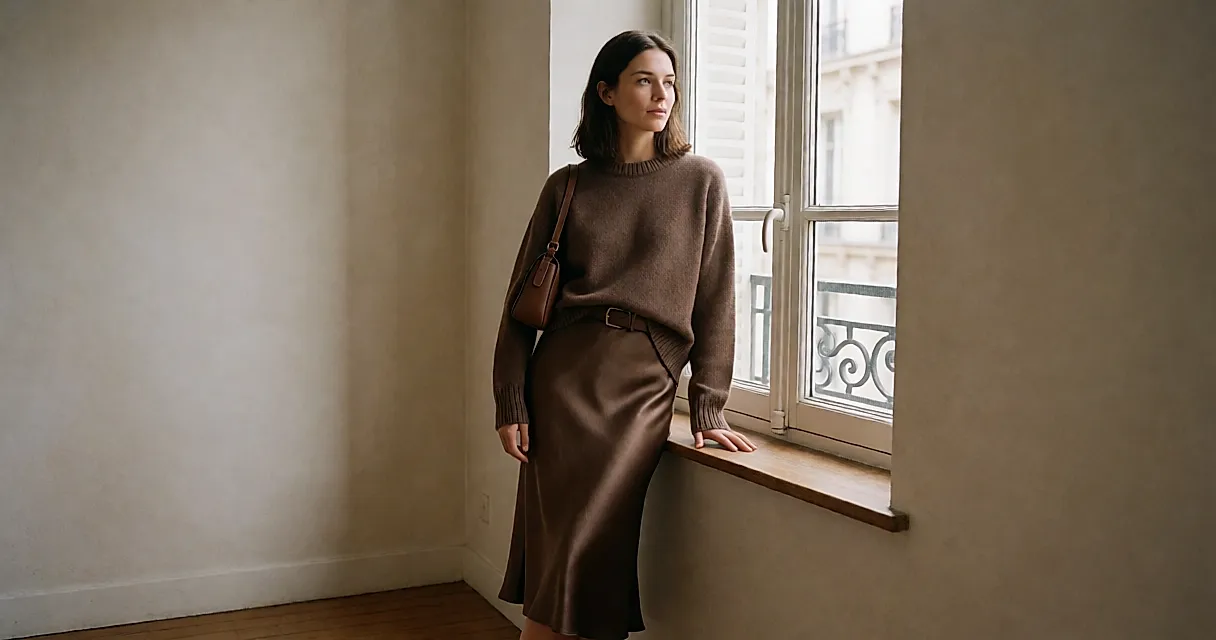
Six o'clock on a Monday and there you are in front of the mirror in a cacao jumper over a cacao skirt, and the whole thing reads a bit like a choir uniform. Run the same pairing again with the satin skirt and the chunky wool jumper and it becomes a different outfit entirely. The colour was never the problem. What was missing was the gap between the fabrics.
Chasing an exact colour match is a dead end
You know how it goes: the parcel arrives, you put the piece on, and suddenly the black of the top pulls blue next to the black of the skirt. Back it goes, refund, start again. Except fashion doesn't ask for a perfect shade card; it asks for depth. Two camel tones that are very slightly different, side by side, give the eye a richness that no strictly identical pairing can offer.
In practice, pick one colour family and allow one shade of difference. A sandy beige with a warmer beige, navy with midnight blue: it breathes. Cut-and-paste colour matching, on the other hand, dates quickly. An outfit built on two neighbouring shades will carry you through season after season without wearing thin, and without buying anything new.
Three textures, one colour
This is where it's won: matte wool, leather and satin together make an outfit that reads perfectly clearly, even in dull grey light. Matte absorbs the light, leather throws it back in patches, satin lets it slide off. The result: the colour seems to move, even though it says exactly the same thing on the label.
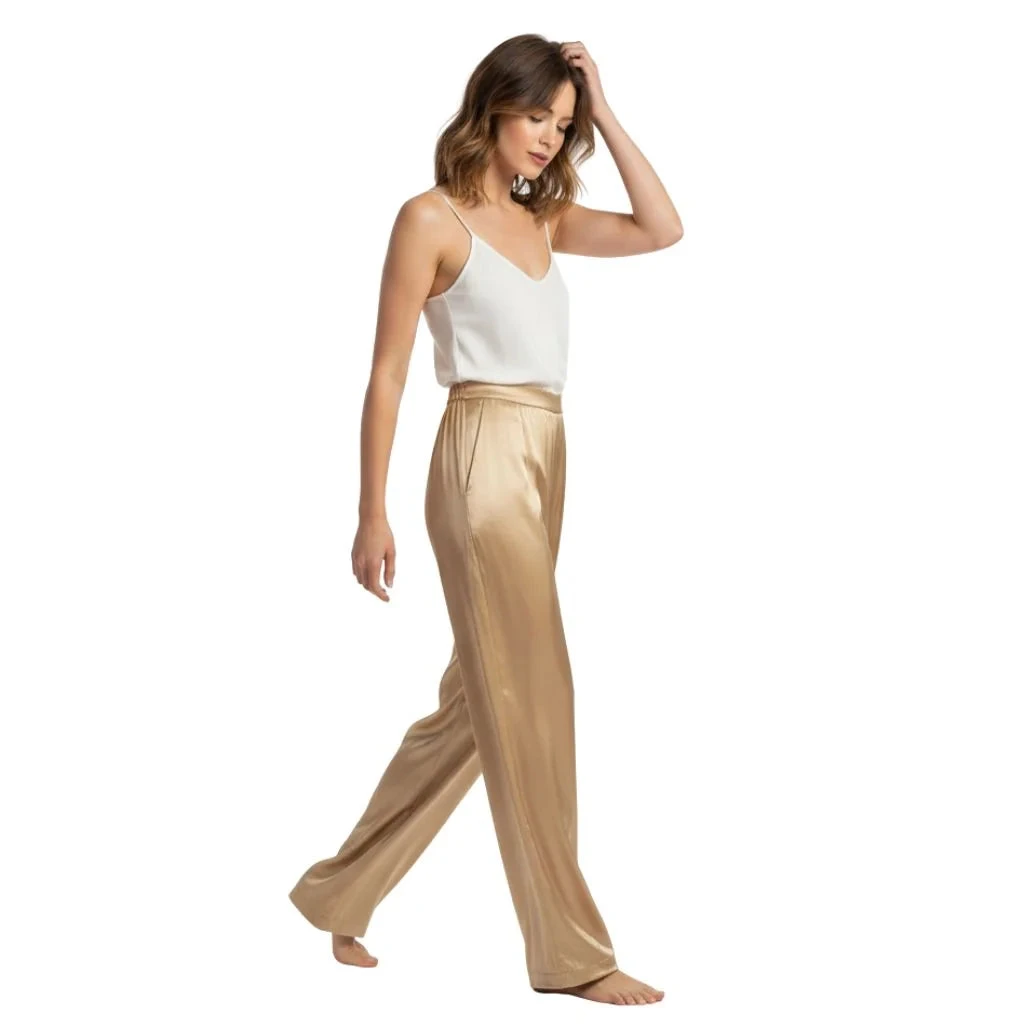
In practice, you layer a matte knit, whether merino, recycled wool or boiled wool, over a bottom half with more nerve: a soft leather skirt or silk satin trousers. On a wet November day, leather takes over, and its stiffer drape needs a fluid piece to answer it. For the office, a ribbed cardigan over a cotton satin shirt does the job without looking like fancy dress.
Drape decides the rest
A fabric is a texture; drape is the way it behaves once it's on you. Two fluid pieces and you're edging towards hotel-bedroom pyjamas; two stiff pieces and you're heading out in armour. All the finesse sits in a contrast of drape: soft against crisp, heavy against light.

Do you like volume? Keep the bottom half straight and plain and let the knit take up the space. Prefer a closer fit? Treat yourself to a skirt that moves, or cool wool trousers. And then the best bit: it's movement that tells the story of the colour, far better than any print.
The black-and-white test. Photograph your outfit, then switch the picture to monochrome and look at it for a few moments. If the silhouette turns into one flat mass, a texture is missing: add a matte knit, a leather piece or a satin one, without touching the shade.
Where to put your money
The good news is that a tonal outfit can very often be built without buying much at all: one textured piece is enough to wake up what you already own. Expect to pay in the region of £50 to £130 for a merino or recycled wool knit, depending on how fine the gauge is and where you shop; high street chains come in lower, specialist knitwear labels go higher.
On the bottom half, a satin skirt or shirt tends to sit somewhere between £35 and £100. Leather costs more: roughly £130 to £450 for a new jacket or skirt, and more again for vegetable-tanned hides. Secondhand, you can find it from around £35 to £100, which remains a smart way to try the material without blowing the budget. Where to look? High street chains, knitwear labels, charity shops, vintage fairs and resale apps, or online when your size has sold out in store.
One caveat, though: a full tonal look doesn't suit every setting. In a very formal workplace it can come across as more dressed-up than expected, in which case keep the tonal treatment for your top half and break up the bottom half a little.
Which leaves one question: are you ready to be noticed a little more than on an ordinary Tuesday? If so, start with your own wardrobe. A matte jumper, a bottom half that shines, a leather piece that gives structure: three textures, one colour, and the outfit stands up on its own. Your first attempt costs nothing but a mirror and a bit of nerve; a satin skirt between £35 and £100 already shifts the balance; above £250, put your money into leather, the piece that will earn its keep.
Comments
Your opinion matters: rate the article, react and reply to comments.
Comments are moderated; AI-assisted comments are flagged. Text emoticons (8-), :-), <3…) are automatically shown as images.