
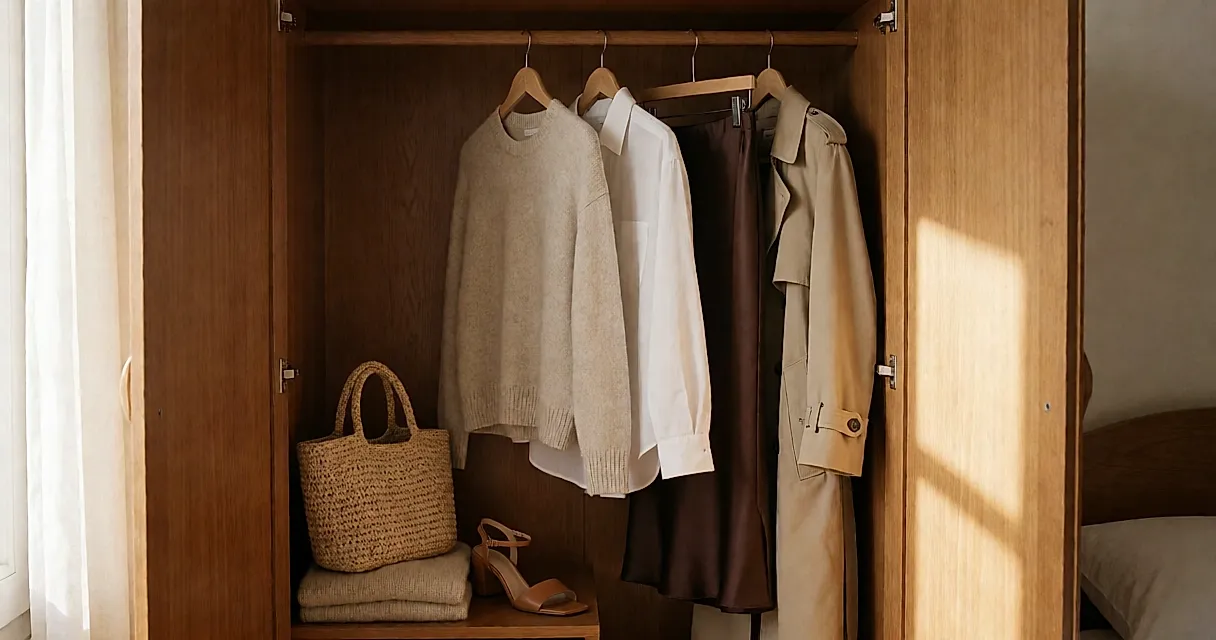
Rain is falling on the chestnut trees, you've got your coat out again, and your screen is full of sandals. It's the same ritual every year: collections that speak of July land just as you're looking for a scarf. You scroll, sigh, close the tab and tell yourself it's not for now. But what if it is?
The calendar gets there first
A collection shown in October isn't telling you about the season ahead; it's telling you about the one after that. On the catwalk and in the lookbook, pieces are styled as a full look – the sandal, the raffia bag, the fluid skirt – because a coherent silhouette has to be shown. It's not a wearing instruction; it's staging.
The right question, then, isn't 'Do I like this silhouette?' but 'Will this piece work in my November?' Edit piece by piece, never as a whole outfit. And in a summer wardrobe there are almost always two or three things that will carry you through winter when you least expect it.

Fabric comes before colour
First move: turn the label over and read the fibre content. What works in autumn is what can handle layering – a fine merino or recycled-wool jumper, a cotton poplin shirt, a slightly heavier silk skirt, a tightly knit cardigan. These pieces can take a roll-neck underneath and a coat over the top.
What stays boxed until June: cotton voile, chiffon, crushed linen and anything too fine to hold its shape under a jacket. It's worth checking the composition – how much synthetic fibre it contains, for example, can tell you a lot about how a garment will actually wear. If a piece is beautiful but sheer, it isn't a winter staple; it's a July impulse. That's a different list, and a different budget.
A summer colour can work in January
We assume pastels belong to spring. In fact, it all depends on what you put around them. Pistachio or sky blue worn as a full look reads instantly as 'May'; the same shade slipped into one piece within a brown, grey or burgundy outfit becomes something else entirely. Chocolate brown, ecru, charcoal: these neighbours translate most pale colours into winter.
The rule fits on one line: one summer colour, submerged in neutrals. A butter-yellow jumper with charcoal trousers, a peach blouse under a navy blazer – that stands up in January. The reverse, three light tones layered together, can wait quietly until mid-April.

Sandals, matching sets and raffia totes wait six months
Let's be honest: some pieces are non-negotiable. The heeled sandal that made your heart beat faster won't survive November rain, unless you live somewhere reliably sunny and don't mind wet feet. The raffia bag, the straw hat, the shell necklace: same story. Note them, keep them in your favourites, come back to them in May.
The matching-set question is more subtle. A set woven in the same fabric, with a matching top and skirt, works as a block: breaking it up takes patience and a little nerve. If you can't see the top with jeans and the skirt with a chunky jumper, leave it. A piece you can't break into three outfits is a piece that sleeps.
What the edit costs
On price, the spread is broad, which is no bad thing — and a few markers help before you start. As a rough guide for new pieces in the UK, expect a fine merino or recycled-wool jumper to sit somewhere around £40–£120, a cotton poplin shirt around £25–£80, a silk skirt or dress around £60–£180, and a trench coat you plan to wear for several winters around £80–£250. Those figures move with the brand tier, the complexity of the cut, the fabric composition and where you shop — high street, department store or online; a designer version will sit well above them, while a good sale can bring them down.
Second-hand is still the best ally for this kind of edit: in charity shops or on resale platforms, a poplin shirt and a wool jumper can often be found for much less — as a rough guide, around £8–£35 for the shirt and £15–£60 for the jumper — as long as you're happy with a cut that isn't exactly the one you'd pictured. And before you buy anything, have a proper look through your wardrobe: the piece your winter is missing is sometimes already there, stored a little too high up.
The three-outfit test. Before you commit to a piece you've spotted in an out-of-season collection, picture it worn three times, with clothes you already own that work in November. If you can only find two, it can wait until June. If you find three – including one that makes you want to go out on a Tuesday night – it's a good buy.
Ultimately, an October collection just asks for a little reading: separate what you can wear now from what you'll wear later, and refuse to take it all as a block. The rest is patience – and a box to rummage through in April with the pleasure of rediscovery.



Comments
Your opinion matters: rate the article, react and reply to comments.
Comments are moderated; AI-assisted comments are flagged. Text emoticons (8-), :-), <3…) are automatically shown as images.