

Sunday evening, November rain is clinging to the windows, and you're standing in front of the wardrobe torn between the chunky jumper that practically stands up on its own and the fine knit that promises very little. You put on the chunky one. Ten minutes later, on the bus, you're overheating; at the next stop, the wind cuts through and you're shivering. Why isn't the thickest jumper always the smartest choice?
Thickness, the misleading clue
What insulates you isn't simply the jumper's weight on the scales: it's the still air trapped in the knit. The better a fibre holds that air without collapsing, the better it can protect you from the cold. A very thick but loosely knit jumper, or one made from a fibre that sags, can therefore disappoint; a finer, denser, well-chosen knit can do the job without making you look like a cushion.
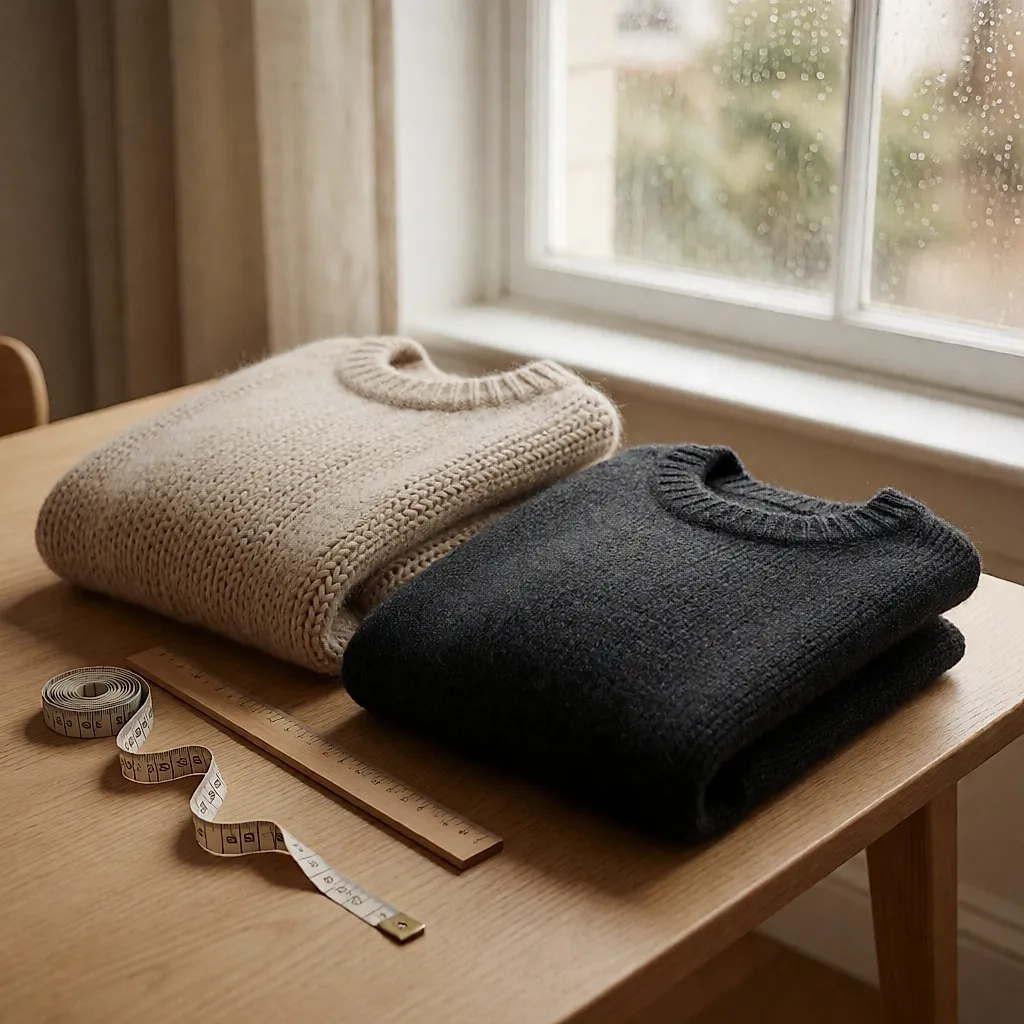
Fabric weight — the weight of material per square metre, usually given in g/m² — is a guide, not a verdict. Two jumpers at the same fabric weight can behave very differently depending on the fibre, the twist of the yarn and how the knit is constructed. The number helps you compare, but it is no substitute for how the fabric feels or for knowing the material.
Cotton, wool and silk each have their own character
Cotton is soft and breathable, but it can absorb a lot of moisture and dry slowly. Under a winter knit, it is pleasant in a heated office, less so if you sweat and then slow down outside: the moisture can stay against your skin and leave you feeling cold quickly. Wool traps air and regulates moisture; a fine merino wool can be warm without being thick, and recycled wool can offer a good alternative. Silk is more discreet: it can insulate without bulk and sits smoothly under a knit without adding volume — provided you are happy with the price and the delicate care it needs.

Synthetic fibres have their technical rationale, but they do not behave like wool or cotton under a knit: they may dry quickly, may not hold warmth in the same way and can feel damp when you stop moving. For a winter base layer, the rule of thumb is simple: check the composition before you buy, and choose natural fibres where you can.
Read the label, not the slogan
"Wool", "cotton", "cashmere": the name on the label tells only part of the story. Look at the exact percentage, then at what else is in the mix. A wool jumper with a lot of polyamide may not behave like a 100% wool piece; cotton mixed with elastane is likely to be stretchier, not necessarily warmer. The knit matters as much as the fibre: tight, supple, ribbed or looped, it may not trap air in the same way. A tightly knitted jumper in a fine yarn can be more protective than a chunky open knit.
And what about the word "weave"? With a jumper, it is more accurate to talk about the knit, because the garment is knitted rather than woven. A loose knit can let air through, sometimes too much; a dense knit can block the wind better but may be less breathable. The right balance depends on what you need it for: waiting for a bus, an overheated office, a weekend in the countryside.
The breath test: hold the knit to your mouth and blow gently through it. If air passes easily, the piece breathes; if it feels like blowing into a bag, it may trap moisture. It's not an exact science, just one more clue before you buy.
Layering, not piling on
Your winter base layer doesn't need to be the thickest: above all, it should be a fine layer that helps wick moisture away and helps you stay dry. A T-shirt or vest top in fine merino wool, silk or organic cotton depending on the day, then a knit, then a windproof layer: that's an outfit that breathes and helps keep you warm. Piling on three chunky jumpers is unlikely to work any better if air can't circulate and you end up clammy.

Watch the fit, too. A base layer that is too tight can compress the knit and stop it trapping air as well; too loose, it can gape and let the wind in. Leave a little ease at the shoulders and waist, without going too far. And if you already have a jumper you like, start by wearing it with a fine layer underneath rather than buying another. That's often where the warmth is won.
The safest approach is to compare like with like: a base layer for the office has different demands from one for a Sunday hike.
Ultimately, the right question isn't "how thick?" but "which fibre, which knit, for the way you live?". Read the label, feel the fabric, try the breath test, and keep what you already own. Warmth is often about fineness — not bulk.
Budget
Prices vary with fibre, knit density, brand and where you shop. As a rough guide, a basic high-street cotton or acrylic jumper usually sits around £20 to £45; a wool or merino knit around £40 to £90; and fine merino, cashmere or silk-blend pieces can run from £90 to £250 or more. Base layers tend to be around £25 to £70, with specialist merino and silk at the upper end. You will find them in department stores, outdoor shops, specialist knitwear retailers and online; charity shops and resale sites can be a good route to second-hand wool and cashmere.


Comments
Your opinion matters: rate the article, react and reply to comments.
Comments are moderated; AI-assisted comments are flagged. Text emoticons (8-), :-), <3…) are automatically shown as images.