
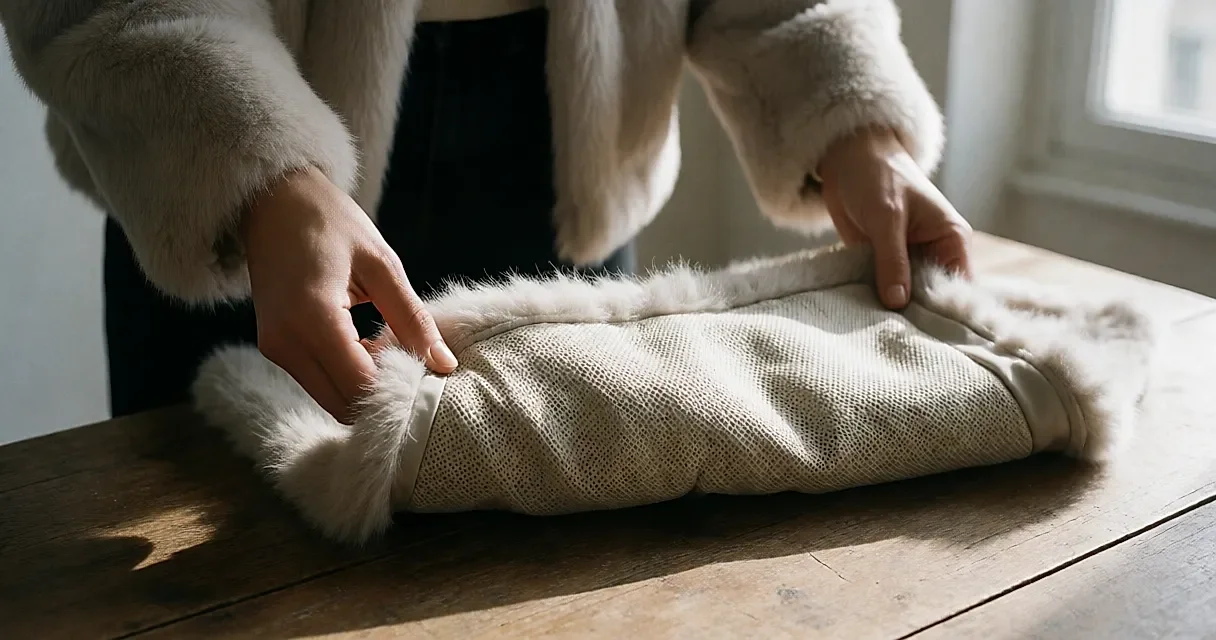
The collar looks perfect on the shop floor: dense, soft, standing neatly on its hanger. Turn it inside out and you see a web of threads, tighter or looser — and it is that side, the one nobody looks at, that will decide whether the piece lasts two winters or two washes. Three quick checks are enough to call it, and none of them requires reaching for your card just yet.
The reverse is the real giveaway
Faux fur is not a solid material: it is fibres implanted in a backing, often a knit or a weave. It is that backing you need to look at before you fall for the drape. If it looks like a loose mesh, almost see-through between your fingers, the fibres have room to slip. If it looks like a tight fabric, with a dense, regular weave, the piece starts at an advantage.
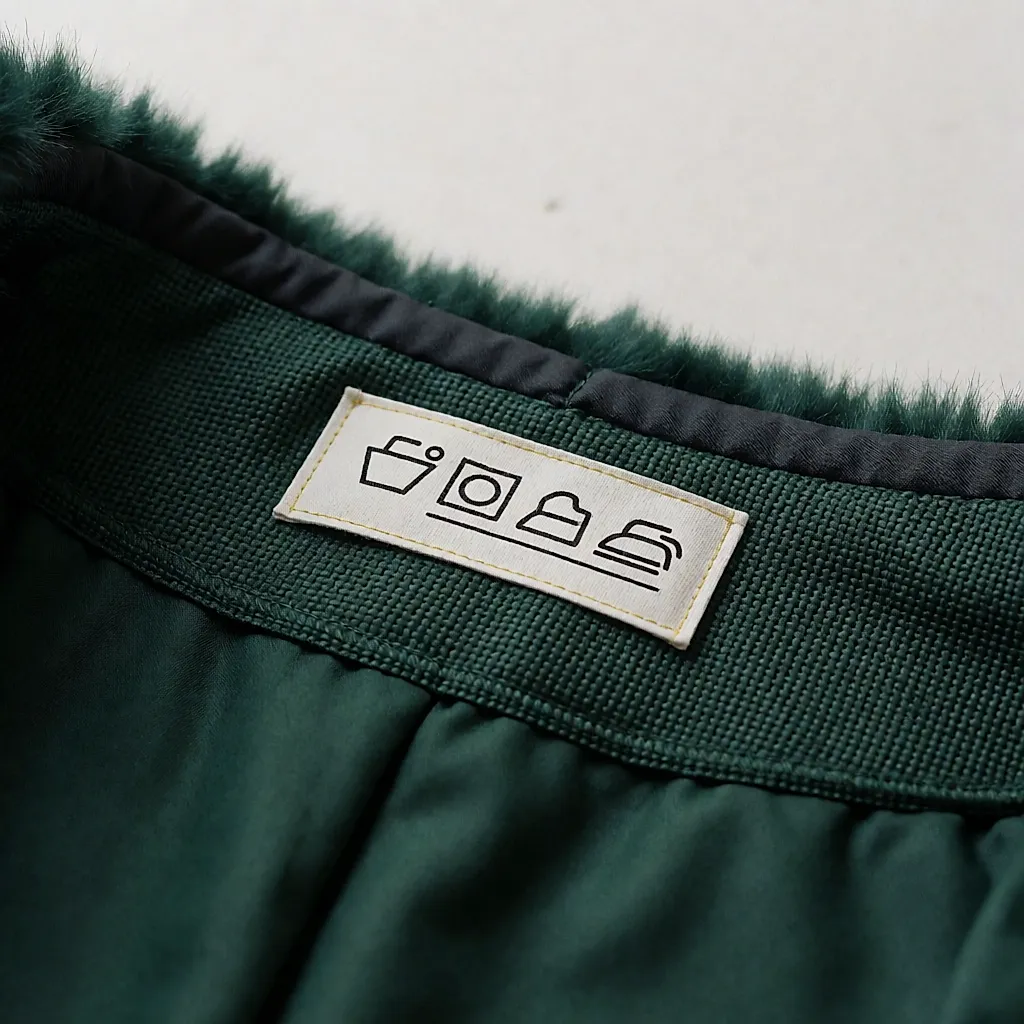
Second detail on the reverse: the seams. A bound edge that has been stitched holds better than fibres that look merely laid on top of the fabric. Use the moment to check the lining too: a lined piece rubs less against your jumpers and against the Tube seat, which limits transfer. And check the composition — a word of warning, because faux fur is almost always synthetic: better to know what you're buying and what you're signing up for.
Pinch the pile, then let go
The move is simple and takes three seconds: pinch a tuft between thumb and forefinger, pull gently, release. A soft pile that recovers and stands upright again suggests fibres with memory. A tuft that stays flattened, keeping the imprint of your fingers like an over-soft cushion, signals the areas that will crush under a bag and at the elbows.

Look at what's left on your fingers too. A couple of fibres are normal, especially on a new piece. A handful that comes away without resistance, though, tells you everything about the backing: what escapes in the fitting room will escape onto your favourite black wool. No one will mind you doing this small test — it's exactly what you'd do before buying a mohair scarf.
The rub test that saves your black coat
Last stop: rub the sleeve against dark wool. Your scarf, the jacket you're wearing, the dark denim at the top of your jeans — it doesn't matter; the idea is to create the friction the piece will meet every day. A few rubs back and forth are enough, then look at the wool, not the sleeve. Fibres clinging to it? There's your answer.

Why dark? Because that's where migrating fibres show up most, on a matte fabric that holds on to them. Ivory faux fur on a cream overcoat can get away with it for years; the same fur on a charcoal coat becomes a daily brushing session. And honestly, who wants to reach for a clothes brush before every coffee outside?
Who it suits, and who it doesn't
A well-anchored collar works beautifully on a tailored coat, a hooded parka or a short jacket layered over a sweatshirt. It warms up a silhouette visually and adds volume where you want it. On a piece you wear with a shoulder bag, though, the friction zone will flatten quickly: go for a shorter strap or keep the faux fur to the collar only.

If your goal is warmth rather than effect, be honest with yourself: a bouclé wool or merino wool collar does the job better, with no fibres to manage. Faux fur remains a piece of style, a touch of texture — not a substitute for down. And true restraint starts with wearing and caring for what's already in your wardrobe before adding yet another statement piece.
Three fitting-room checks, in this order: turn the collar inside out and look at the backing; pinch and release a tuft; rub the sleeve against your dark wool. Add the care label to the mix: many faux furs can't go in the tumble dryer or near an iron, and the wrong wash will flatten the pile for good.
What the price tells you
As a rough guide in the UK, faux-fur collars and scarves from high-street chains tend to sit around £20–£50; coats and parkas with faux-fur trim around £70–£220; and from £250 upwards at luxury labels that make faux fur a proper part of the collection. In charity shops and resale, pieces turn up at £15–£45 — with the advantage of seeing straight away how the fur has aged, which is worth more than any test.
Where to buy? For the three checks above, nothing beats a physical shop. Online, rely on customer reviews that mention shedding and on photos of the inside of the piece when the retailer provides them. And keep in mind that a high price guarantees nothing: the reverse doesn't lie.
A collar turned inside out, a tuft pinched, a sleeve rubbed: three tiny gestures, and you're left with a wardrobe that no longer leaves fibres on other people's coats. At the till, you'll know why you're paying — and what you'll have to brush.



Comments
Your opinion matters: rate the article, react and reply to comments.
Comments are moderated; AI-assisted comments are flagged. Text emoticons (8-), :-), <3…) are automatically shown as images.