

A sock is best judged inside out, the toe pulled over your index finger, looking for a ridge that has no business being there. That tiny bump at the end of the foot is what decides whether you forget the pair as soon as you pull on your boots or feel it with every step. And it has nothing to do with the price tag or the grams of wool on the label.
A bulky toe seam isn't inevitable
Most socks end with a fiddly operation: closing the toe. There are two schools, and they are not equal under the toes. The most common and quickest method sews the two edges together: the thread forms a raised cord, the bump you find when you take your shoes off. The other, slower method links the stitches back together. The edges meet without added thickness; the toe is round, smooth, almost invisible.
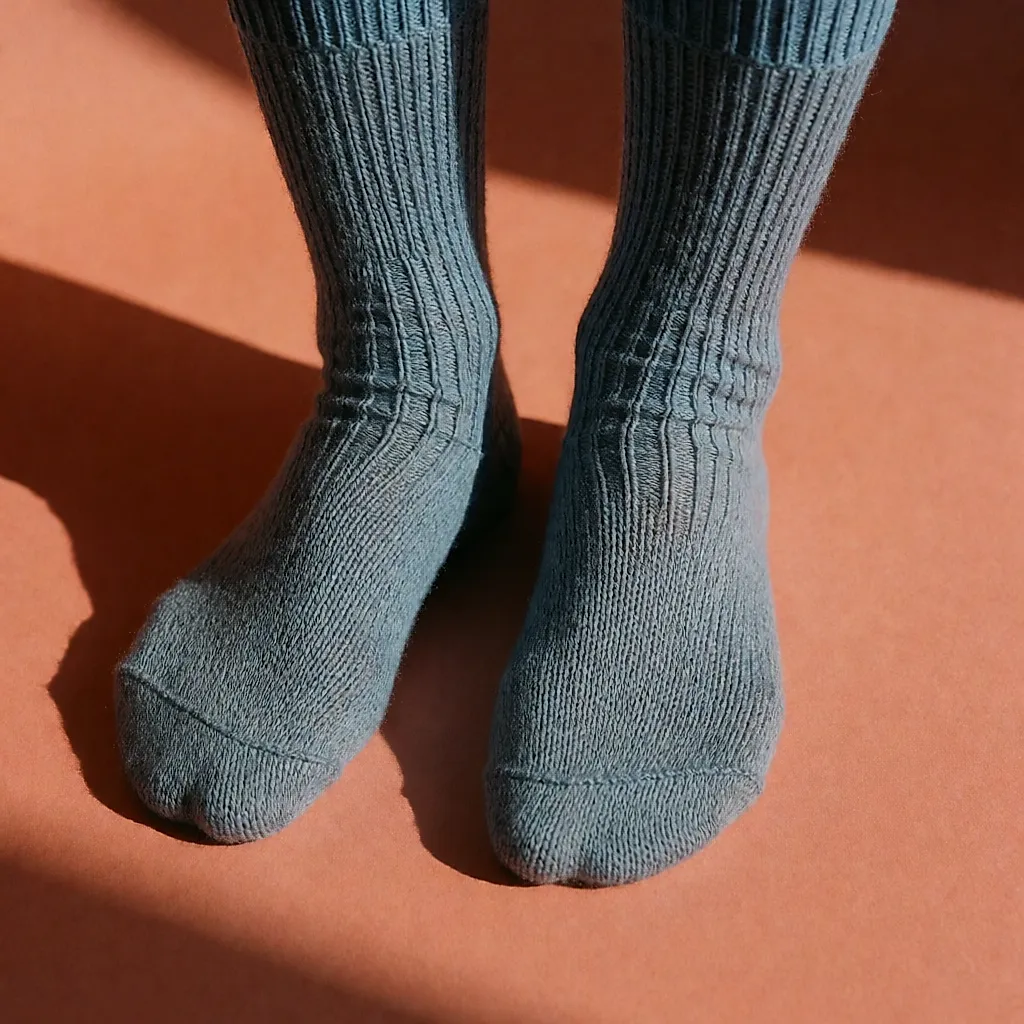
So it isn't about how soft the wool is, but about finishing. A chunky wool sock can have a very neat raised cord, and a fine everyday sock can have a perfectly flat toe. In the marketing copy, you'll hear plenty about merino and wool percentage; rarely about what happens at the toe. Why do product pages list the composition to the nearest gram and never mention the toe? A mystery for the marketing brief.
In practice, a few seconds are enough
In a shop, there's nothing to stop you turning the sock inside out: it's the only test that counts. Look at the toe inside out and run your thumb underneath. Can you feel a raised cord, like a little rope? That's a standard seam. Can you feel almost nothing, just a supple band and a rounded toe? You have a flat seam, or a linked toe.

The words on the label can help: 'flat toe seam', 'seamless toe' and 'hand-linked toe' all mean roughly the same thing. Conversely, '100% wool' tells you nothing at all about this particular detail. Online, a photo of the inside is your best ally when there is one; if not, ask customer service and check the returns policy. You can't see the toe in a product shot, however well lit.
The thumb test, in three steps — turn the sock inside out, run your thumb under the toes, and if you feel a cord, put it back. A flat-toe style also gives itself away by its shape: a rounded end, no added band, a seam that blends into the knit.
Winter pairs that actually have it
Technical socks are a good place to look for this finish: hiking, skiing, running, racket sports — uses where the foot spends hours in a closed shoe. Some outdoor brands that work with merino mention it, as do some European hosiery makers who produce fine wool everyday socks.

Elsewhere, it's a lottery. Supermarket multipacks, novelty pairs and many 'extra warm' socks sold on promotion settle for an attached seam: outside, impeccable; inside, the cord is there. That makes sense, really — linking requires a machine and time, two things that sit badly with a very low unit price. A small warning while we're here: in sports models, check the share of synthetic fibres, sometimes in the majority even when wool is front and centre on the shelf.
Budget
Expect to pay around £5 to £10 for a basic supermarket multipack, where a flat toe remains the exception. For technical sports models, prices rise to around £10 to £22 a pair, and £17 to £30 for a properly finished outdoor merino, thicker and more hard-wearing.
At the top end, hand-linked pairs and fine everyday hosiery sit more often between £26 and £43 a pair, sometimes more from heritage houses. Price varies with wool percentage, knit fineness, leg height and where you buy: the sports aisle of a general retailer, an outdoor shop, a hosiery department or an online store — mind the returns policy.
There's still a simple truth: you don't choose a sock by its stated thickness, but by what you feel at the end of your foot. So next time you're torn between two pairs side by side, turn both inside out and let your thumb decide. And if hand-linked merino is over budget, the best bet remains a technical hiking pair at around £20, which will do the job perfectly under a boot: no one will see the difference, except your toes.



Comments
Your opinion matters: rate the article, react and reply to comments.
Comments are moderated; AI-assisted comments are flagged. Text emoticons (8-), :-), <3…) are automatically shown as images.