

The winter coat is too hot on the platform and useless on the Tube — and the gap between the two is a matter of minutes. You know the scene: the person who opens it, closes it, then finishes the journey with the coat over their arm and a face like thunder. What if three properly ordered layers sorted it out, instead of a hopeful pile-up?
Start with a thin base layer
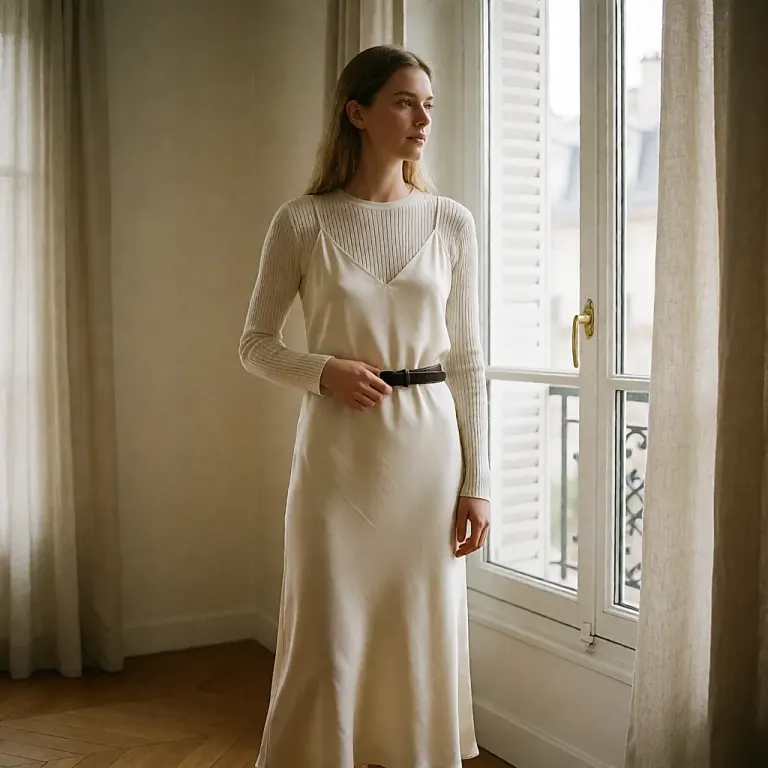
The rule that changes everything fits in one sentence: the layer next to your skin should stay thin. A fine merino, a washed silk, an organic cotton a touch heavier depending on the season — what matters is that this first layer stays discreet under everything else. The brushed sweatshirt shoved under a shirt: we've all tried it on a January morning, and ended the day with rugby-player shoulders in a jacket that had turned too tight.

The cut matters as much as the fabric. A collar that doesn't spill out, long sleeves thin enough not to bulge at the wrist, flat seams: three details that play nicely with everything else you own. And if you're cold, don't add bulk here — the middle layer does the work, not the one against your skin.
Warmth without the volume in the middle
It's the piece we forget to choose, and yet it's the one that decides the silhouette. A fine wool or cashmere knit, a slightly thicker organic cotton knit, a cardigan that hangs straight: as long as it can survive without the coat — at the office, at the table, at a friend's — it belongs in the middle. The soft chunky cable knit stays for weekends, for days when you're not planning to go out any other way than bundled up.

Sleeve thickness is the detail that ruins a lot of layering. A slightly loose knit under a fitted jacket and the armhole pulls, the line turns to armour. The question to ask before you buy? 'Will this piece work with the jacket I wear most?' If the answer is no, leave it on the rail and keep the thin cardigan.
Let one layer, and only one, do the talking
Here's the idea to take from all of this: one piece stands out, and it's the outermost one. It's the one people see, the one carrying the colour, the texture, the print. A scarf that cuts through, a well-cut coat, leather with a bit of patina — one of those is enough. Put the statement piece next to your skin and nobody benefits: with the coat closed, the good thing disappears until lunchtime.

That demands a try-on most of us skip: pull the coat on over the thickest knit in your wardrobe, not over a July T-shirt. At the shoulder you should be able to lift your arms without the seam riding up. And on length, dropping below the waist gains you coverage without piling on an extra scarf.
What works at the office and what's just for the photo
At the office, layering has to come apart without the whole look collapsing. In other words: discreet layers, one piece that speaks, and shoes you can stand up in for three hours. Save for the evening photo whatever won't survive a day at a desk — the oversize scarf, the structured high collar, the XXL coat. Is it worth wearing all day for ten minutes of good light? Rarely.

The real test remains: does the outfit survive three hours sitting down, a spilled coffee and an office radiator? If yes, it's a good one. Successful layering isn't the warmest combination — it's the one you can adjust one-handed, without spending the day getting dressed and undressed in public.
The order in practice — 1. A thin base that stays close to the body. 2. A knit or cardigan that can live without the coat. 3. A coat tried on over your thickest layer. And a single piece that draws the eye, the outermost one.
What you'll pay
New, expect roughly £35 to £80 for a fine merino wool base layer, £50 to £130 for a light wool or organic cotton knit, £25 to £70 for a scarf that actually keeps you warm, and £130 to £350 for a decent coat. The spread comes down to fibre, origin, manufacture and where you buy: high street, specialist labels, charity shops and resale platforms aren't playing on the same pitch.
On the sustainability front, the best find is often already in your wardrobe: a base that holds up, a knit that doesn't pill, a coat that's been looked after. Before you add another layer, check the synthetic fibre content on the label: the composition gives you an indication, but how a piece wears also depends on fibre quality, the weave, the cut and how it's cared for.
The November move, in the end, comes down to three words: thin, middle, outer. A base you forget about, a knit that can be seen without the coat, one piece that takes the light — the rest is just unnecessary bulk. And if you're still standing in front of the wardrobe tomorrow morning, think of the Tube platform: the layer you can take off without wrecking your hair is the most valuable one.


Comments
Your opinion matters: rate the article, react and reply to comments.
Comments are moderated; AI-assisted comments are flagged. Text emoticons (8-), :-), <3…) are automatically shown as images.