
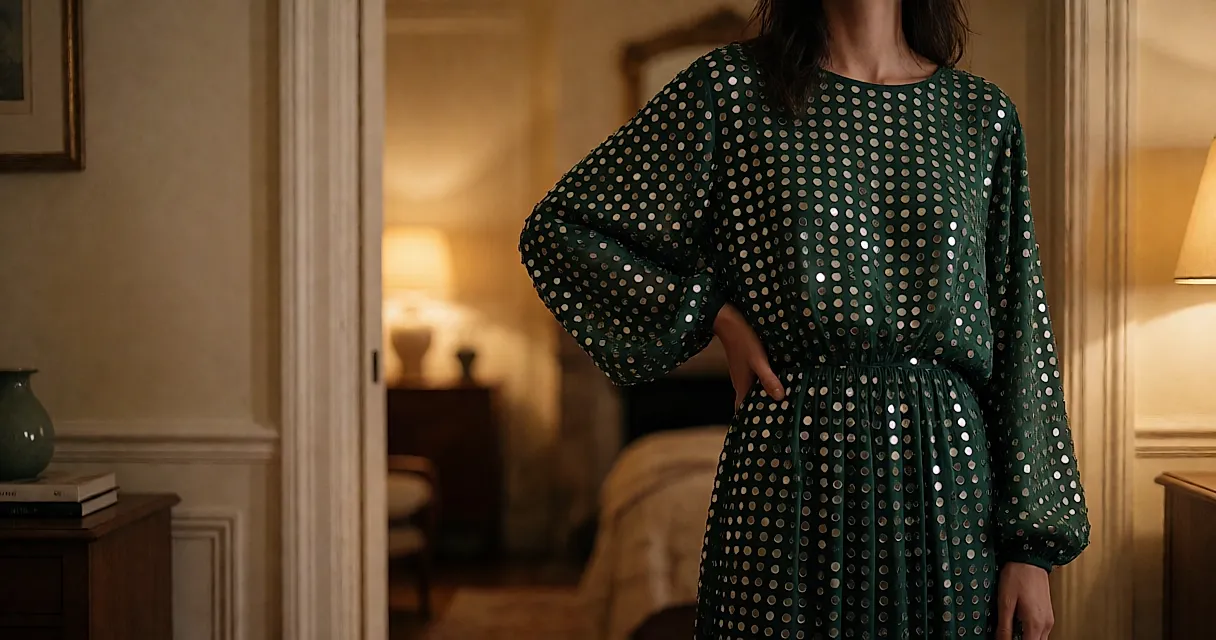
You assume it will be light — it's a party dress, flimsy by definition — and then you lift it off the rail and the hanger sags in protest. The embroidery and the setting of the mirrors, one at a time, don't evaporate into the fabric. You feel it at the shoulder, in the way the cloth falls, and in that faint chink of glass as you walk.
The work behind the mirrors
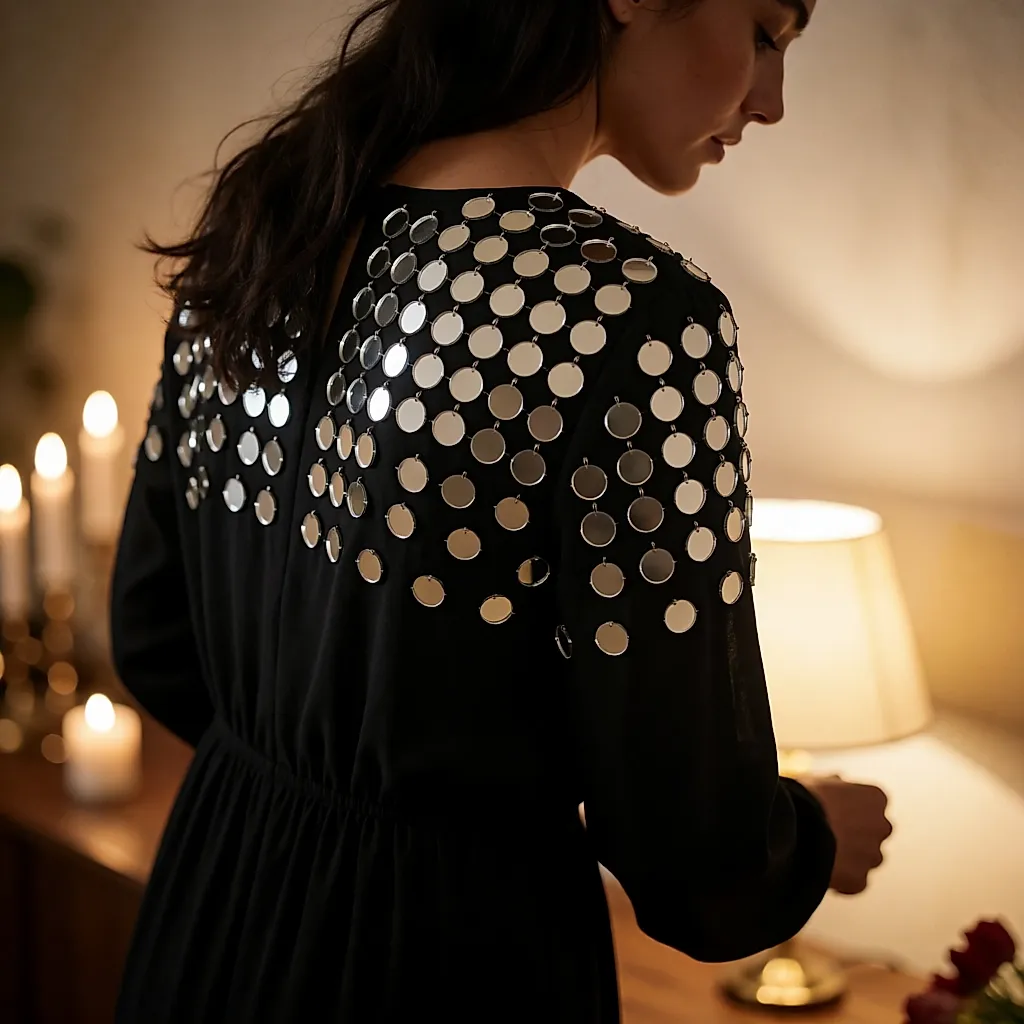
On a piece like this, a mirror is never glued: it's captured. The thread runs around its edge, crosses, pulls tight, and holds it the way you'd hold a kitten in your palm. Do that across a surface that won't forgive a near miss, and you get some small idea of the labour involved.
So where does the cost actually sit? Not in the showmanship, but in the regularity. One disc slightly off and the whole line starts to wink at you. The hand learns, slows down, starts again. The time doesn't show — it's in the unbroken gap between one mirror and the next. It's the exact opposite of a printed motif, where nobody got sore eyes on your behalf.
Weight changes the way it falls
First effect, and it's physical: the piece gets heavier. A fabric studded with sewn mirrors stands a little away from the body, marks the line without clinging to it, and refuses to follow your every move to the millimetre. On a fluid dress you gain real structure; on an already rigid cut you're edging towards reliquary. Which is why it's worth trying on standing, sitting, and with an arm raised — real life, in other words.
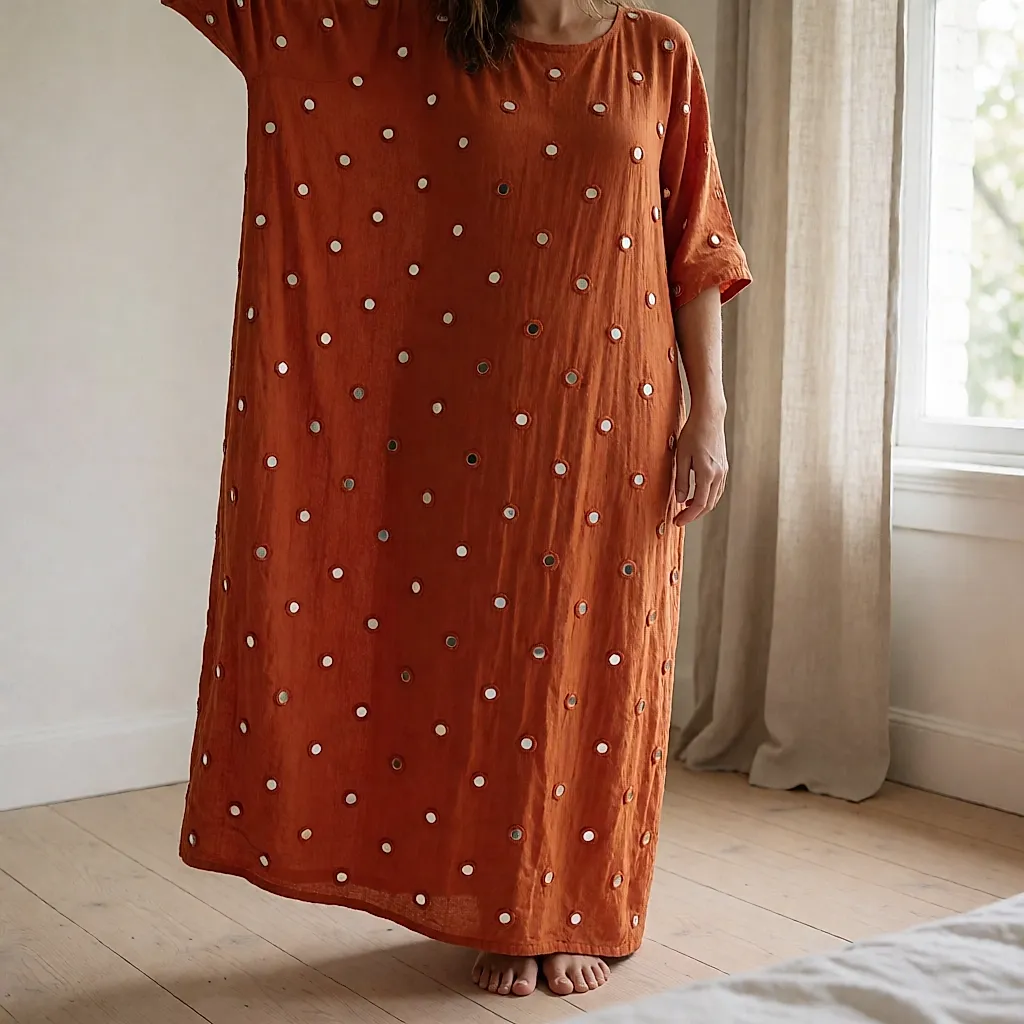
Second effect: you don't forget you're wearing it. A piece like this won't scrunch into a ball in a bag at one in the morning, and it forgives nothing in the cut, because there's no stretch in it. Who is it not for? Anyone who wants to forget what they've got on, and anyone who resents a garment asking for attention. It's a statement piece, not a wardrobe workhorse.
The glued-on lookalike
At three metres, who can tell a mirror-print from a network of sewn glass? At two in the morning, under the lights, the answer is obvious: glass throws light back in shards and moves with you, while print stays politely flat. On durability the verdict is just as quick — a glued ornament can peel off and leave a pale ring; a sewn mirror can be stitched back into place.
A caveat, though: hand-sewn is not a badge of virtue. Ask where the piece was made, who embroidered it, and whether the price tells a coherent story. A price that's too comfortable for that much painstaking stitching and setting can be a warning sign that the work was done elsewhere, in conditions you'd want to ask about.
Turning it inside out is the real test
The underside tells you almost everything. Good work shows threads neatly finished off, discreet knots, sometimes a lining that shields skin from the roughness of the glass. A stiff glued backing, with traces of adhesive? Then you know exactly what you're dealing with, whatever the patter in the shop.
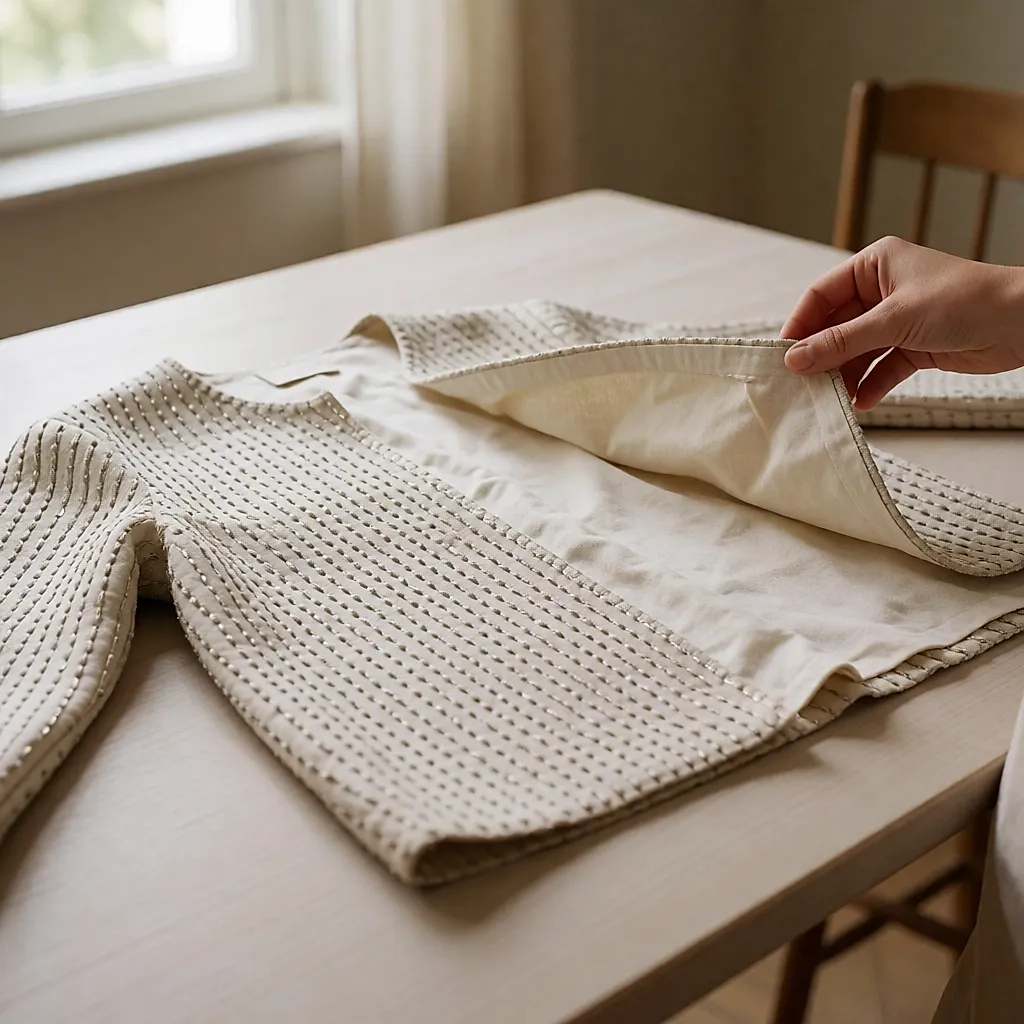
On care: store it flat or on a wide hanger, in a cotton bag, and flag the mirrors before you hand it over to be cleaned. These are clothes you keep — which means treating them like it, rather than like a Saturday-night accessory.
Three checks in the changing room: the reverse (finished threads or glue), how firmly a mirror holds when you pinch it gently between two fingers, and the fibre label — you can check how much synthetic is in there without turning it into a lecture.
What you'll pay
For ready-to-wear trimmed with imitation mirrors, expect roughly £25–£80. For a genuinely hand-embroidered piece in a small run, you're looking more at £250–£800, and made-to-measure often runs past £1,000. Second-hand changes the maths: vintage mirror-embroidered pieces turn up between £50 and £220 in charity and vintage shops or on resale sites, as long as you inspect the back. These are indicative ranges: city, maker, materials and the amount of handwork all move the figure.
To make one yourself, a mirror-work embroidery kit is around £12–£35, and a packet of small mirrors a few pounds at a haberdashery — and the time, of course, is non-refundable. The real question is still this: does it need to shine for one season, or grow old with you?
Still wearing it after six parties?
A piece like this isn't judged on the first mirror selfie but on its third outing: if the mirrors hold, if you still like the way it falls, if you'll happily wear it again the same winter without resentment — it's earned its place.
The luxury here may not be the glass at all. It's knowing what's behind it: the hours, a hand, one gesture repeated until it becomes constant. At that price, you look at it differently — and you choose more slowly.



Comments
Your opinion matters: rate the article, react and reply to comments.
Comments are moderated; AI-assisted comments are flagged. Text emoticons (8-), :-), <3…) are automatically shown as images.