
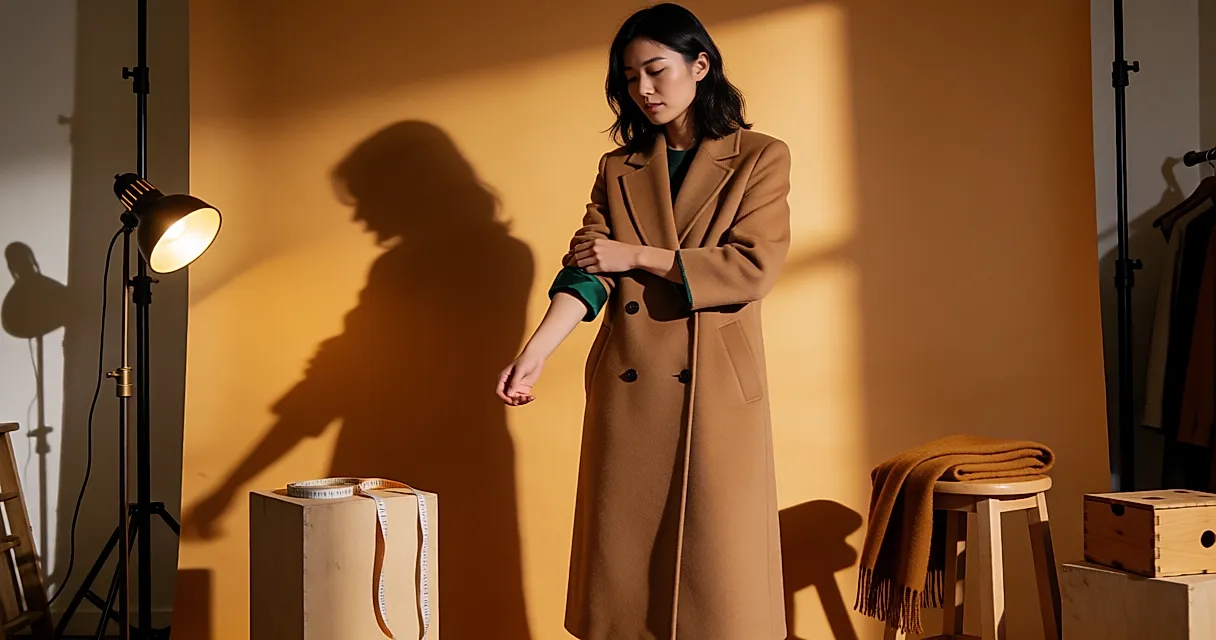
Wool decides whether a coat feels right in the fitting room; the lining decides how long it stays in your wardrobe. Turn the coat inside out and run your hand around the inside: that is where the small print is written — how the lining is put in, what can be taken apart one day, and whether the coat has been designed for a second life. Beyond a quick glance, what matters here is the difference between a free-hanging lining and one stitched flat to the shell — and, ultimately, what a repair or a full replacement will cost.
What you find when you turn back a sleeve
A well-designed coat gives its lining room to move. The lining should slip, with ease at the armholes, and it shouldn't pull when you lift an arm to reach for your Oyster card. Tailors know this freedom well: the lining is free-hanging, sewn with a fold of ease that absorbs movement. It works without being stretched taut — and if it splits, it can be unpicked without wrecking the rest of the coat.

By contrast, a lining stitched flat against the cloth looks neater inside at first glance. But it takes all the tension at the weak points, especially under the arms, and forgives far less. When it gives, the repair is often more involved. The price tag tells you nothing about this: it is better to look than to assume.
So what should you inspect? First, the lining fabric: cupro, viscose or silk on the more carefully made versions — and check the label for the proportion of synthetic fibres, which age badly when rubbed. Then the finishing: a lining hem worked with small stitches, visible seam allowances rather than trimmed right to the edge, armhole seams with a little breathing room. Those few centimetres of spare fabric will decide whether your coat can be repaired in five years or ends up in the charity bag.
What can actually be repaired
Problems tend to crop up in the same places: lining fraying under the arm, a hem coming undone, a button that goes off on its own. A dressmaker or alterations tailor can fix all of these if there is enough material to work with — which is why ease and seam allowances matter. Expect to pay around £20 for a lining hem, and a little more for an underarm repair.

Another option, more drastic and often underestimated: replacing the whole lining. On a wool coat whose cloth has held up, this is a routine workshop job. You end up with a coat that should last for years, provided the cut and armholes are straightforward to take apart. Ask for a quote first: with a padded lining or a bonded construction, the bill climbs and the result is less predictable.
In the fitting room, the question to ask is simple: if this lining fails in three winters, can I save it? If the answer is no, you are buying a coat with a limited lifespan — which can be a perfectly reasonable choice, but not at the price of a piece made to last.
The lining check in the fitting room — Run your hand under the armhole: does it pull? Look at the inside hem: is there any fabric left in reserve? Give the coat a gentle shake: a free-hanging lining moves a little, which is a good sign. Finally, check the composition label and how the seams are finished at the armholes.
What it costs
A decent wool coat usually sits at around £180 to £450 in mainstream ready-to-wear, and more once you move up a level. A lining repair at a local alterations shop costs £20 to £45; replacing a lining completely costs £80 to £180 depending on length and fabric. It is a budget, yes, but compare it with buying a new coat — and it preserves a cut you already like.
On the second-hand side, you can find very good wool coats for £30 to £90, provided you are willing to have alterations done. Some brands also offer a repair or alteration service: check their website before buying, as the commitment varies a lot from one retailer to another.
And if your budget is tight, the best bargain is often the coat you already own. Having the lining repaired on a coat that has been sitting at the back of your wardrobe costs less than splashing out on something new whose inside you know nothing about.
The next time you try on a coat in the fitting room, turn it inside out. It is the least glamorous move in the fitting room, and probably the one that pays off most.


Comments
Your opinion matters: rate the article, react and reply to comments.
Comments are moderated; AI-assisted comments are flagged. Text emoticons (8-), :-), <3…) are automatically shown as images.