

The courier rings at 7.12pm on a Sunday, and you open the door in the only thing that has passed for an outfit since brunch: a wrap-front robe tied at the waist, patterned with cranes, with wide sleeves. Pyjamas? Dressing gown? Sofa kimono? A bit of all three — which is exactly where to be careful. Under the same name you’ll find the piece you put on to read for three hours without feeling dressed for bed, and the one that gapes open at the first movement. The difference isn’t in the print, however pretty it is.
What the kimono cut does for the silhouette
The principle comes down to three things: a wrap front, a belt that nips in without compressing, and sleeves that fall straight from the grain instead of being set into a shoulder. The result is a V neckline that lengthens the neck and a defined waist without buttons — a cut that forgives a great deal, including the previous night’s slightly boozy dinner. It’s also why it returns every autumn: it dresses stillness better than leggings.
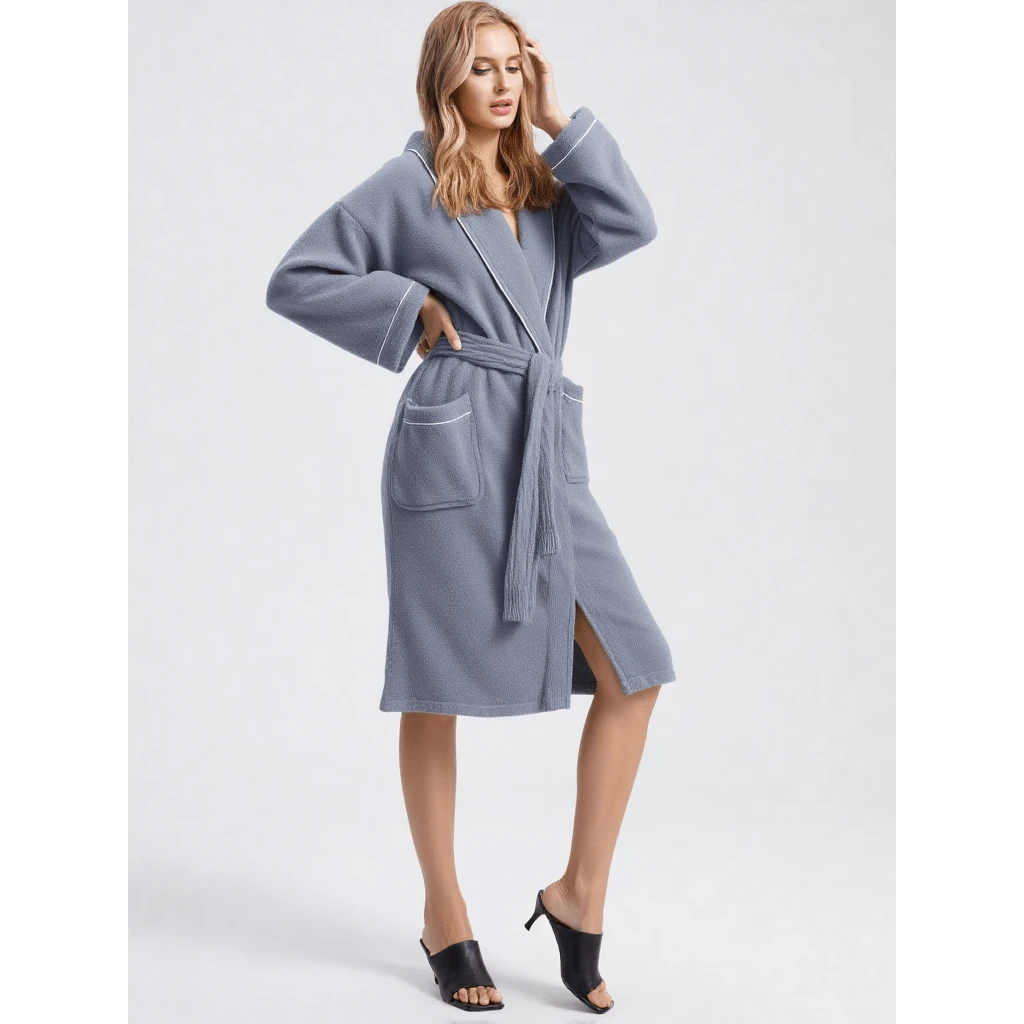
But there is a downside. Too long, it drowns the figure; too stiff, it stands up like a pattern-cutter’s nightdress. The right style finishes at mid-calf or knee, and the fabric should move without holding its shape on its own. In front of the mirror, you’re looking for a line, not bulk.
Fabric decides the use, not the other way round
This is the first question to ask, before colour even comes into it: will I sleep in this gown or answer the door in it?
For receiving — a friend, a delivery, a dinner that runs late — go for printed satin: it drapes, has a little sheen that does the work of jewellery, and doesn’t crease the moment you sit down. The snag is that it slips off the shoulders and shows water marks, which isn’t ideal for a piece worn through a November evening. Check the label: satin can be silk or polyester, and it will say so.
For sleeping, cotton flannel remains the reliable choice: matte, warm and dry under the duvet. In between, heavy cotton jersey gives a soft drape, a little less structured at the belt — the piece you’ll reach for most often, and the one that will slacken fastest.
The belt, the detail nobody looks at
A dressing gown is judged by its belt. Too short and it makes a loose knot you have to retie every ten minutes; too thin and it cuts into the waist and leaves a mark through the T-shirt underneath. In practice, look for a long belt — enough for one and a half to two turns — with a flat knot that stays put without pins. As a guide from the editorial team, allow at least 1.5m for an average waist.
Width matters too: 8 to 10cm gives structure and acts like a high waist; a thin belt reads more like a slip. One last detail, and it matters if you answer the door: a bow at the back looks elegant but is impossible to tie alone. At the front it’s easier — and more honest.
The armhole before the print
Here’s the detail that separates a dressing gown from a kimono parody: how the armhole falls. On a kimono sleeve, the fabric runs straight from the grain and falls at an angle; if it drops too low under the arm, a bundle of fabric rides up as soon as you raise your arm — to reach a glass from a high shelf, close a curtain or ruffle a child’s hair.
The test needs no equipment: the three-move test. Raise your arms, sit cross-legged, walk three steps. If the sleeve pulls, the belt rides up or the front opens completely, the gown stays on the rail. As for the print, check it last: a crane-and-wave motif is charming, but it will never rescue jersey that clings to your thighs.
The three-minute mirror test: put the gown on, tie the belt, then raise your arms above your head. If the armhole doesn’t ride up enough to distort the shoulder and the wrap front stays in place, you’ve found a dressing gown. If not, you’ve found pyjamas — which is perfectly fine, as long as you don’t call them anything else.
Budget
Prices vary mainly by fabric, not by cut. In supermarkets and on lower-priced lines, budget around £20–£45 for a kimono cut in cotton jersey or flannel: this is the segment with the widest choice of prints and the most variable wash performance. In lingerie departments or womenswear retailers, the range runs from about £45 to £100, often with better-finished belts. For silk satin, expect more like £110–£220, and read the composition before you fall for it. Second-hand is still the best find: £10–£30 for an older piece, often in thick cotton, that has already proved itself.
Then it comes down to your life. For Sundays when you have people over without changing, a kimono-cut printed satin gown with a long belt and elbow-length sleeves will do for coffee at 11am as well as a glass of wine at 8pm. For winter evenings and slow mornings, cotton flannel wins without argument, with a wide belt that stays put on its own.
And if you’re still hesitating at the rail, ask yourself the only real question: would you be happy to open your door in it? If yes, it’s a dressing gown. If the answer is ‘absolutely not’, you’re holding excellent pyjamas — and there’s nothing to fix about that.

Comments
Your opinion matters: rate the article, react and reply to comments.
Comments are moderated; AI-assisted comments are flagged. Text emoticons (8-), :-), <3…) are automatically shown as images.