

A black-and-white square, about 2cm across, printed beside the fibre composition and the 30°C care symbol. You increasingly see this little chequerboard at the neck of a sweatshirt or on the back of a jeans label. Scan it and a page opens; the garment starts to talk — where the fibre came from, who spun it, wove it, dyed it and sewed it. The question is how far the code really goes, and what it leaves in the dark.
What the code really tells you
Depending on the brand, the scan opens a page that is more or less forthcoming. The most thorough ones trace the chain step by step: the country — sometimes the region — where the raw material comes from, then spinning, weaving, dyeing, the garment workshop and occasionally the name of the production site. Others stop at the country of manufacture, which could mean anywhere on the planet.
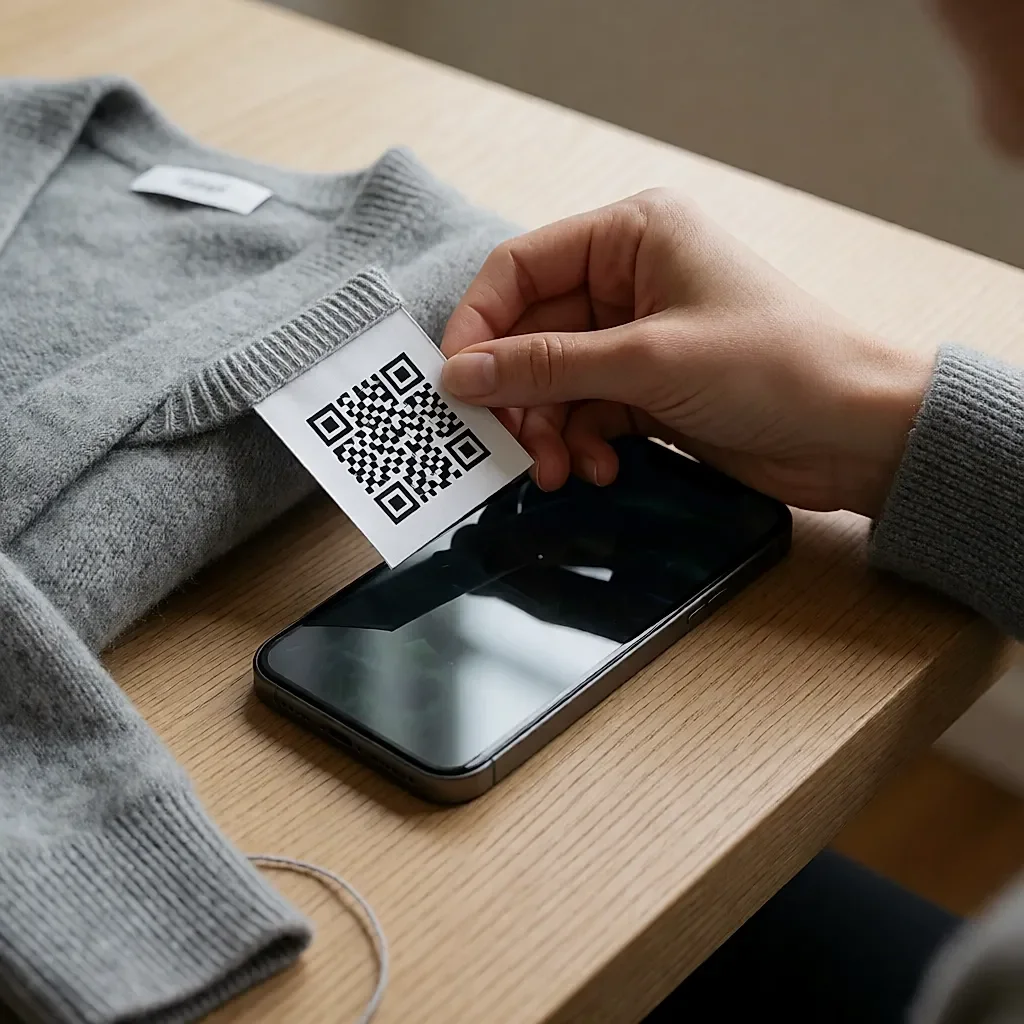
What matters when you are choosing is not the nice story but seeing the stages. A T-shirt whose cotton grows in Turkey, is spun in Portugal and sewn nearby has not travelled the globe in the same way as a piece whose fibre, weaving and sewing come from three continents. You will not know which one will last better — more on that below — but you will know what you are buying.
The digital product passport, still being defined, could cover many sectors; its details, including how it would apply to textiles, have yet to be settled. So the QR code is not just a packaging fad.
What it will never tell you
It may tell you where the wool comes from. It will not tell you whether it itches. Nothing about the drape of a bias-cut dress, how a denim feels, the thickness of a sweatshirting, the softness of a lining or the number of stitches per centimetre on a shoulder seam. The code tells the journey, not what decides whether the piece will survive three winters.
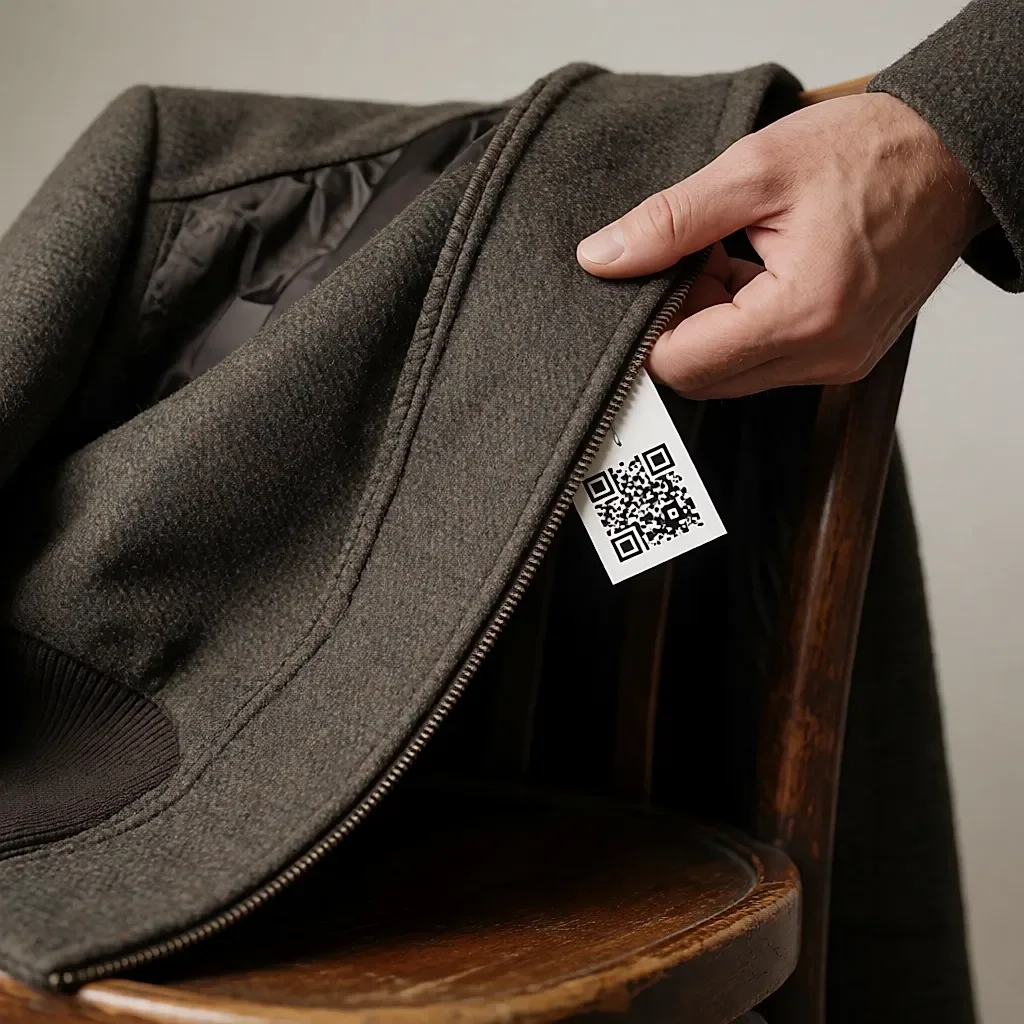
To our knowledge, no regulation currently requires a readable quality score on a label: this information sheds light on origin and impact, not durability. Traceability tells you where something came from, not how long it will last. Two merino wool jumpers documented with equal care can come out of two different workshops and age completely differently — and if a web page promises otherwise, it is selling, not informing.
In the shop, what your hands can check in three minutes
Scan it, then go back to your usual habits: a code is no substitute for a fitting room. Turn the piece inside out; the reverse often tells you more than the front. Look at the topstitching on the side seams, the hem and the buttonhole; gently stretch the knit to see whether it springs back; scrunch the fabric and release it: does it keep the crease or relax?
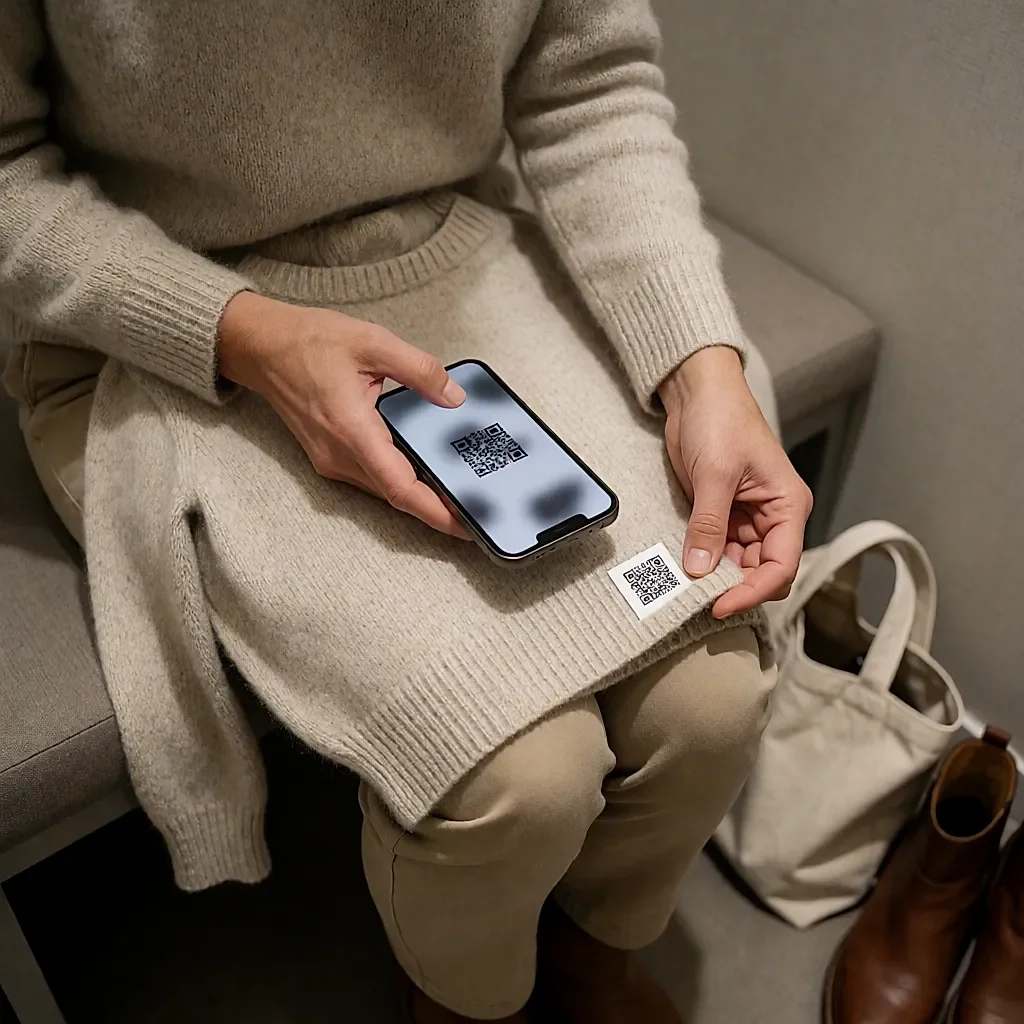
And actually try it on. Raise your arms, sit down, walk to the mirror at the back of the shop. How many pieces that looked impeccable on the hanger turn out to be distinctly limp once worn? Drape cannot be guessed from a rail or a QR code — and no scan will replace that.
The three-second check. Scan the code, then ask three questions: does the fibre come from one country or four? Is the garment workshop named, or just a continent? Does the page set out the stages, or does it only tell a nice craft story? If the code answers, you know more than the printed label tells you. If it stays silent, that does not make it a bad garment — just a garment without a pedigree.
Price
On price, detailed traceability is not enough to give a reliable figure: the cost depends mainly on the material, the city and the retail channel, and a multi-brand retailer may charge more than a brand that sells direct.
Where to look? Specialist online brands, young labels that publish their workshop details, and some general retailers too. And if the budget will not stretch, you do not have to give up: a second-hand piece already has a history, even without a QR code.
Scan, then touch
The QR code is a good starting point, not the final judge. It tells you whether the wool has come from far away, whether production has moved to another workshop, whether the brand is being upfront. It does not tell you whether the sleeve sits right at your wrist: that is for your fitting to decide.
Use it as a guide, and keep your hands free for the rest: touch, turn inside out, hesitate. A garment chosen this way gets worn for longer — and it is also the best way to make what is already in your wardrobe last.

Comments
Your opinion matters: rate the article, react and reply to comments.
Comments are moderated; AI-assisted comments are flagged. Text emoticons (8-), :-), <3…) are automatically shown as images.