
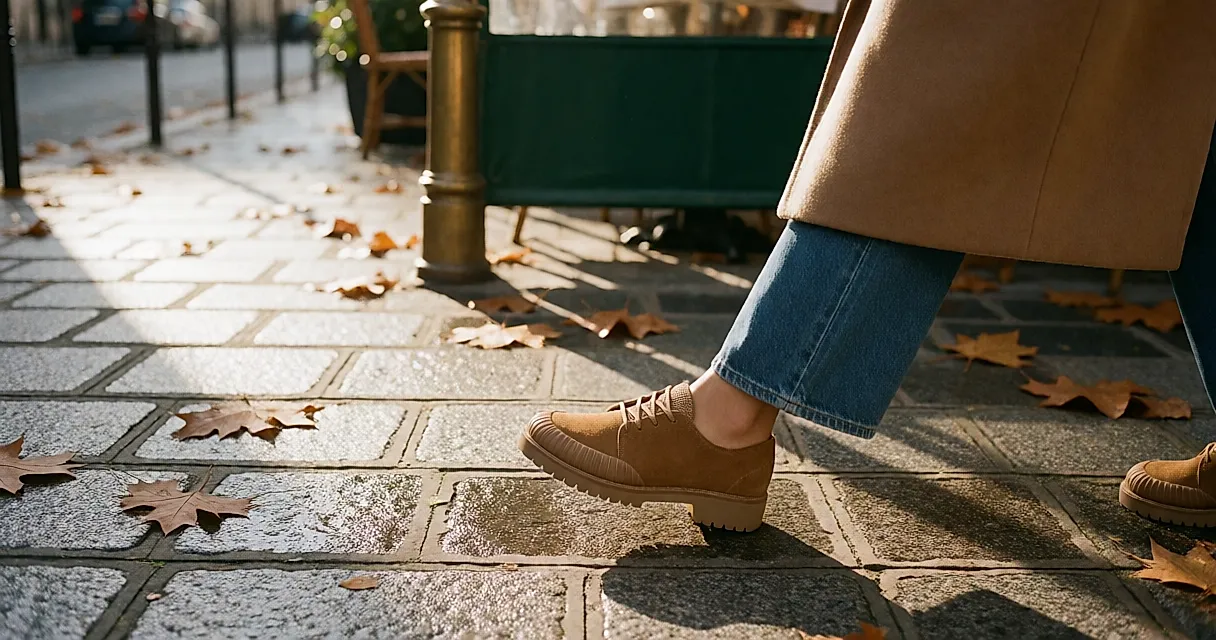
The toe bumper is that band of gum rubber that wraps over the toe, like a bracket around the front of the foot. On a trail it stops your toe from splitting against a stone; on a pavement it stops a trainer from ending the season ripped open by Tube steps. Until now, you would only find this kind of shoe between the climbing ropes and ice axes. It has come down into town, and it has a case to make.
A rock shoe that has learned the pavement
It has the shape of a walking trainer, but more structured: low-cut or mid-cut, suede or leather, rubber that wraps up the sides, lacing that runs far down the foot. The line is clean, the sole deeply lugged, the colour rarely neon: sand, grey, moss green. It is not a piece that tries to be cute, and that is exactly what makes it interesting in a wardrobe where everything else is trying so hard.
What really matters in the city is not the look but the build. An approach shoe is designed to carry the foot over uneven ground: firmer support than a running trainer, a protected toe, a sole made to bite. Brands with a long history on rock, such as Salomon and La Sportiva, now offer very city-ready versions. You keep the technical side and lose just a little of the off-for-three-days feel. A useful middle ground, surely?
What it replaces and what it doesn't
The first is the walking trainer. Comfortable, yes, but with its soft sole and mesh it lets in water at the first shower and wears down on asphalt faster than you would like. The second is the waterproof city shoe: smart, but with a smooth sole that slips on wet pavements and a heel that clunks down every kerb. The approach shoe sits between the two: toe protection, grip in the wet, and a silhouette sober enough not to shout hiking.

Don't expect it to do everything, though. On a long hike with serious elevation gain, a proper hiking boot is still the better choice. And with well-cut suit trousers, the match is… let's say bold. This is a shoe for commutes and weekends, not for client meetings.
Wet cobbles, steps and everyday wear
Think of the Tube step, the drain cover, the painted pedestrian crossing that turns into a skating rink as soon as it rains. That is where the toe bumper and the gum rubber are supposed to improve grip and protect the front of the foot. If you walk a lot but don't want to wear running shoes, the difference in comfort is noticeable.
Weight is worth a try-on, though: some pairs are heavier than a classic trainer, and over a long day of walking you will feel it. Think about upkeep, too: a brush, a cloth and a suede protector, because a well-cared-for pair will last several seasons. And check the label: the quality of the materials and finish gives some clue to how well the shoe will last, though the synthetic content alone doesn't tell the whole story.
Three things to test in the shop
Start with the toe bumper. It should cover the front of the foot without becoming a rigid shell that fights every flex. Press it and bend your foot: the rubber should move with you, or it will block you.
Next, heel flexibility. Twist the shoe and fold it in half; if the heel distorts or the sole refuses to move, you will feel it after a day. Finally, the rubber: run your thumb over the sole; it should feel slightly tacky. The softer it is, the better it grips, and the faster it will wear on asphalt. That is a trade-off, not a flaw.
Low-cut or mid-cut? The low-cut is more flexible and slips under wide-leg jeans; the mid-cut holds the ankle better on steps and uneven ground. In town, low-cut is enough most of the time. Always try them with the socks you will actually wear: approach shoes should fit close to the foot, never loose.
So, is it worth seeking out? If your commute is a course of cobbles, steps and showers, yes: the approach shoe does the job without looking like it has just come down from a mountain refuge. If you want a smart pair for the office, look elsewhere. Otherwise, it is easy to be tempted by a low-cut suede pair in the region of £120–£150, which you will wear from Monday to Sunday.

Comments
Your opinion matters: rate the article, react and reply to comments.
Comments are moderated; AI-assisted comments are flagged. Text emoticons (8-), :-), <3…) are automatically shown as images.