
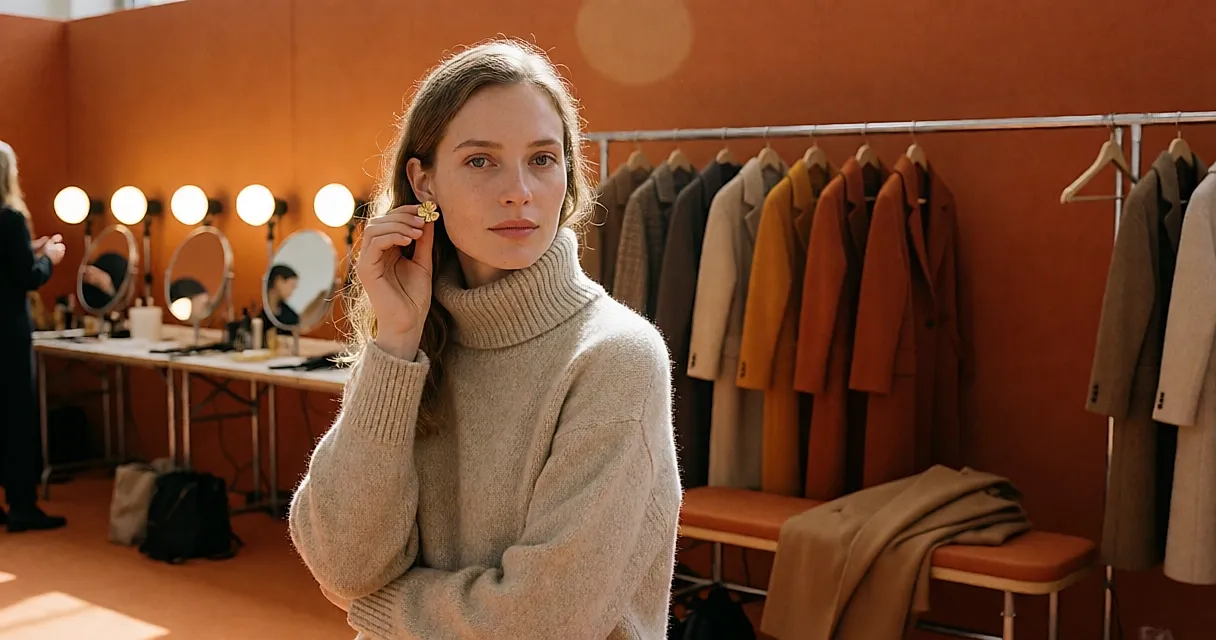
It isn't the wool that's fragile. It's the earring itself — its setting or its fastening. A claw setting opened a fraction too wide, a hoop that was never soldered: the first stitch of the season catches on it and pulls a thread. The earring itself is unharmed, which is precisely the problem.
The setting on the face, the fastening at the back
Look at the face of your studs first. On an open claw setting, several tiny metal claws stand proud of the setting to hold the stone: these are what snag, and they are very good at it. A closed setting — the stone enclosed in a continuous metal rim — gives the knit nothing to catch on. The same applies to hoops with an unsoldered join: the two ends of the metal wire meet without joining, and a wool fibre slips into the gap as if into the eye of a needle. A soldered hoop is a closed circle. Full stop.
At the back, the second suspect is the fastening. A magnetic clasp is a sneaky one: it can spring open under a wool collar and let the earring slip loose. The classic butterfly back has two thin wings that make excellent knit-hooks; a screw back holds more securely, but its screw thread catches the finest fibres. Have you ever found an earring at the bottom of a sleeve? That wasn't bad luck.
What gets through winter without a snag
The lever-back — the little hinged flap that folds over the post — secures the fastening in one movement and shouldn't reopen by itself. In the hand, look for a firm hinge, a flap that clicks shut and a post that doesn't wobble; avoid a weak lever. This is the first thing to check, before shape, before colour, before anything else. Next comes the setting: for cold weather, choose stones in closed settings, cabochons, smooth solid studs, or simply no stone at all.
As for shape, sleepers (small hoops that sit snug against the lobe) and flat ribbon-style hoops are the best friends of a roll-neck: almost nothing sticks out, almost nothing catches — what more could you want? Fine hoops are still wearable if the hoop is soldered, but they can be less comfortable on a thin earlobe or on a day when you're putting on and taking off three wool layers. Ear cuffs are a lovely aesthetic buy and a bad knitwear buy: they can slip, and an ear cuff that slips under a scarf ends up in a pocket.
Snagged knitwear? Don't cut it
The reflex that ruins everything is a pair of scissors. A pulled thread is not a lost thread: the knit is still intact, it has simply been caught. Turn the jumper inside out, slide a round-tipped wool needle or a fine crochet hook under the thread, and gently bring it back to the wrong side of the knit. Spread the length across the neighbouring stitches, secure it with a tiny knot on the inside, weave in the end — the repair should barely show.
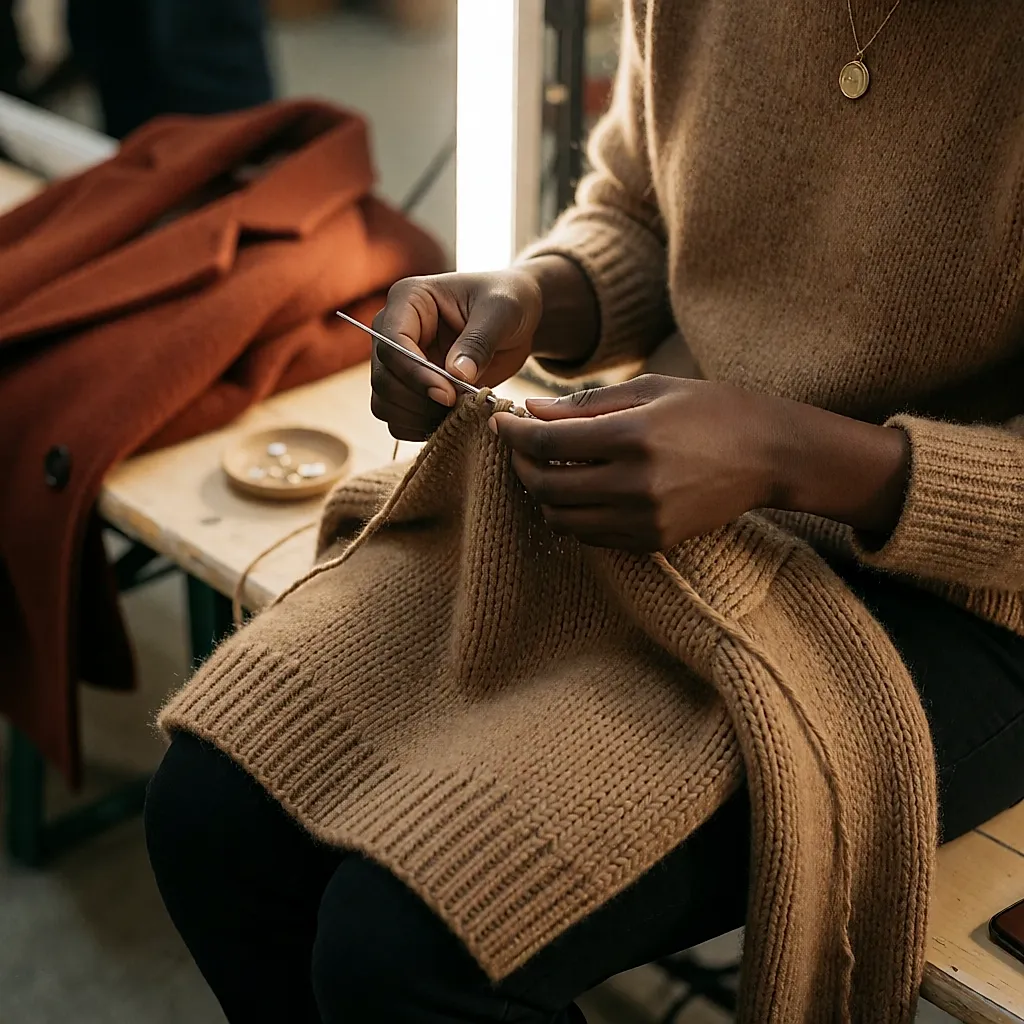
If the snag is wider than a thread, take it to an alterations service or a haberdashery counter: darning two or three stitches is often cheaper than replacing the jumper. And if your earring has been the culprit all along, have a hoop soldered by a local jeweller — ask for a quote on the spot.
The sleeve test, in-store: keep the jumper on your arm and run both faces of the earring across it — the setting side, then the fastening side — for two or three centimetres each. If the knit loops up, it's a no — even if the earring looks perfect in the mirror. For transport, a small rigid box per pair does the job.
Budget
As a rough guide, expect to pay £10–25 for a pair of gold-tone brass studs, £20–60 for 925 silver with a closed setting, and £25–75 for soldered silver hoops depending on diameter. With gold, the bill moves up a level: from around £90 for 14- or 18-carat studs, and several hundred pounds for hoops.
Where to find them? Local jewellers and makers at markets for simple shapes; specialist jewellery shops and department stores for silver studs; online for sleepers — provided you check for '925 silver' or 'sterling silver', not 'silver-plated'. What changes the price: the retailer and city, the material, whether the soldering is done by hand, and the stone.
The choice at two budgets
The decision comes down to this: if the budget is tight, a pair of 925 silver studs with a closed setting does the job without cutting corners. If you can spend a little more, soldered silver sleepers are often more comfortable day to day, and you may forget you're wearing them. And if you're attached to your claw-set hoops, the pair isn't the first thing to change: look instead at the material of your collar and scarf.
The principle is simple: look at the back of the jewellery before you decide it's beautiful. Fall for the pair, never for the pulled thread in the middle of your jumper.


Comments
Your opinion matters: rate the article, react and reply to comments.
Comments are moderated; AI-assisted comments are flagged. Text emoticons (8-), :-), <3…) are automatically shown as images.