
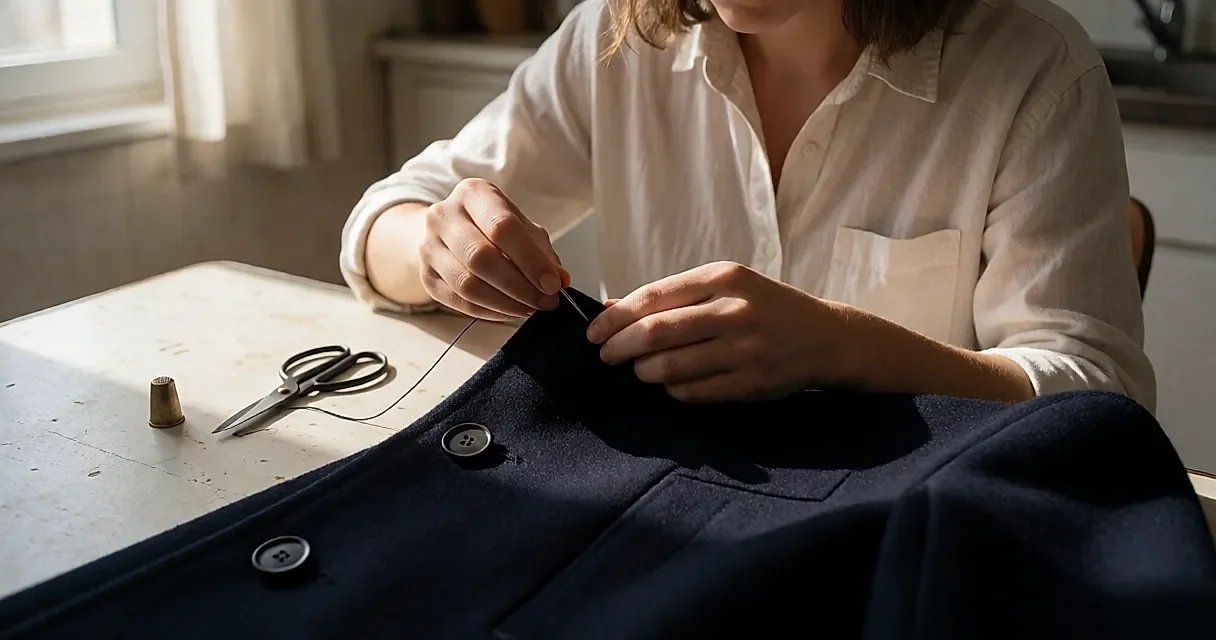
One loose, dangling button is all it takes for a sleeve to tug every time you lift your arm, and for a small dimple to form in the wool around the buttonholes. We tend to blame the thread, or the coat itself. The real culprit is quieter: the button was sewn flat, without the extra room the fabric needs. It is a tiny detail, which is exactly why it is so irritating.
Why a flat button doesn't work on thick wool
A wool coat is a fabric with enough body to almost hold its own shape on the hanger: ideal for warmth, less so for sewing. The button, however, stays flat. Sew it tight against the cloth and every time it goes through a buttonhole it pulls on the same few centimetres of thread, in the same place. Over time the thread frays, the button tilts, and the fabric develops a small hollow around the holes.
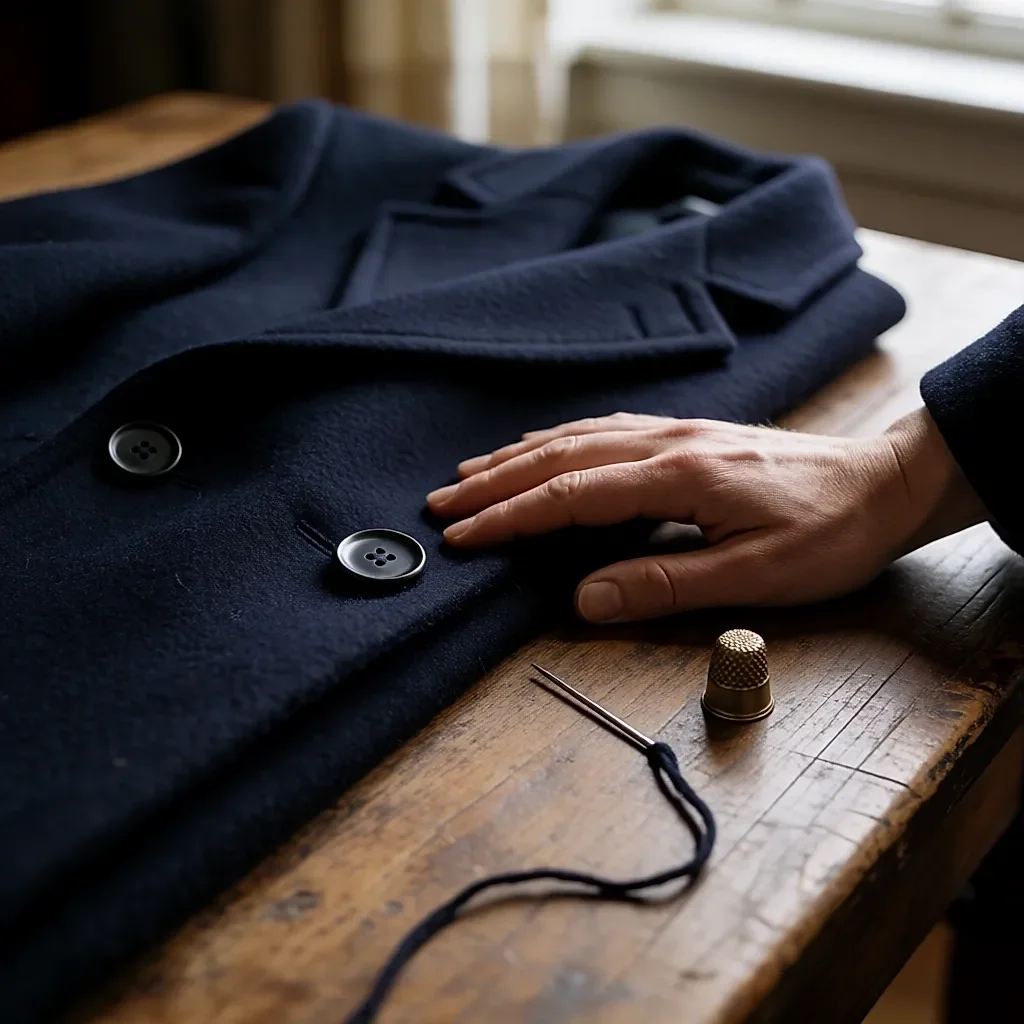
You notice it not on the hanger but in motion: getting on the bus, a bag catching on your shoulder, turning up your collar against the wind. That is when the button reminds everyone it is there. A well-sewn button, by contrast, disappears—which is more or less the definition of good maintenance.
Raising the button: how a thread shank works
Seamstresses call it making a shank: a small collar of thread between the button and the fabric, giving the button exactly the height of the cloth. From a distance you won't see it. Up close, the difference is obvious: the button sits on the thickness of the fabric instead of crushing it, and the thread has an easier job.
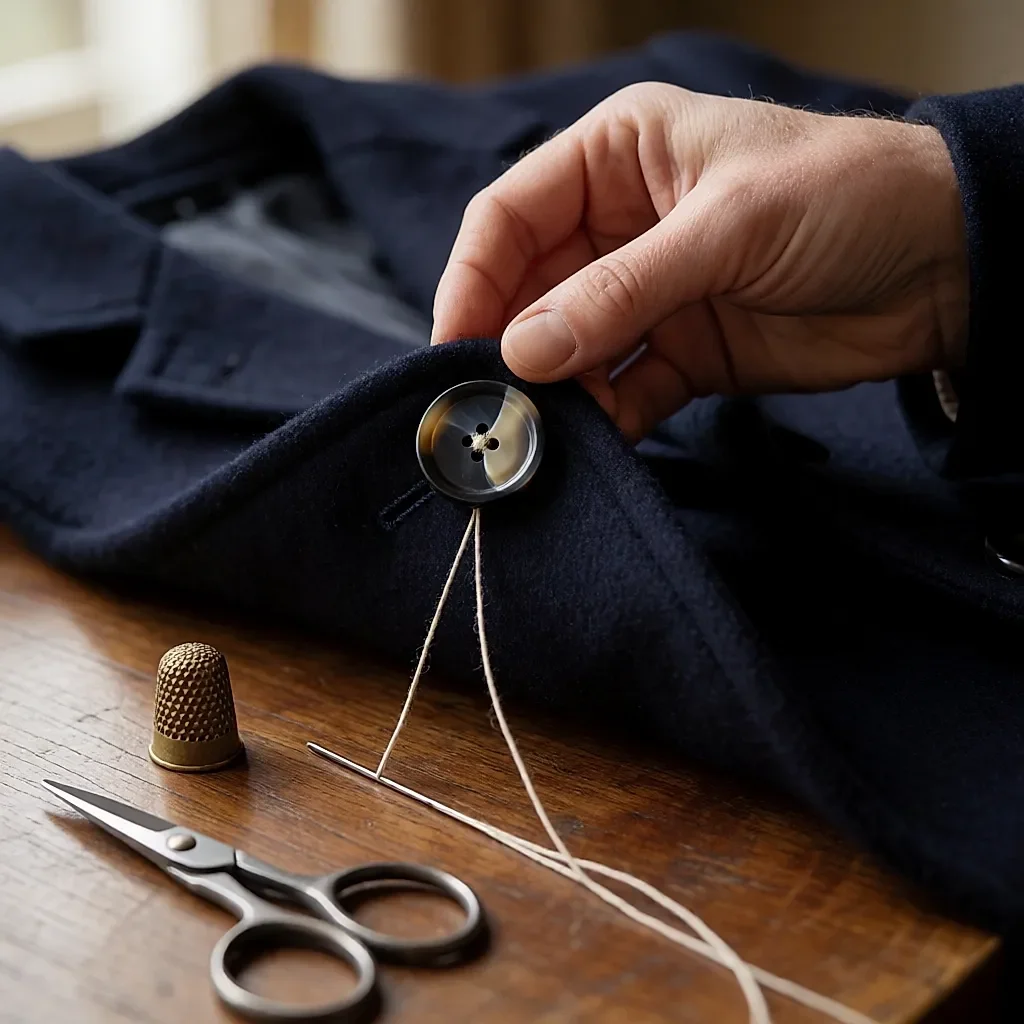
Height? It follows the thickness of the fabric, not a universal rule. On a fine jacket wool, allow one or two millimetres; on a pea coat or a dense cloth, two to three millimetres is more comfortable. In practice, people often use the thickness of a thumbnail as a guide.
The toothpick, the needle and the stitch
Thread a needle with matching cotton and double the thread. Stitch into the fabric where the button will sit, then through one of its holes. Now slip another needle or a toothpick between the button and the fabric, crosswise, and sew through all four holes, passing the thread over this support. Remove the support once the button is fixed: it will stay raised on its shank.
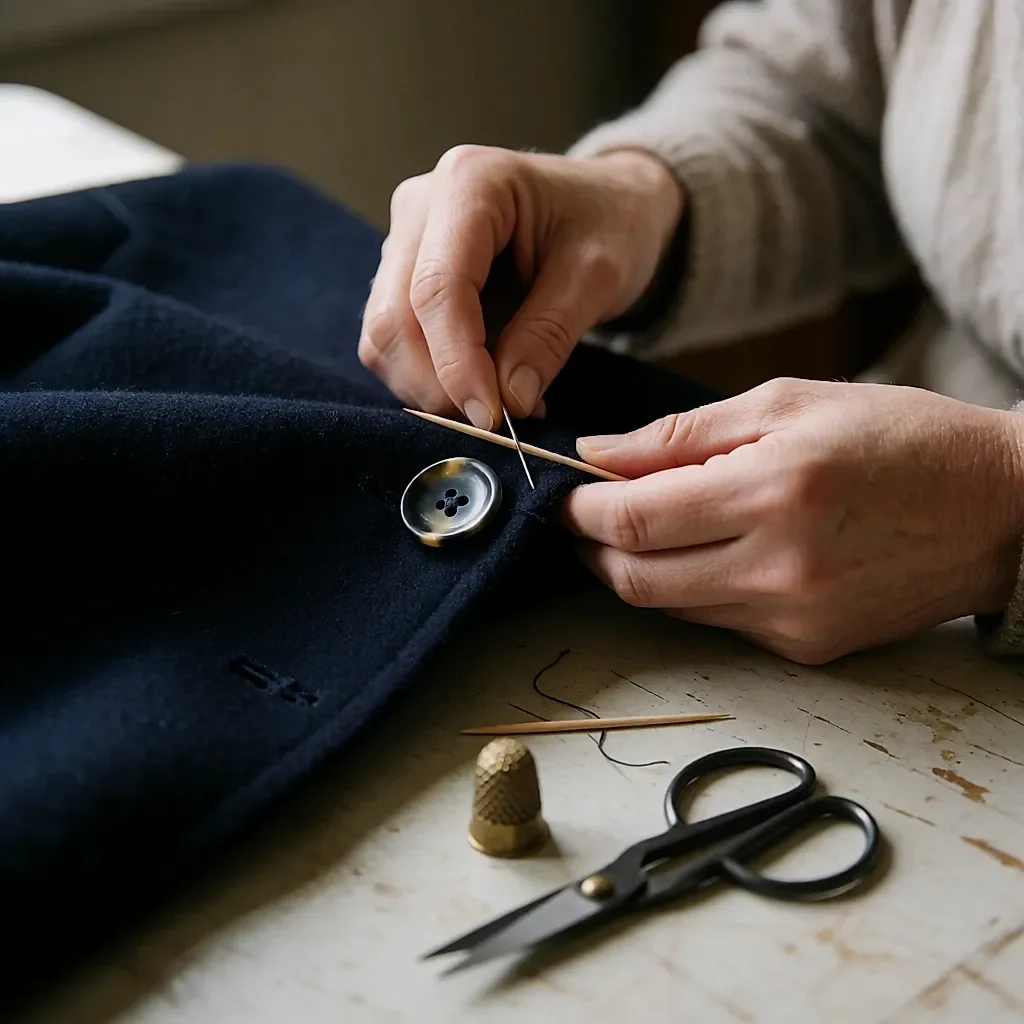
Then secure it. Wind the thread several times around the shank beneath the button, snug but not tight enough to crush it, and fasten with one or two stitches on the wrong side. This small wrapping of thread protects the fabric where the thread passes through and stops the button from working loose. A few minutes the first time, a little less afterwards. For very thick cloth, linen thread is stronger and works well too.
What this won't fix
Let's be honest: this extends the life of a coat, it doesn't bring it back. If the fabric is torn around the button, a shank won't hold on ripped fibres—you need reinforcement, a small patch sewn on the reverse, a job for a tailor. And if a button keeps falling off, the thread may simply be too thin for the fabric: a shank won't change that.
The second limit is more fundamental than technical: sewing cannot correct a cut. A coat that gapes between buttons because it is tight across the chest will carry on gaping, even with perfect buttons. Sewing maintains; it does not alter.
What it costs
Prices vary, so treat these as a rough guide. This is one of the least expensive fixes in the wardrobe. A reel of cotton thread costs around £2–£5 at a haberdashery and will do for a good ten buttons. A set of hand-sewing needles is about £2–£6, and a thimble £3–£10. For needles, Bohin—made in France, in the Orne region—is a reliable choice, available from haberdashery shops and online.
If you have neither thread nor patience, a tailor or alterations service will often replace a coat's buttons for a modest sum; as a rough guide, allow around £5–£15 depending on where you are and how many buttons need doing. And if the coat is new with a button already loose, tell the seller before you remove the tags.
The raised-arm test. With the coat fastened, raise an arm as if reaching for a handrail: if the button pulls the sleeve or lifts the front panel, it has been sewn too flat. Check every button before the first cold spell, then again at the end of the season—worn thread is easier to spot before it snaps.
Your call: a few minutes with a needle, or a trip to the tailor. Either way, the real luxury when the cold arrives is a button you don't notice.



Comments
Your opinion matters: rate the article, react and reply to comments.
Comments are moderated; AI-assisted comments are flagged. Text emoticons (8-), :-), <3…) are automatically shown as images.