

An 80-denier opaque pair and a 40-denier merino wool pair, worn under the same skirt, do not tell the same story. On the label, the first looks as though it has twice as much material. Over the course of a day, a fine merino pair can feel as warm, or warmer, than an 80-denier pair, depending on the knit, density, cut and where you are wearing them. Denier tells you about yarn thickness, not about the warmth that stays around your leg.
Denier measures a yarn, not a thermometer
The denier is a unit of linear mass density: 80 denier means 80 grams per 9,000 metres of yarn. The higher the number, the thicker the yarn, and the more likely the tights are to be opaque and dense. But thickness alone says nothing about how well the knit holds warm air. A very tightly knitted 80-denier pair can block the wind and still feel cold to the touch; a 40-denier wool pair can trap a layer of insulating air without that encased feeling.
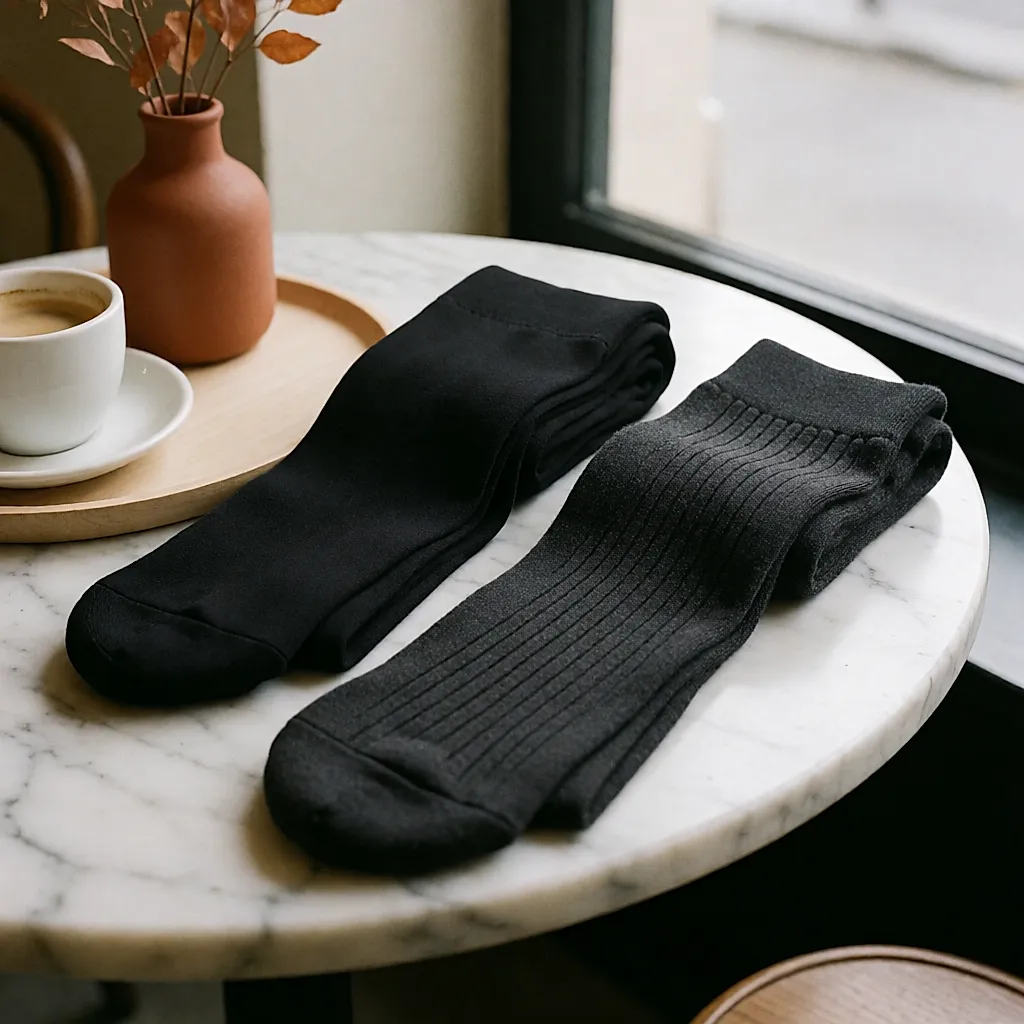
The idea that more denier means more warmth does not hold up. Warmth depends on the fibre, the knit and the cut, and on how the tights fit your leg. A pair that is too big lets air through; a pair that is too small pulls and itches. And an 80-denier pair in synthetic fibres can be less comfortable than fine merino under a midi skirt, especially when you move from a heated office to a station platform. So should you still look at denier? Yes, but as an indicator of opacity, not as a certificate of warmth.
What wool changes under a skirt
Merino wool has an advantage rooted in the fibre itself: its fine, naturally crimped fibres create tiny pockets of air, and it manages moisture better than a smooth synthetic yarn. In practice, it insulates without clinging to the leg and stays more comfortable as you walk, sit down and set off again. Under a wool-flannel skirt or a jumper dress, it adds that discreet layer that makes a difference in a winter wardrobe, without the bulk of leggings.
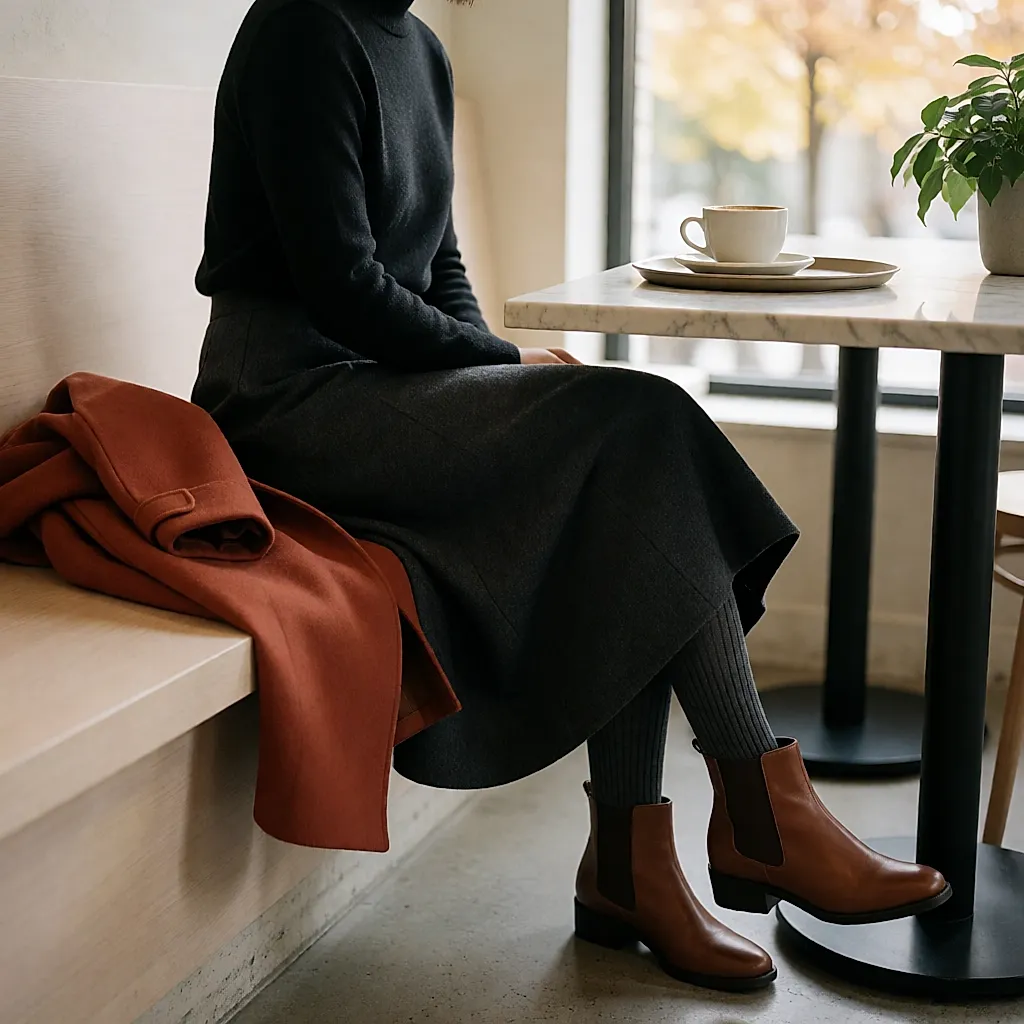
Can a fine merino pair really replace an opaque pair? Not under a short skirt: a very fine merino will not conceal as well as an 80-denier pair. If you want a fully opaque look, look for a denser knit, sometimes a 50- or 60-denier wool pair, or accept a slight sheerness. Conversely, for a long skirt, fluid trousers or tall boots, a 40-denier merino pair is often enough. It is a supporting piece, not a statement piece: you choose it for what it does under the outfit, not for what it shows.
Where your money is better spent
So where should you spend? Start with a wide, flat waistband: without a rolling elastic, it holds the tights up without digging in at the waist. Next, reinforced heels and toes, often invisible but crucial if you walk a lot. Flat seams and a well-cut gusset also count for everyday comfort. Finally, the wool content and its fineness: extra-fine merino does not behave like a rustic wool, and the price reflects that.
Care is part of the budget, too. Wool tights should be hand-washed or put on a wool cycle with a gentle detergent, then dried flat. No tumble dryer, no 60°C wash. That is less convenient than an 80-denier pair you can throw in the machine, but it is what helps them last. And that changes the maths. A warm pair worn for two winters can sometimes cost less than three thick pairs bought in a panic.
Before you buy, stretch the waistband and hold the knit against the light: if it looks very uneven, or if the wool seems to be floating in a synthetic veil, the warmth may be more decorative than real. Check the fibre content, too: merino should be the majority fibre, and a small amount of elastane is enough for fit.

Budget
Expect to pay around £10–£25 for a classic 80-denier opaque pair from a supermarket, high-street lingerie chain or fashion website. It is the easy answer for a winter in the office, but how long it lasts varies and the warmth depends on the knit. Merino wool tights often sit between £35 and £75; above £80, you are mainly paying for the fineness of the wool, the finishing and the brand.
Where should you look? Lingerie chains and department stores let you try for size and feel the fabric; specialist tights and wool brands are mostly online, with size guides worth reading carefully. The sales can be a good way to try your first merino pair, as long as you do not compromise on size: tights that are too small lose their good qualities before they even keep you warm.
The pair that works
If opacity at a low price is your priority, an 80-denier pair will do the job under a long skirt, with a pair of boots and a coat that blocks the wind. If you want warmth without too much bulk, a fine merino pair can be a good find, depending on the knit, density, cut and where you wear them, as long as you accept a sometimes finer look and a gentler wash.
Not sure which way to go? Start by looking at your legs in the evening: if they feel cold in an 80-denier pair, they may simply need a different fibre, not a bigger number.

Comments
Your opinion matters: rate the article, react and reply to comments.
Comments are moderated; AI-assisted comments are flagged. Text emoticons (8-), :-), <3…) are automatically shown as images.