
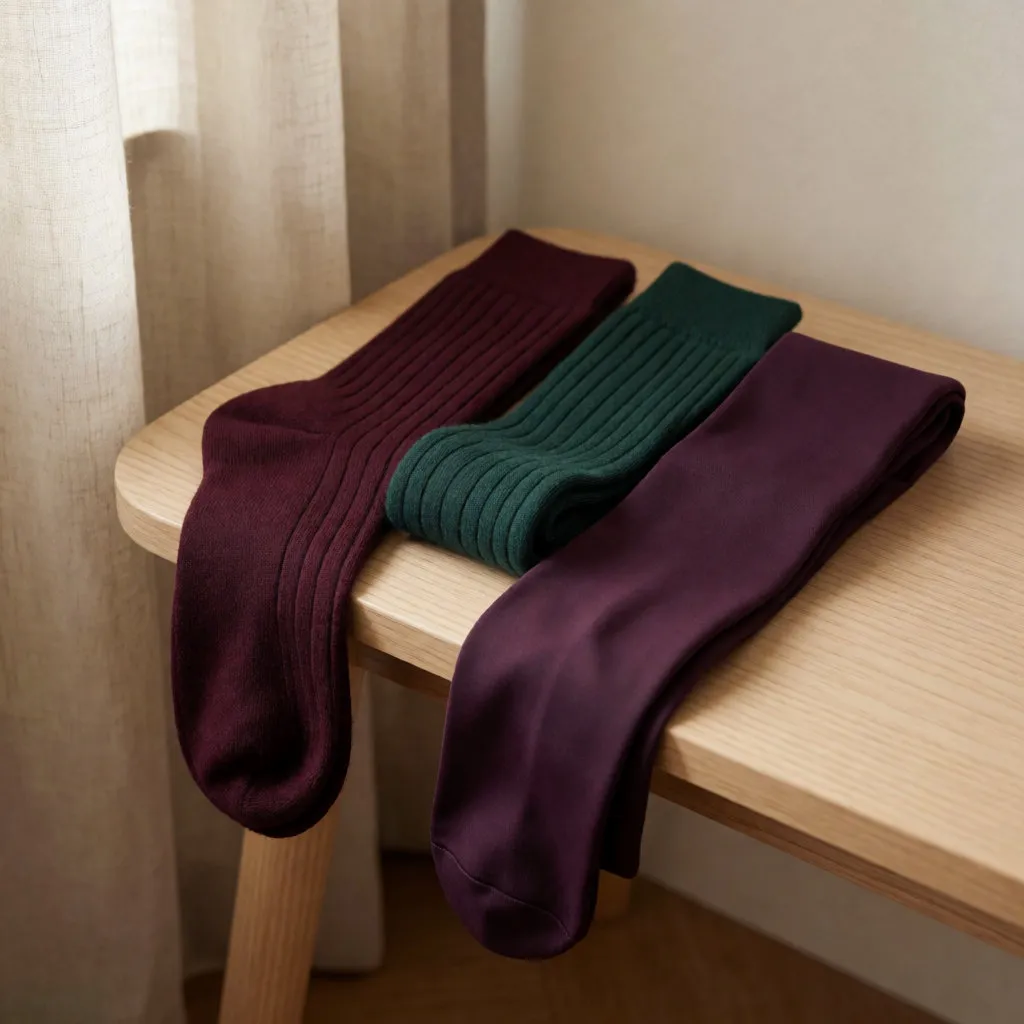
You've dug your loafers out of the wardrobe again, and there's a piece missing from the look. Not just another pair of trainers: a high sock, pulled right up to the calf, happy to be seen. The detail we used to tuck under a pair of trousers ten years ago is quietly climbing back. Why now? Because so much of the silhouette is decided from the feet down — and it's one of the cheapest ways to change an outfit.
The high sock finishes the look
The movement started on the catwalks, but these days it plays out on the street, from the ground up. You pull the knit above the ankle, let it show over a loafer or a derby shoe, and work the texture: tight ribbing, chunky knit, a contrasting edge. Nothing complicated — but the result is nothing like a functional pair you only put on out of duty.
What makes the difference is how they sit. A sock that's too thin tends to sag quickly and break the look clean in two; a slightly denser knit holds the leg and draws a clean line. So feel the fabric before you buy: if it's limp between your fingers, it'll be limp on the calf too.
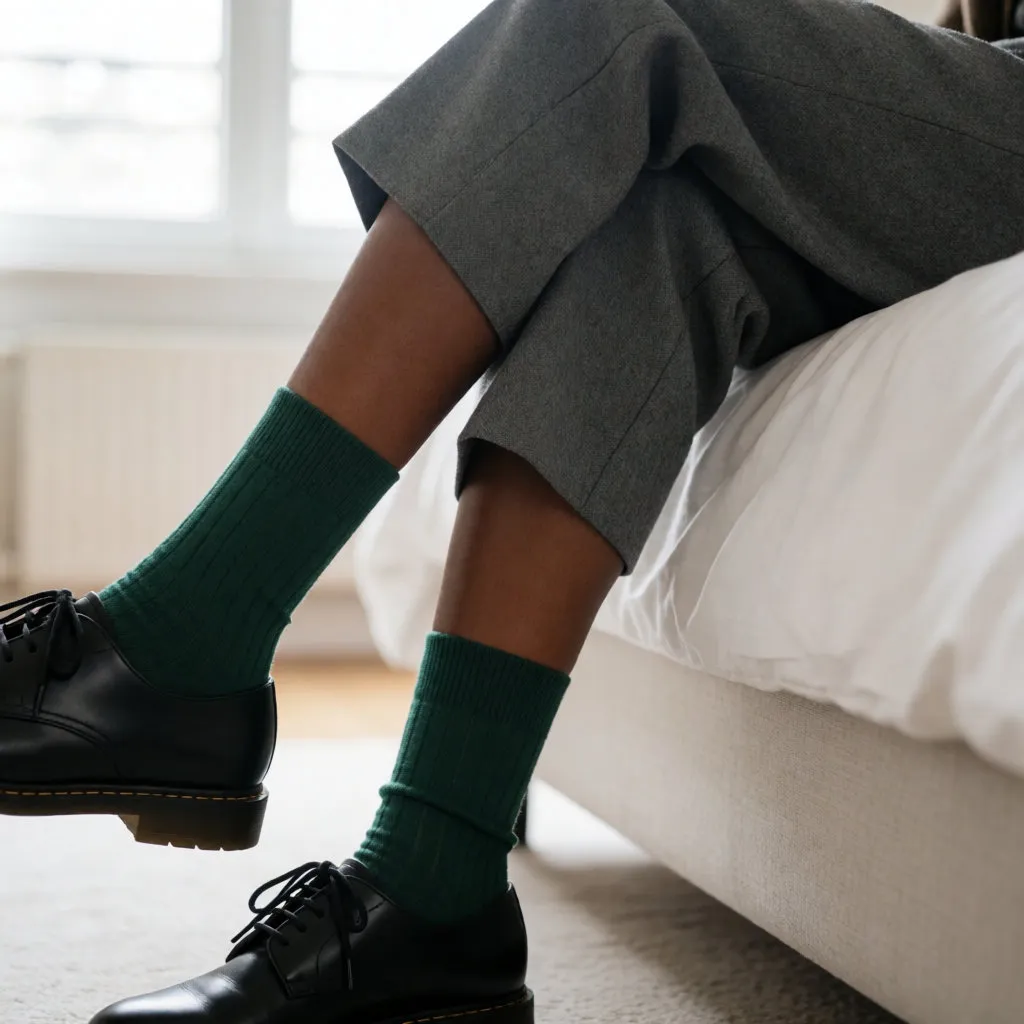
On the colour front, forget sports-white and go for depth. Burgundy, forest green, navy, brown, marl grey: a single well-chosen pair is enough to wake up an all-raw-denim-and-ecru-jumper look, or to team with a midi skirt and derby shoes. With ankle boots, let a centimetre or two peek out — that quiet bit of layering is exactly what separates "I put socks on" from "I put a look together".
Opaque tights: matte takes over from fishnet
On this season's catwalks, fishnet has given way to something more textured: opaque, matte, sometimes ribbed. The principle is simple — you absorb the light instead of bouncing it back. Shiny tights can look cheap fast against a wool skirt; a matte finish, by contrast, lengthens the leg and works with dry, textured fabrics.
To find your way around, go by denier — that is, the weight of the yarn. Count on roughly 40 to 60 denier for a semi-opaque that still hints at skin; from 80 up, the opacity is full and covering. Past 100, you're into proper winter tights — warm, almost a base layer. In practice, many find 80 denier enough in October; thicker styles (100–120 denier) are often chosen in the depths of winter.
Same colour logic as the socks: plum, chocolate, forest, ink. Black remains the wardrobe basic, the one that goes with everything — but it's no longer the only box to tick.
The criteria that really make a difference
Composition. Merino wool is fine and temperature-regulating; its softness depends mostly on how fine the fibre is. Ideal for the shoulder seasons. Cotton breathes but holds less warmth — perfect for mild days. Beware, though: an organic label concerns how the fibre was grown and processed, and on its own doesn't guarantee that a product will suit reactive skin. Also check the elastane content: it varies widely from one product to the next, and how well they hold depends as much on the construction, the fit and the waistband as on the percentage. Which is why it's worth trying before you buy, and checking how the piece sits.
Labels. This is where greenwashing likes to hide. GOTS certifies a full organic supply chain, with social and environmental criteria — particularly strict on cotton. OEKO-TEX Standard 100 certifies that a product meets strict limits for certain unwanted substances, without guaranteeing a total absence of them; it says nothing, however, about whether the fibre was grown organically. For wool, RWS covers animal welfare; for recycled fibre, it's GRS. A serious label can be checked — it isn't just a green word printed on the tag.
Size and fit. Socks are sold in real sizes: if you're between two, size up — a slight shrink in the wash can make up the difference. With tights, the waistband should hold without leaving a mark at the waist, and the heel should be shaped — otherwise you'll spend the day pulling them up.
How they wash. Cotton that pills on the first cycle is a wasted purchase. Look at the density of the knit on the shelf, not the promise on the packaging.
The one habit that changes everything is a laundry bag. Socks and tights go in, delicate cycle at 30°C, gentle spin, and above all no fabric softener — it clogs the fibres and destroys the elasticity. Dry flat, never in the tumble dryer. Treated like that, a pair of tights lasts far longer!
Budget
Expect around £6 to £12 a pair for cotton socks, in supermarkets and from affordable brands alike. For merino wool or certified organic cotton, the range rises more like £10 to £22. For opaque tights, budget £7 to £18 in supermarkets and high-street fashion, and more like £12 to £22 for ribbed or recycled yarn.
What moves the price: the raw material (merino and recycled yarn cost more), whether there's a genuinely certified label, where it's made, and where you shop — a concept store or an independent brand charges more than a supermarket. Where to find them: the sock and tights aisles in supermarkets, hosiery specialists online (often sold in packs of two or three), haberdashery counters and lingerie departments. Also remember the January sales, when the deeper colours go first — so it pays to get in early.
Sources
- The Textile Products (Labelling and Fibre Composition) Regulations 2012 — UK rules on fibre names and labelling.
- GOTS (Global Organic Textile Standard) — certification criteria for the organic textile supply chain.
- WRAP — UK resources on textile sustainability, care and the Textiles 2030 initiative.
- Competition and Markets Authority (CMA) — guidance for businesses on environmental claims.

Comments
Your opinion matters: rate the article, react and reply to comments.
Comments are moderated; AI-assisted comments are flagged. Text emoticons (8-), :-), <3…) are automatically shown as images.