
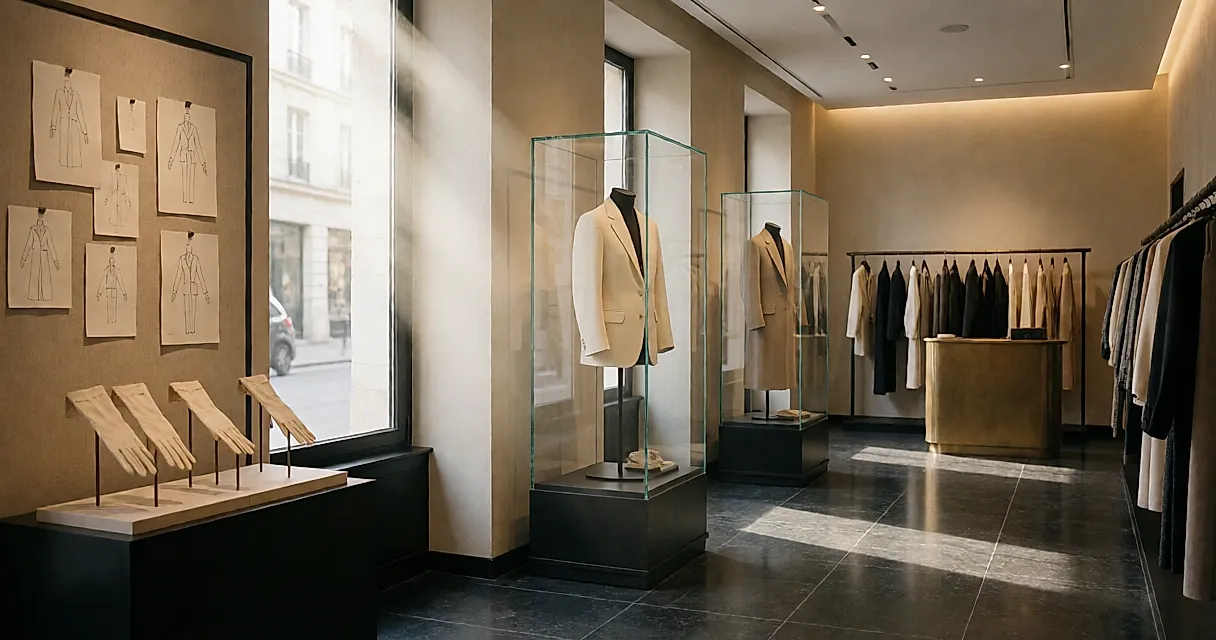
On a Tuesday morning, outside a façade where people usually queue for a bag, the line is moving for something else entirely. A voice asks, "Where's the till?" and the answer comes back, perfectly calm: "At the back, past the third room." The shop has changed job. You no longer go in to buy a piece; you go in to see a story. The piece comes afterwards — and very often it comes anyway.
The route before the rail
Push open the door of a flagship playing this game and within three metres you know exactly what kind of place you're in. Low lighting, a floor that echoes, vitrines treated like museum cases: archive gloves, sketches pinned to a board, a jacket whose lining is explained to you before anyone mentions the new collection. You walk the exhibition before you reach the till — archives, a workshop film, the movement of hands, and only then the rails. You come out with a chronology in your head, which is a rather elegant way of getting you into a shop without charging you a penny at the door.
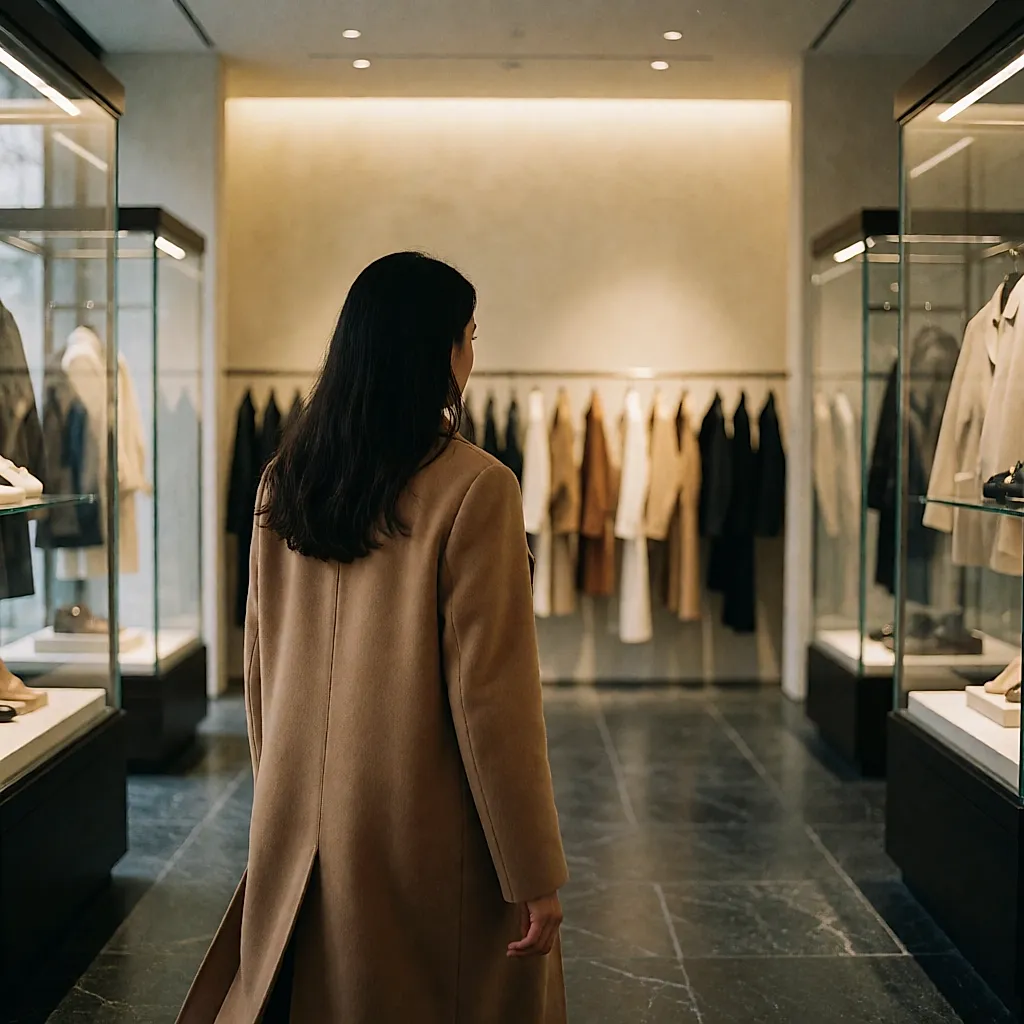
This kind of luxury is expensive, and not only in the finishing: giving over an entire floor to a free retrospective, on one of the most expensive sites in the city, is a gamble. What the houses get out of it is headspace — yours — and a story that gets told over lunch the next day. There is a limit, though, and it's a big one: free entry doesn't make everyone feel they can walk in. A gloved doorman, a deep carpet, the smell of leather, and you start wondering whether you're allowed to touch anything. Cultural staging can hold people back just as effectively as it pulls them in.
The story before the product
Without seeming to, the order of things has flipped. You go in for a retrospective and come out with a silk square: museums worked out the mechanics long before luxury houses did, since every exhibition exit leads to a shop and nobody complains. The object is no longer bought for what it is, but for what it extends. A souvenir, in short, with a price tag.
And that's where it can go wrong. A narrative can be used to justify a price, and beautiful staging to draw the eye away from a seam. Good staging has never made a knit any better: check the fabric, the drape, the lining, the finishing — the same instincts as anywhere else, they just arrive later in the visit. If a piece can't stand up without its caption, does it really need to join your wardrobe?
The other approach: the department-store pop-up
Then there's the other way: the pop-up installed for a few weeks on the ground floor of a department store, between the fragrance counters and the escalator. You didn't come for it — you were after a baby gift, and you leave with a conversation about leatherwork. It's free, no appointment needed, sometimes with a coffee and, on certain evenings, a personalisation workshop. A flagship has to be sought out; a pop-up you simply come across. And the two aren't telling the same story: one tells you about a house, the other about a season.
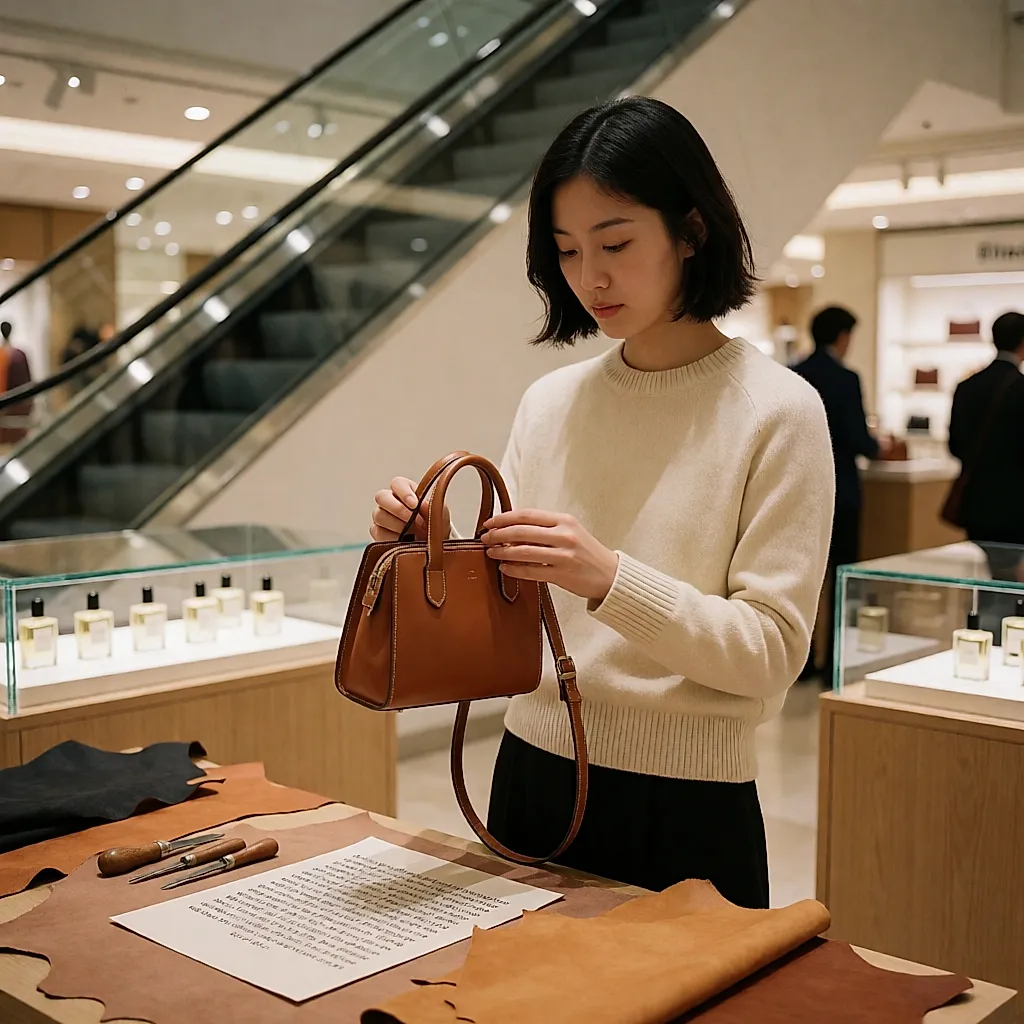
Let's be honest: a pop-up has no room for archives; the pitch often amounts to a good set and three styled pieces, with a photo backdrop that will end up on someone's story. Does that matter? Not necessarily — you get twenty minutes of pretty, no obligation to buy and the sense of having seen something. But don't confuse the emotion of a set with proof of craft: the second is checked by touching, not by looking.
Three signs there's a real point of view, rather than three mannequins in front of a screen: dated, documented captions; a curator or set designer named somewhere; and someone in the shop who can answer you with something other than "It's the new collection."
Budget
Entry to an exhibition staged inside a shop is usually free; for fashion museums, expect closer to £10 to £20 at full price, depending on the show. For the pause that stretches the visit out, a coffee or tea in the adjoining space is around £4 to £7, with a clear gap between London and the rest of the country.
The real budget is the one that comes after: depending on the house and the country, an entry-level accessory — scarf, belt, small leather goods — usually sits between £150 and £400. Which is why it's worth arriving with a precise idea and giving yourself a night to think it over. If the urge is still there when you wake up, it's probably genuine; if it evaporated along with the set, you've just saved yourself a decent sum.
A shop that tells its story well doesn't twist your arm: it lets you walk out with an idea, which is already a lot. So next time you push open a door for the exhibition, look at what you're being told, then ask where the till is. The answer will tell you everything about the place.

Comments
Your opinion matters: rate the article, react and reply to comments.
Comments are moderated; AI-assisted comments are flagged. Text emoticons (8-), :-), <3…) are automatically shown as images.