
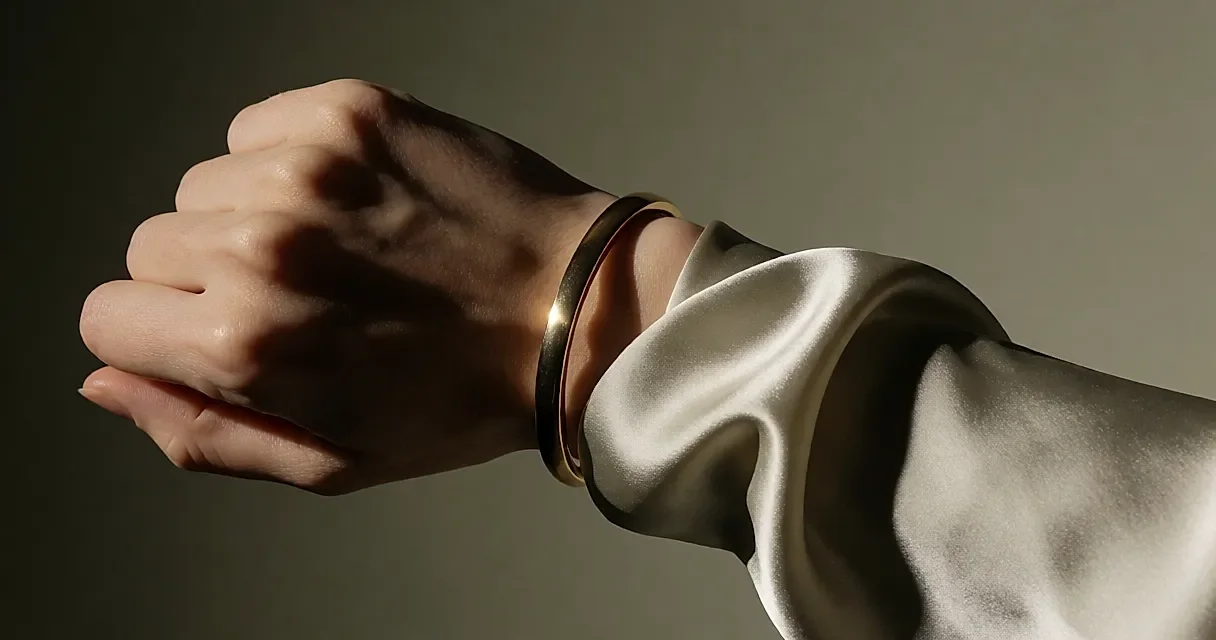
A ring is sized for the finger; a closed bangle is sized for the hand. That is the twist on which the whole piece of jewellery turns, and it is exactly the thing we forget at the moment of ordering. We know our wrist measurement by heart, we recite it to the seller like a password — and the day the parcel opens, the bracelet refuses to clear the knuckles. On or off: with a closed bangle there is no middle ground.
A closed bangle is a single piece, with no clasp and no opening. No links to lengthen, no catch to move. Which makes the question of sizing more straightforward than it looks — and much more interesting.
The wrist, the narrowest point
It is the slimmest part of the arm, so the most flattering to measure, and the most misleading. A 15cm wrist measurement says nothing about the hand that has to take the piece: the bangle has to clear the knuckles at the base of the fingers, where the structure is widest. In practice the gap between the two measurements often runs to a couple of centimetres, and it varies with your build and how supple the joints are.
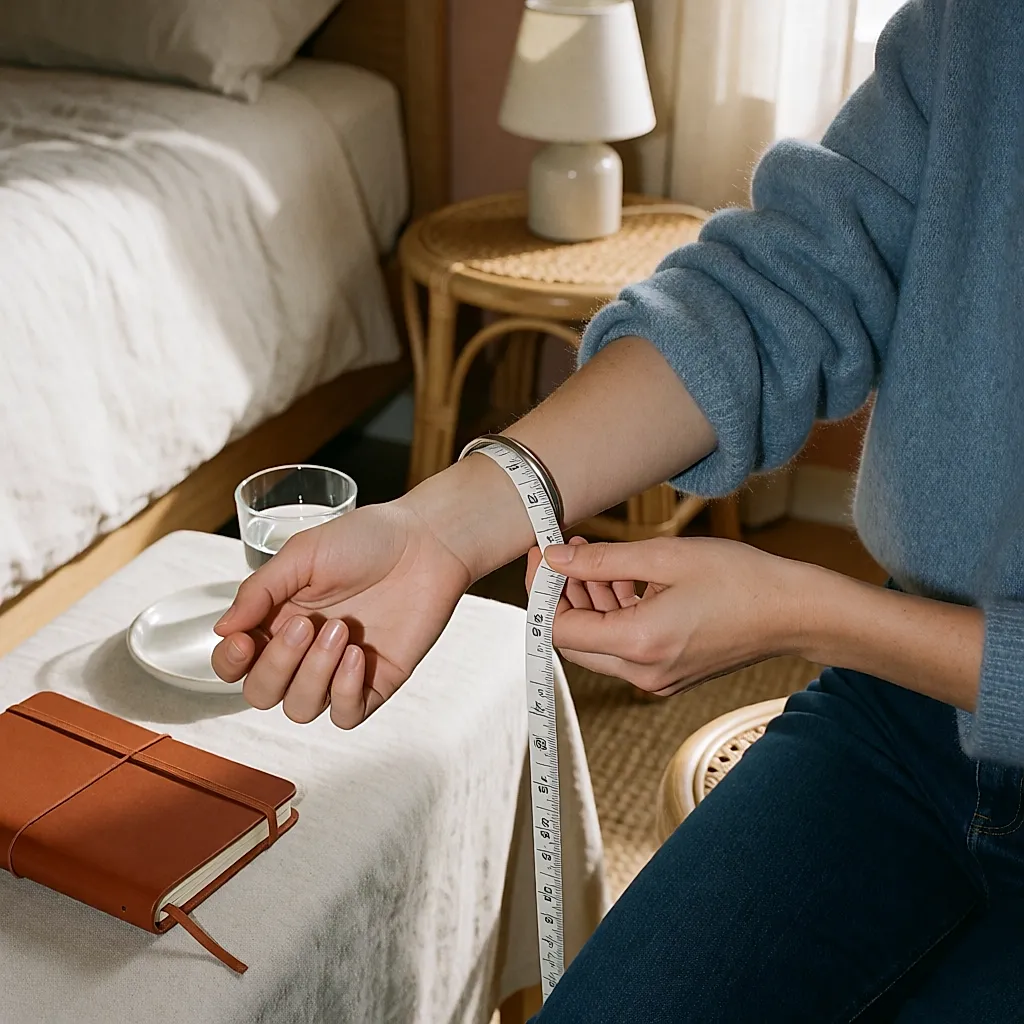
Bottom line: a bangle ordered in your wrist size can turn out impossible to get on, or so loose it spins around like a hoop. And there is no simple fix for that. You have the piece, but not the hand to go with it.
The measurement that actually counts: closed fist
The gesture is simple, but it is easily got wrong. Tuck your thumb into your palm, close your fingers over it as if you were about to grip someone's hand, then run a flexible tape measure around your hand, over the knuckles, at the widest point. The tape should be snug without compressing the skin: if it leaves a mark, you will get a measurement that is too small, and a bangle that is too tight.
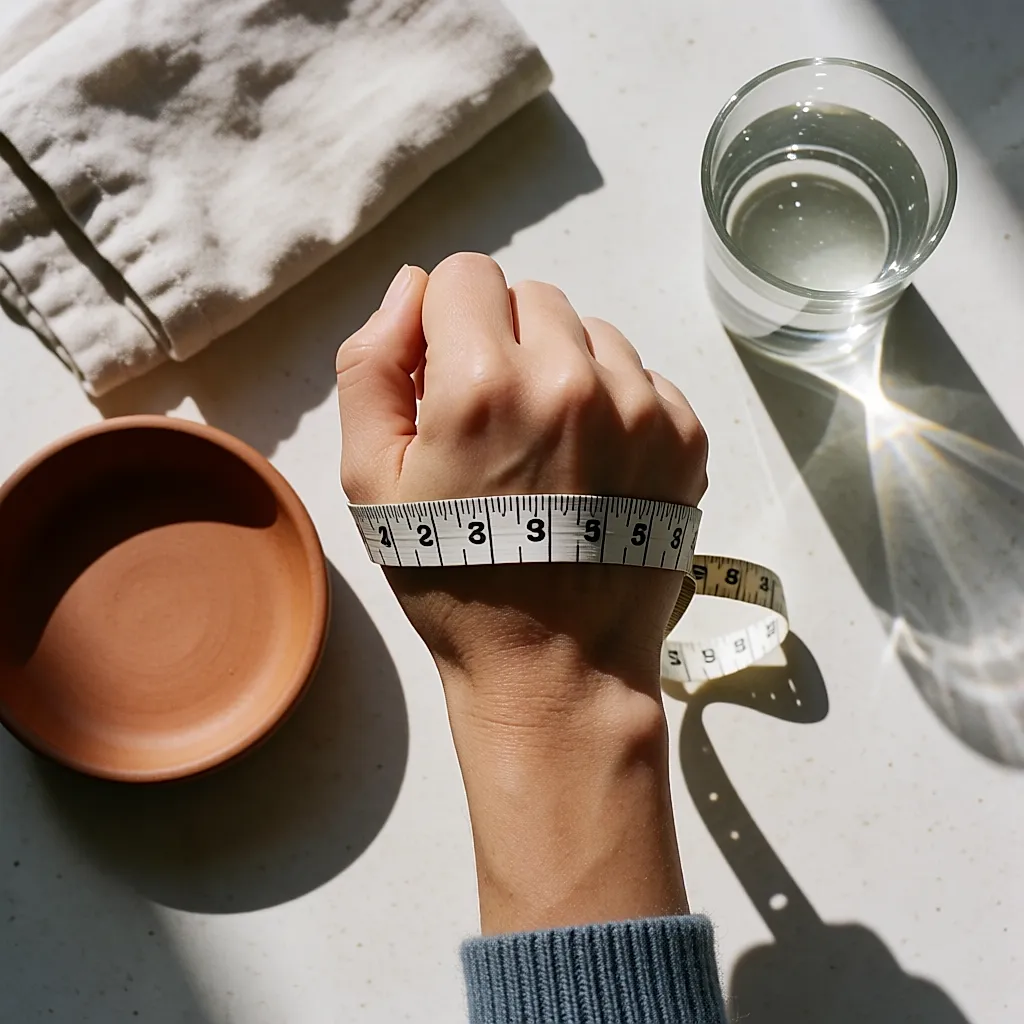
Measure both hands, twice each. The dominant hand is often slightly wider, and a few millimetres can make all the difference. That number is your closed-fist hand measurement — the only figure the bangle has to respect.
The measurement in three steps. (1) Fist closed, thumb tucked into the palm. (2) Flexible tape measure around the hand, over the most prominent knuckles, without pulling tight. (3) Note the number in centimetres and keep a small margin of a few millimetres if you are hesitating between two sizes. A slightly large bangle — worn with a pushed-up sleeve — is better than one you cannot get on.
"One size": the label that keeps everyone happy
On product pages, one size comes back like a reassuring refrain. Except a bangle is never quite one size: from one model to another the inner diameter changes, and sometimes even within the same range. A slim round-wire bangle slips on more easily than a wide flat one of the same diameter, because the surface in contact with the hand is not the same.
Second detail, the shape. A round bangle asks you to pass your hand through a circle; an oval bangle follows the shape of the wrist and goes on with a sideways movement, which is easier — but its measurement is then read as width and length, not a simple diameter. So always ask for the inner diameter in millimetres, from the seller or on the product page. It is the only figure that really compares from one model to another.
Solid silver or plated: what it changes for getting it on
Sterling silver, hallmarked 925, can take an adjustment: a jeweller can sometimes open a bangle by a few millimetres to get it on, then close it again. A job to have done, not to improvise — repeated, it weakens the metal. Gold-plated brass, on the other hand, cannot be adjusted: the coating is thin, and it is exactly where the bangle rubs against the hand that it wears first. Worth knowing if you plan to wear it every day.

Think about the reverse gesture too: a closed bangle goes on in the morning and comes off at night, with no clasp to slide. If it is too tight, that little ritual becomes a daily contortion. Comfort through the day matters as much as the second when the piece finally deigns to clear the knuckles.
Engraving, and the compromised return
This is the online-shopping trap. An engraved bangle is a personalised piece, and personalisation falls within the exceptions to the 14-day right to cancel under the UK's Consumer Contracts Regulations. In other words, if the initials are already in the metal and the size is wrong, a return is not automatic.
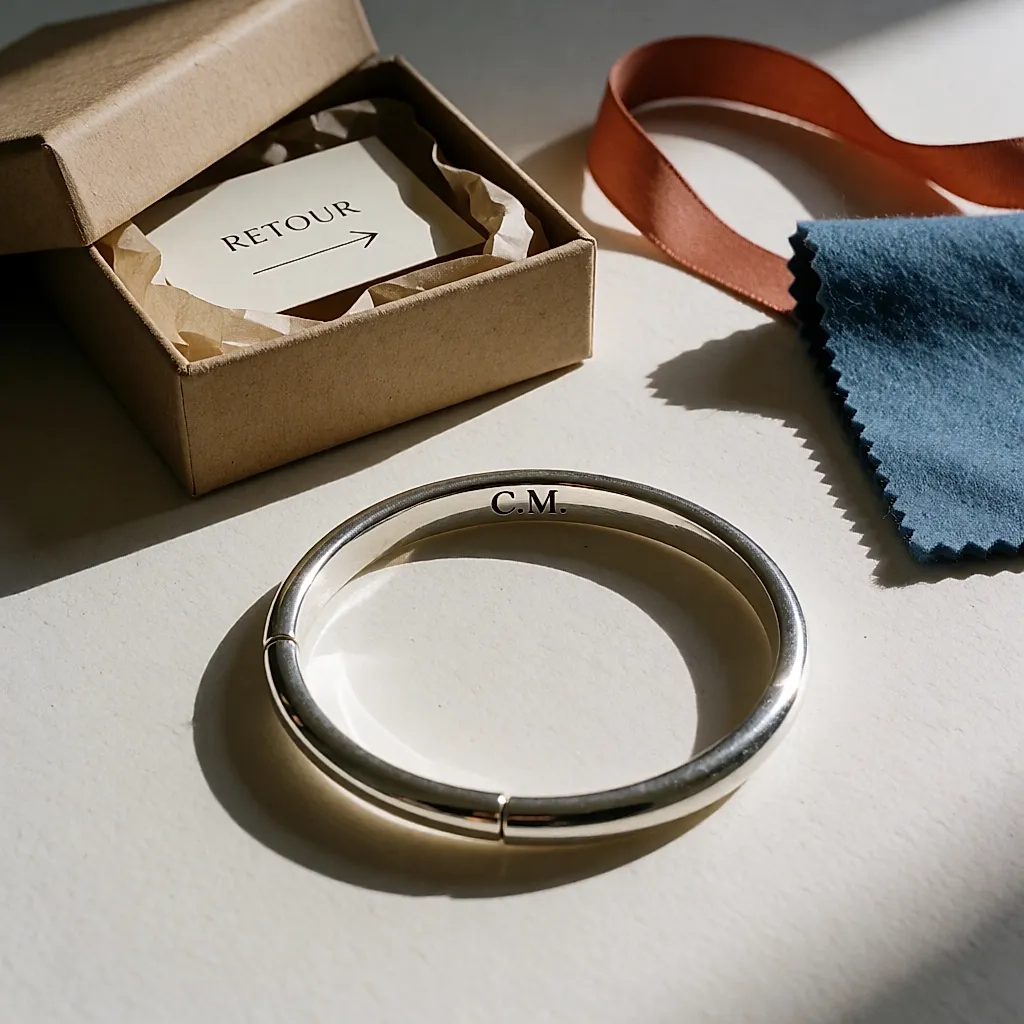
The workaround comes down to three words: try it first. Order the piece without engraving, wear it for a few days, then have it engraved — in-store, at an engraver, or by sending it back to the brand if they offer it. A few days' wait against a piece you do not regret: the maths is easy.
Budget
On price, expect roughly £20 to £50 for a gold-plated brass or plated bangle, £50 to £130 for 925 silver depending on the weight of metal and the fineness of the work, and £130 to £300 from a designer or for a thicker solid bangle. Solid gold, meanwhile, starts much higher. Engraving usually adds £0 to £35, depending on whether it is included, done by hand or by laser. As ever with jewellery, check the current price on the product page.
What moves the total: the weight of silver, the width of the band, whether the piece is welded or not, and where you buy. Costume-jewellery shops, designer workshops, online jewellers, high-street shops: prices are not the same. And for a closed bangle, the chance to try it on in person remains the best selling point — for once, the fitting room is not a luxury.
The number to keep
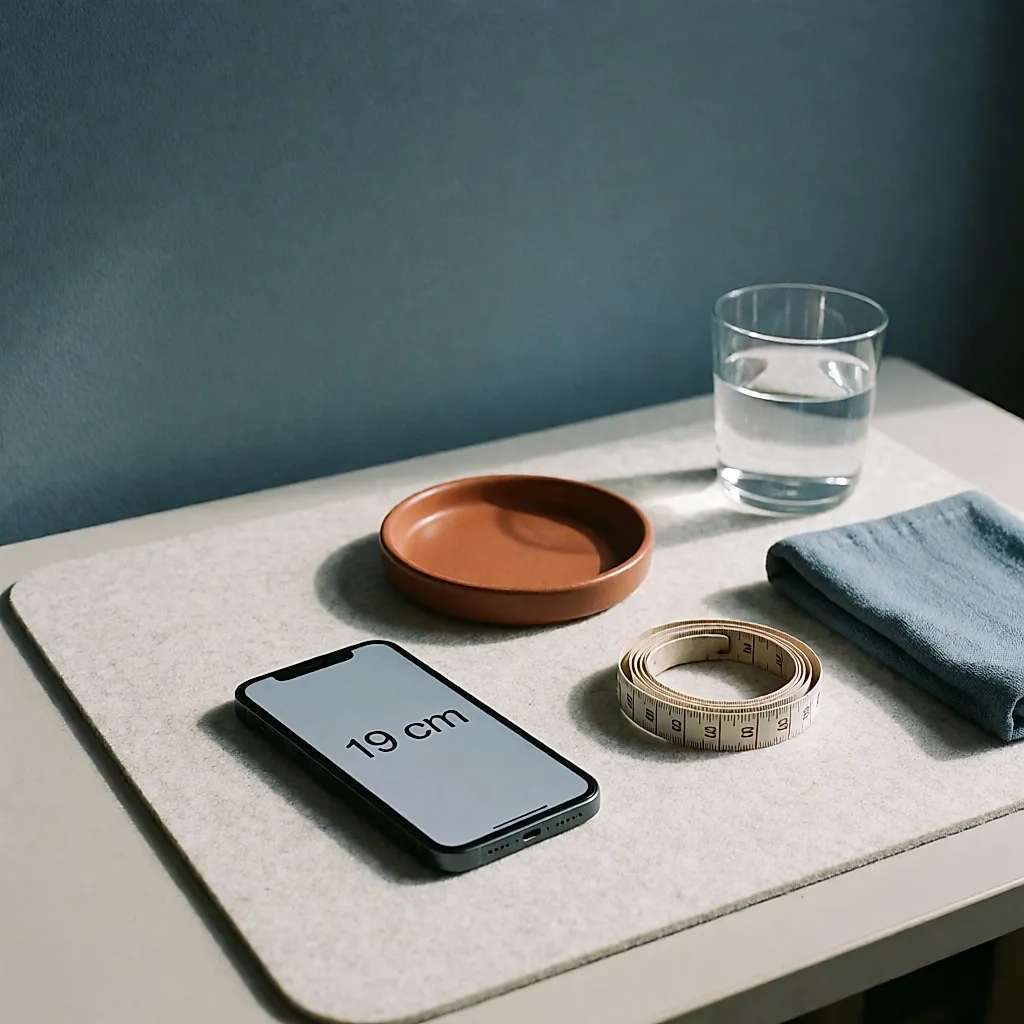
Measure properly once, fist closed, and note the result on your phone. That hand measurement will serve you for every closed bangle of your life, including the one you have not spotted yet. And if you are still torn between two sizes, remember that a slightly large bangle gets worn, while one that is too tight stays in its box — an expensive price to pay for a centimetre of pride.

Comments
Your opinion matters: rate the article, react and reply to comments.
Comments are moderated; AI-assisted comments are flagged. Text emoticons (8-), :-), <3…) are automatically shown as images.