
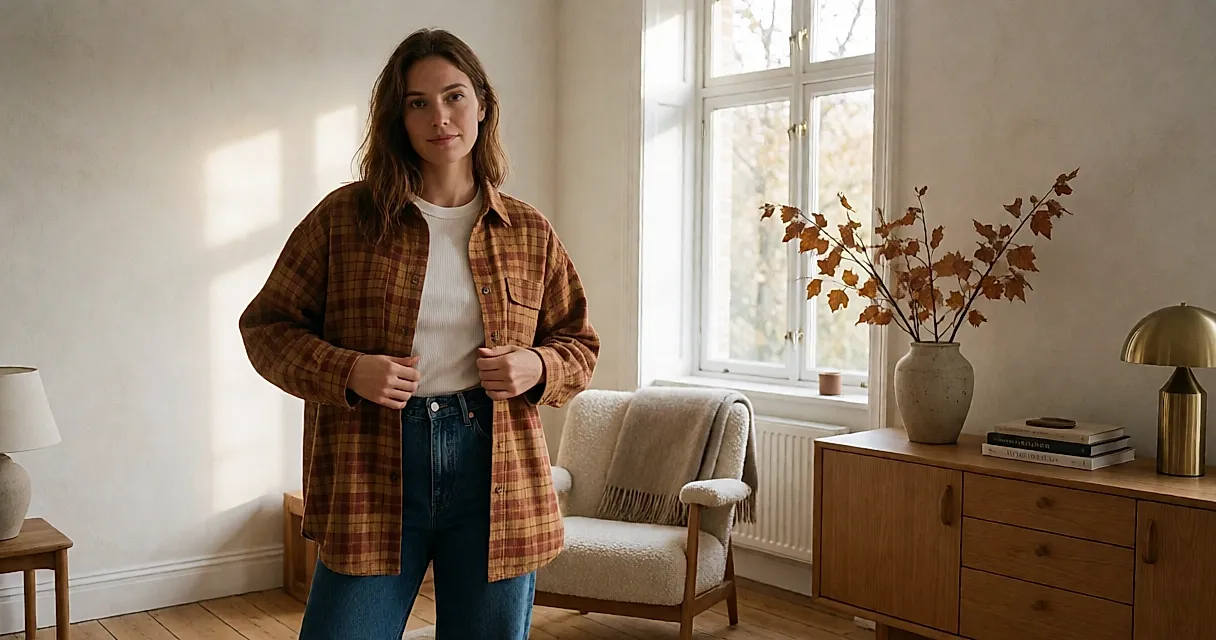
On the rail, two flannel shirts can look like sisters: same check, same collar, same urge to wear one on a Sunday. Pick them up one after the other and the illusion collapses — one has the softness of a sheet, the other the density of a jacket. Between them sits a number hardly anyone reads: the fabric weight.
What fabric weight really tells you
Fabric weight is the weight of the cloth per square metre, given in g/m². It is not the same as how heavy the shirt feels on the hanger: a 180 g/m² shirt in a size 8 will weigh less than the same fabric in a size 16, without a single thread changing. Yet it is this figure that tells you whether you are holding a blouse, a shirt-jacket or a light coat.
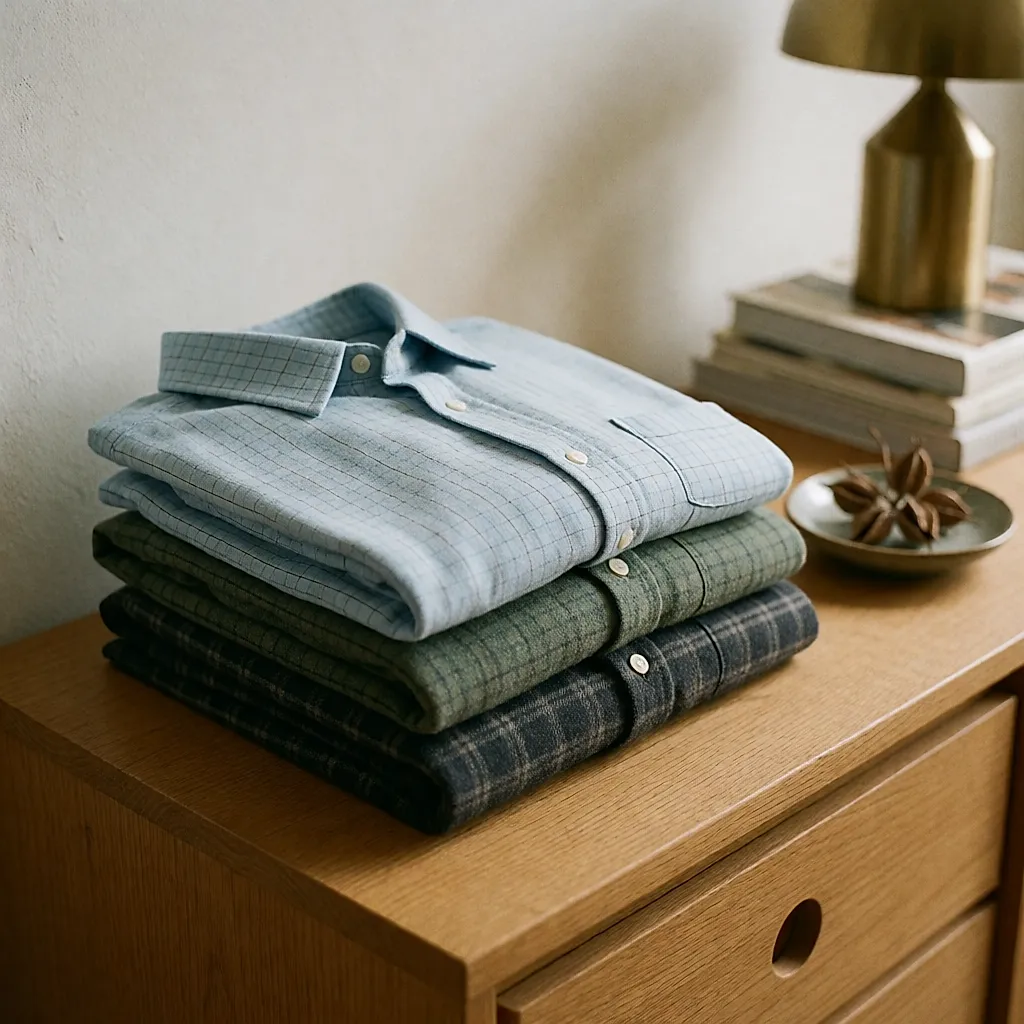
Where do you find it? It is rarely on the composition label, often in the online product listing, and sometimes available if you ask the shop assistant. In practice, flannel tends to run from about 150 to 320 g/m². Below 180, you are in light territory, almost fluid. Between 190 and 250 is the core range, the one that covers a good part of the year. Above that, the shirt changes camp. Can a 180 g/m² shirt take on November? Yes, if you help it a little.
Three checks before you get to the till
First reflex: scrunch it in your hand. A light flannel creases and springs back quickly; a heavy one resists, holds the fold and returns it to you. Then shake it out: it should hang cleanly, without the stiffness of cardboard. An over-finished fabric gives itself away through exactly that stiffness — it will not follow your back.
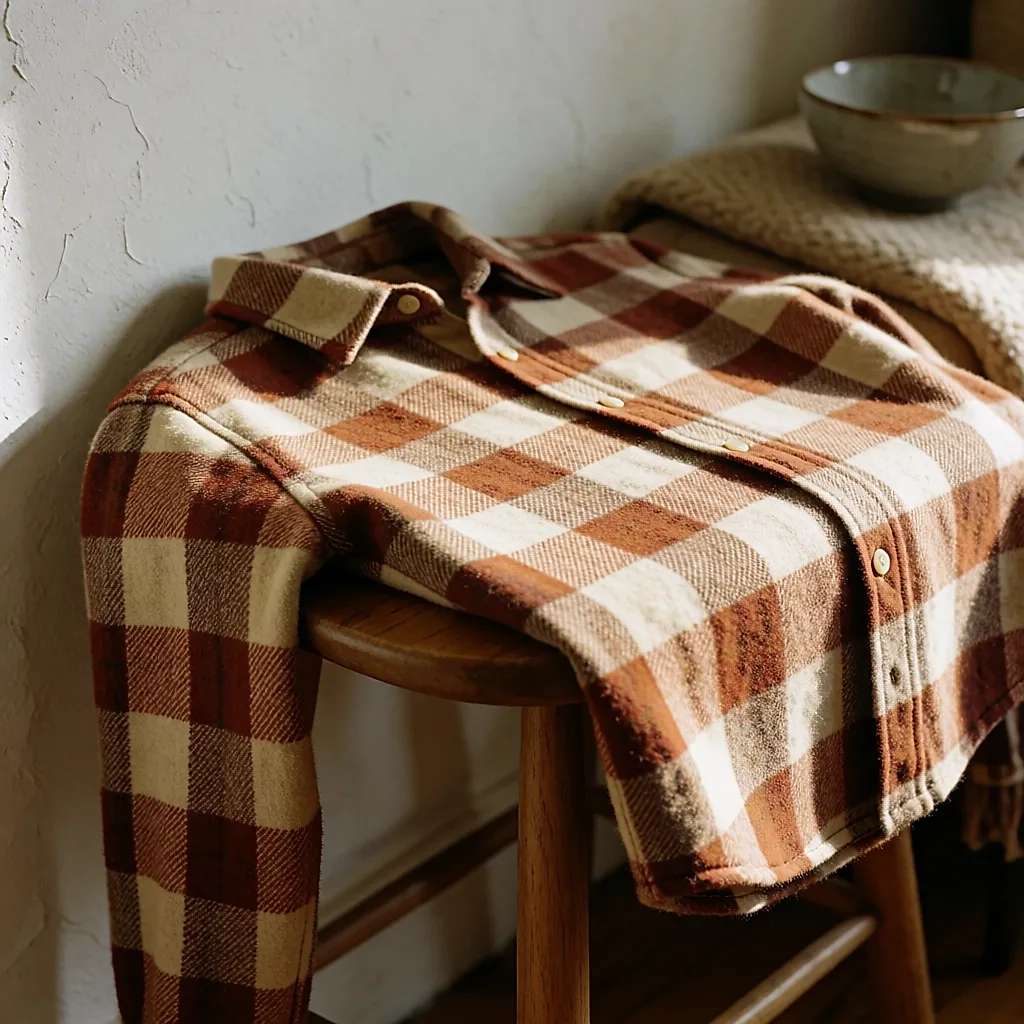
Second: look at it under the shop lights. A double-brushed flannel, brushed on both sides, catches the light in a matte, even way; if you can see daylight through it, be wary of transparency at the armholes. Third: read the composition. Brushed cotton, wool, a mix of the two — and check the share of synthetic fibres, which can sometimes make a piece heavier without making it warmer.
The lightweight one, best for indoors
This is the shirt you throw on over high-waisted jeans, tucked in, sleeves pushed up, and it does all the work. Wear it alone in September, over a vest top in November, or open over a fine knit when the office gets too warm. Its softness moves with you, its drape stays close to the body, and it slips under a jumper without creating bulk at the shoulders.

Its limits? It will not give a silhouette structure, and it does not forgive a slapdash ironing job. If you want a piece that dresses you on its own, this is not it — that is the next one.
The heavy one, which needs a layer underneath
Between 250 and 280 g/m², a flannel shirt becomes an outer layer. Wear it open over a heavyweight tee, over a fine roll-neck, or closed with two layers underneath when the thermostat drops. It holds its shape, hangs straight, and gives that workwear look we like without looking as if you are about to saw logs.
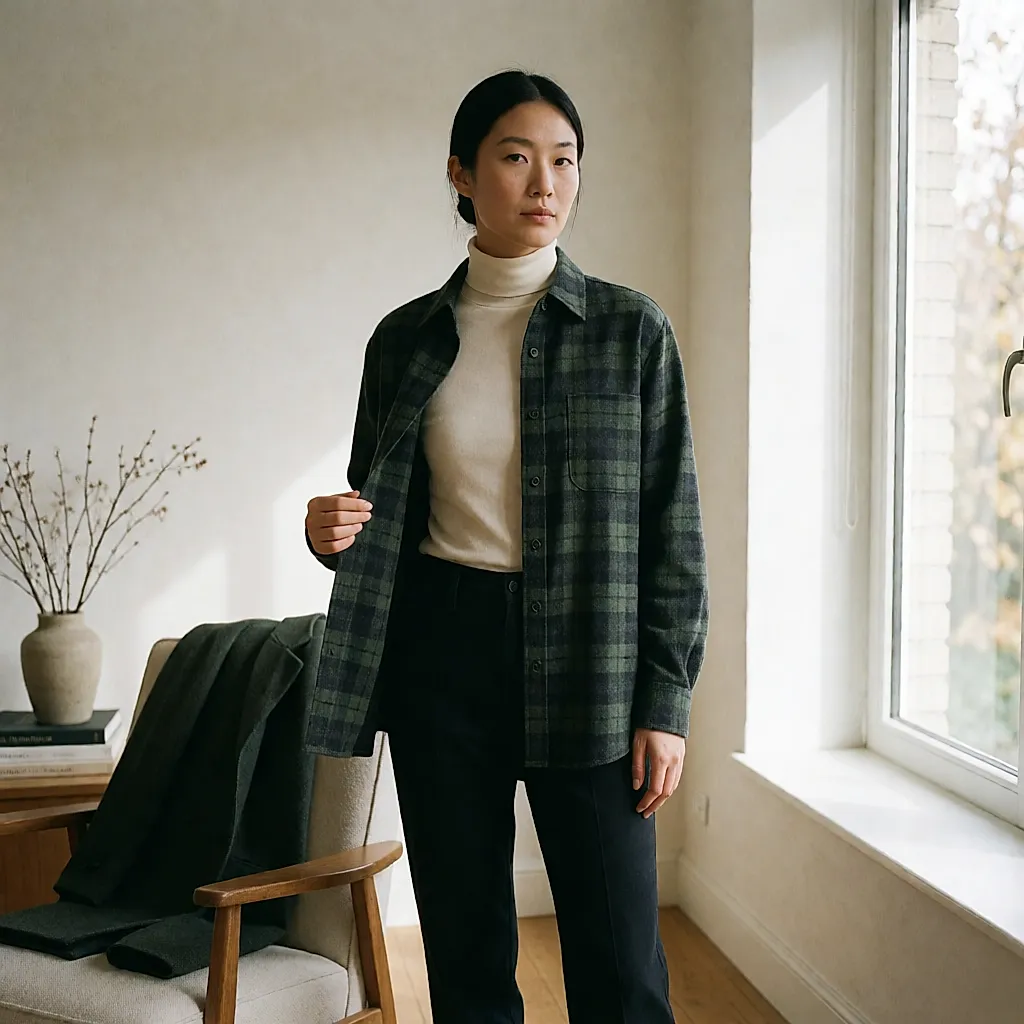
Watch out for stiffness: worn against bare skin straight after purchase, a dense flannel can itch. One or two washes often soften it, but if you want it soft from the start, aim for 200–220 g/m² and save the very heavy one for really cold days.
Budget
Expect to pay roughly £30–£55 for a decent flannel shirt at a supermarket or an accessible high-street chain — the weight often sits around 160–180 g/m², ideal for indoors. At roughly £60–£110, you get denser brushed cottons and more considered cuts, often at 200–250 g/m². Above about £130, you are paying for wool, finishing and the label; check that the weight keeps up, otherwise you are paying for a name.
The smart buy is still charity shops and second-hand: roughly £10–£35 for men's flannels cut oversized, often much heavier than their new equivalents. That is where you find some great outer layers for very little — and where you can afford to wait for the right one.
The 30-second check: weigh it in your hand, scrunch it, hold it up to the light. Light and soft, it will live indoors. Heavy and structured, it needs a layer underneath — and a place in your outerwear.
Flannel is not 'a' piece, it is a family. A 180 g/m² for days when you just want a collar and sleeves; a 280 g/m² for days when you want a look. And in between? The 220 g/m², often the most versatile — the one you wear until it falls apart, which, honestly, can take a while.
Comments
Your opinion matters: rate the article, react and reply to comments.
Comments are moderated; AI-assisted comments are flagged. Text emoticons (8-), :-), <3…) are automatically shown as images.