

The right hairstyle for your face shape
Have you ever wondered why some cuts make you glow while others seem to drag your features down? The mirror doesn't lie: what looks stunning on your friend won't necessarily work for you. And it isn't about luck — it's about proportions.
Round with fuller cheeks, naturally balanced oval, square with a defined jaw, or long: your face has a few features that stand out more than others. Face-shape hairstyling — the technique used by stylists who work with face shapes — starts exactly there to work out what will suit you. A square face will never be styled in the same way as an oval face — and that's a good thing, because it means there's a cut designed with you in mind. So, which hairstyle for which face shape? Let's map out the main guidelines.
Before you start, take five minutes to look at yourself. Hair pulled back, soft tape measure in hand, note four measurements: width of forehead, width of cheekbones, width of jaw, and length from forehead to chin. It's quick to do, and it will give you a reliable basis for talking to your hairdresser!

Oval face: the lucky one
Do you have an oval face? Then you're a lucky one, because this face shape can get away with almost anything. It's the easiest shape to style: naturally balanced in both length and width, with harmonious, soft, fine features. From long to short, it's up to you! Focus above all on a soft, unstructured cut, with volume if possible to highlight the delicacy of your face. Curly mid-length, layered cut, tousled short: the next step is choosing according to your hair type — don't panic, this is the moment to talk honestly with your hairdresser.
If you go short, make sure it's well tapered at the nape. And think about brightening your cut with a few lighter highlights to illuminate your face!
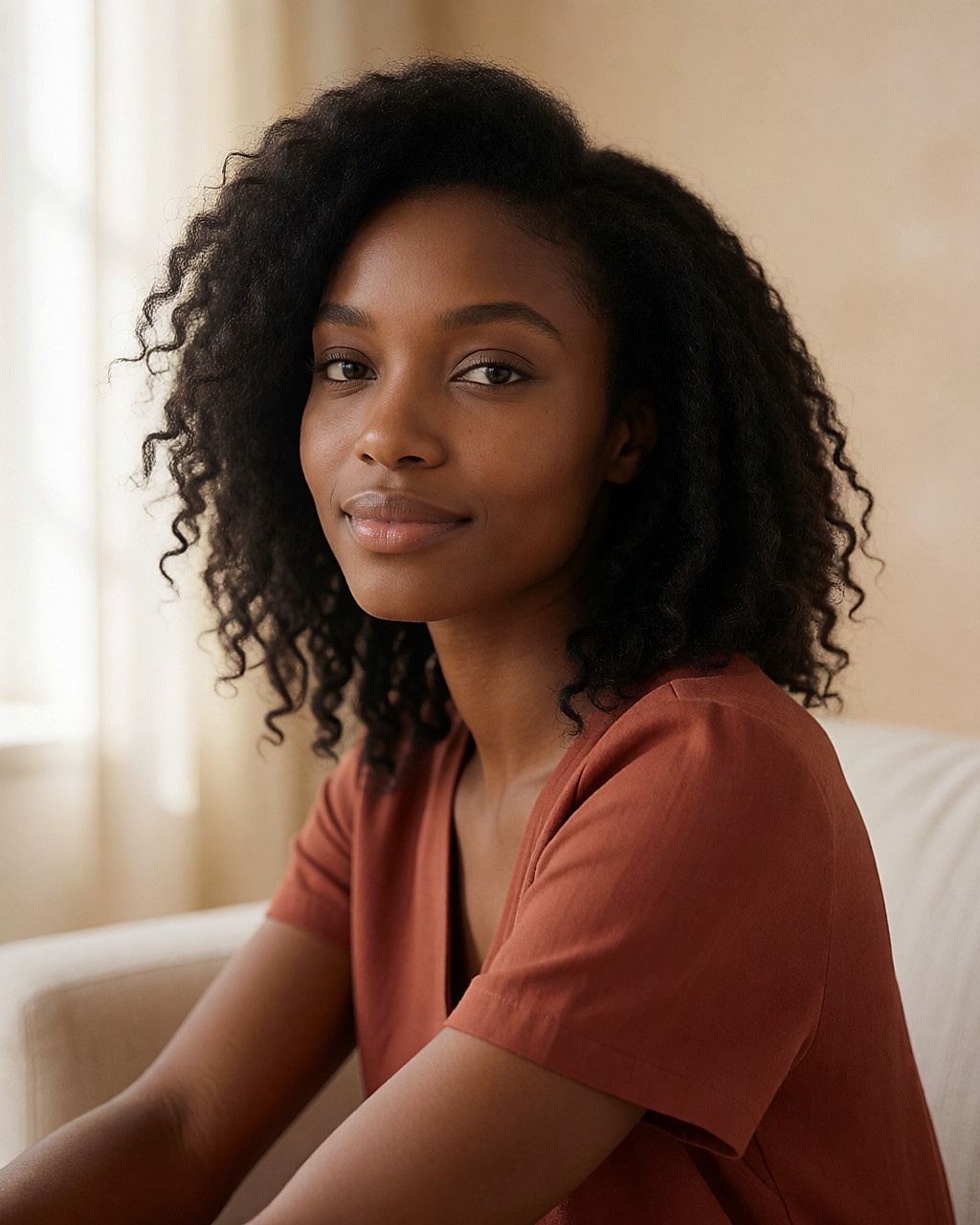
Square face: soften without rounding
Do you have a rather square face shape, a broad forehead and a defined jaw? Go for a structured, square or asymmetric cut, with a clearly drawn parting. The aim isn't to hide, but to balance.
To soften your features, choose volume above the head with layers around the jawline. But above all, avoid rounded shapes — they emphasise the heavier effect — and choose a mid-length cut (below the chin) or long rather than short. An off-centre parting makes a big difference too.

Long face: break up the length
Do you have a rather long face, longer than it is wide? You need to break up the length by rebalancing volume. Forget long, shapeless hair, which would make your face look even longer, and very short styles, which would shorten it abruptly: go for something in between.
Go for a mid-length style with volume — layers are ideal for that. A long bob with a low fringe, for example, would look lovely on you! A fringe has the advantage of rebalancing long faces while giving your hair a considered touch, but be aware that it needs regular trims and daily styling if your hair isn't naturally straight.

Round face: all softness
Is your face round? Soft and rounded, round faces have fuller cheeks, a small chin and a small forehead. To avoid emphasising the roundness, choose a cut whose length goes past the chin.
Generally, what suits you best are long or mid-length cuts with layers, graduated or not, that frame the face. If you fancy a short cut, curl your hair rather than straighten it! Avoid, on the other hand, a centre parting, bouffant styles and a blunt bob.

Texture matters as much as shape
One last word, and not a minor one: no cut really holds without a bit of styling. We can never say it enough — your hair texture matters as much as your face shape, and it's often what decides everything.
On the product side, we're looking for the desired effect: a texturising spray for movement, a volume powder at the roots, a light serum on the lengths. Where possible, favour glass or refillable containers, and formulas with naturally derived active ingredients — to avoid weighing down either your budget or your hair.

No cut makes up for misunderstood texture: very fine hair can't take the same layers as thick hair, and tight curls aren't styled like loose waves. Talk to your hairdresser before you commit — that's the first question to ask, even before showing the photo you saved from social media.
Budget
On price, expect around £25 to £45 for a cut alone in a local salon, and more like £60 to £120 with a face-shape specialist or in a high-end salon, including a blow-dry depending on the salon. The price varies with the city, hair length, styling time, and whether shampooing is included or not. The simplest thing is to ask for a quote when you book, or to check with a hairdressing college, where cuts are often offered at reduced prices.
For products, a texturising spray or volume powder from a pharmacy or online usually sits at around £10 to £25, depending on the size and formula. It's up to you to decide what matters most: the result, or the container you keep for longer.
Let's be honest: the perfect cut — the one that suits you and holds — often takes two or three tries to get right. So be patient, ask your hairdresser the right questions, and let yourself be guided — your face already knows what suits it!


Comments
Your opinion matters: rate the article, react and reply to comments.
Comments are moderated; AI-assisted comments are flagged. Text emoticons (8-), :-), <3…) are automatically shown as images.