
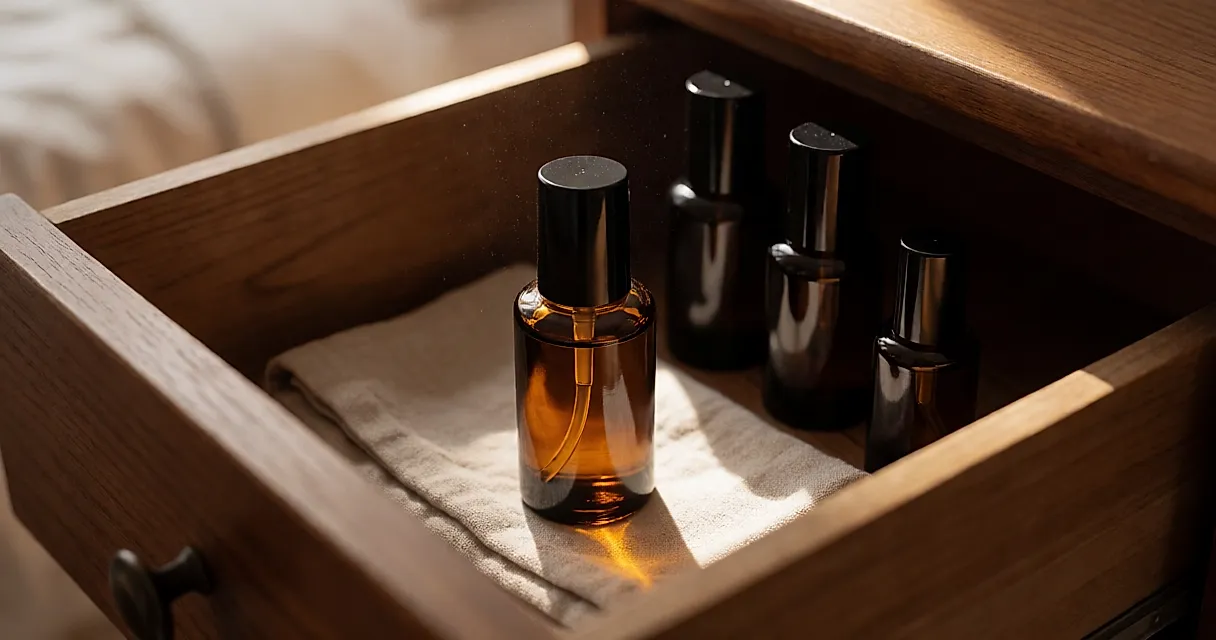
A half-empty serum bottle, a whiff of rancid oil, and that small grimace when you realise you've missed the boat. Last Sunday, while clearing out the bathroom drawer, we pulled out three like that—all bought with the best intentions and stored wherever. The real question isn't how they ended up there (we know: one tired evening, we packed the whole routine away in three moves). It's where and how they should have been kept to last the course.
The drawer wins, but not just any drawer
Let's be honest: between the shelf above the radiator and a closed drawer, there's no contest. Light isn't a formula's best friend, and a bathroom that steams up twice a day doesn't help keep a bottle fresh. A drawer is still the right instinct, away from light and heat. The question is which one—because the bathroom drawer, warm and damp, isn't the ideal hiding place you might imagine.

Which is why the simple solution is to move them. A bedroom drawer, an opaque box on the chest of drawers, and you're sorted. Why make life complicated with a dedicated storage case when a cardboard box or a wooden drawer does the job perfectly? No need for a specialist case: the real luxury is dark and dry, and it costs nothing.
The original box is a surprisingly handy little record
We often throw away the cardboard outer box thinking it serves no purpose. That's a mistake—not always, but often. It lists the ingredients, sometimes the manufacturing date, and above all the famous PAO (period after opening), shown as the little open jar with 6M or 12M inside. This symbol isn't a marketing device: PAO shows how long a product can be used after first opening, a labelling convention. So long live the cardboard box—at least until you've copied down what you need!

Keep it until the essentials are copied down—or photographed on your phone, which takes three seconds and gets lost far less easily. Amber or opaque bottles protect against light. With clear containers, the outer box can help; with clear tubes and plastic jars, the cardboard matters most. And for products you keep for a while before opening, the box remains the best reminder.
The fridge is useful, but not for your whole collection
There's a scene social media adores: the mini beauty fridge, neatly lined up and labelled, next to the yoghurts. In real life, the kitchen fridge is already overflowing with Tuesday's leftovers, and giving over a whole shelf to cosmetics is a luxury few kitchens can afford. More importantly, it isn't useful for everyone. So what should be kept cold, and why?

What benefits from being kept cold: formulas with oxygen-sensitive actives, such as certain vitamin C serums known to age badly in air and light, some botanical oils that go rancid quickly, and products where the brand explicitly mentions refrigeration on the packaging. What doesn't: thick balms and butters that set, textures that separate at the slightest change of temperature, and all the products you take out and put back ten times a day—the warm-cold back-and-forth doesn't help much. If in doubt, read the label: when the manufacturer recommends refrigeration, they say so.
Three signs, no hesitation
Smell is often the first indicator, and the most telling: a bottle that smells of rancid oil or wax crayon has had its day, even if the label still shows a reassuring date. Colour is next—a clear serum that has turned yellow, then brown, hasn't gained character. Texture last: an emulsion that separates, a gel that stings when it didn't before, a product that turns grainy. Those three often say more than a date.

The felt-tip trick: when you first open a product, write the date straight on the label. A few months later, you'll know exactly where you stand—and you won't have to play archaeologist in the bathroom drawer.
To sum up without turning it into a lecture: a bedroom drawer, the original box for as long as it's useful, the fridge only for formulas that can take it, and a little method with labels. The result: a saner routine and a drawer that stops looking like a graveyard of good intentions. The one gesture left, when you only have five minutes on a Sunday evening: a felt-tip pen on the label—and a quick look at what you already own before buying the next one.


Comments
Your opinion matters: rate the article, react and reply to comments.
Comments are moderated; AI-assisted comments are flagged. Text emoticons (8-), :-), <3…) are automatically shown as images.