
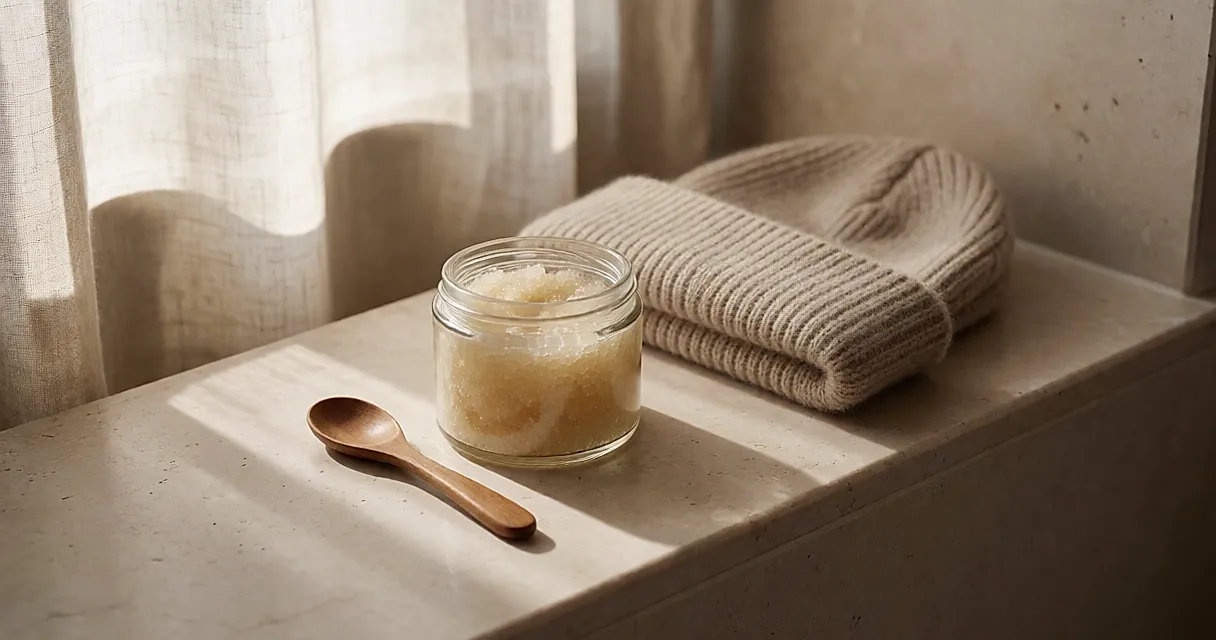
The first hat of the season always feels like a reunion. You dig it out of the drawer, pull it on, and by 6pm the parting itches. Wool gets a bad rap — but under the knit there's skin, and nobody offers it a fraction of what they'd lavish on their face. So why not deal with it before the season starts, rather than in February when everything already itches?
The skin on your head is still skin
It produces sebum, sheds cells and holds on to whatever you put on it: dry shampoo, hairspray, leftover conditioner, sweat from under a hat. Yet we treat it like a rug — a bit of lather, a quick brush, move along. Your face, meanwhile, gets textures, massages, careful handling and Sunday-night appointments.

So the logic holds up: the skin on your head is skin, deserving the same care in smaller doses. A fine grain for a scalp that reacts quickly, a coarser one when it produces plenty of sebum — but always a reasonable grain, because a scrub that scrapes isn't a more effective scrub.
What it won't do: regrow hair, sort out dandruff, or stand in for proper advice if it's been itching for weeks. Best to say that before we get to the how-to.
How often, and how much
This is where the transfer usually goes wrong. With your face, you've learned to space things out; with your scalp, you assume you should go hard. In practice, once a week to once a fortnight usually covers it — and closer to twice a month if your scalp feels tight or prickles. That's a rule of thumb, not a prescription: only you know what your head can take.
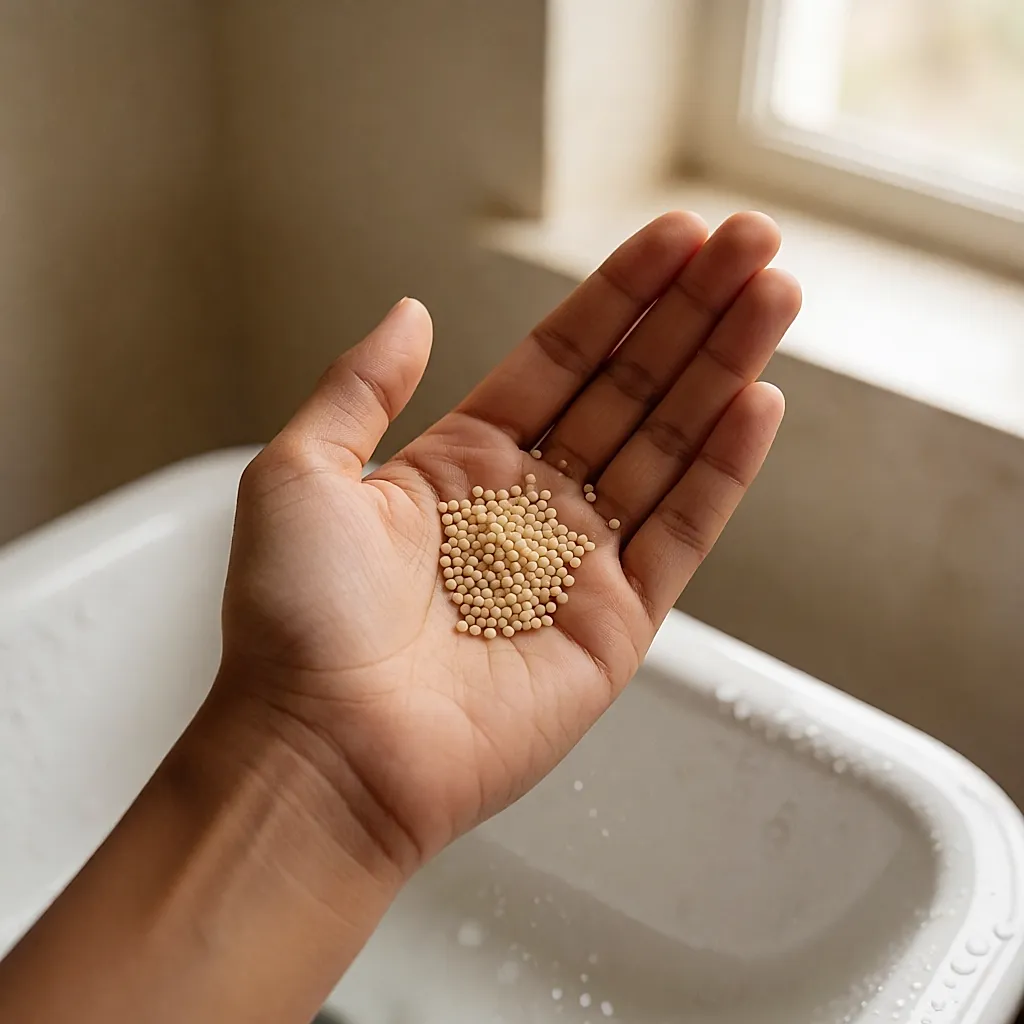
On quantity: a small amount, not a slab of butter. The work happens in your palms, not in the pot: if the product is running through your fingers and down your temples, you've used far too much. And if it stings, that's not proof it's working — it may simply be irritation.
The right moment is October — and a quiet evening
Two moments overlap here. The seasonal one: now, before hats, central heating and turned-up collars settle in for five months. The routine one: before shampooing, on damp hair or a dry scalp depending on the formula, a light massage in small circles, a thorough rinse, then wash — the order matters.
Then there's the time of day. Pick an evening when nobody is waiting for you: Sunday, rain on the window, a face mask on and a scrub on your scalp. Avoid doing it right before you head out bare-headed, though, and ask your stylist if you've just had colour or a smoothing treatment — that's not the day to improvise.
What to budget
Expect to pay roughly £8 to £20 for a basic sugar or salt scrub from a chemist or high-street beauty retailer, £20 to £35 for a natural formula from a beauty retailer or online — often in a glass jar, sometimes in a refill — and £40 to £70 in a salon when the scrub comes with a scalp massage and a consultation. City, size and brand all move the price, so treat those as a guide rather than a quote.
What matters on the ingredients list: plant or mineral grains (sugar, fine salt, clay, ground kernels) rather than plastic microbeads, a foaming or oil-based base depending on your scalp, and packaging that's recyclable or refillable. A label such as Cosmos Organic tells you what the formula leaves out, not how well it works. Kitchen version: a spoonful of fine sugar in a plant oil for a few pence, rinsed for a long time — and best avoided if your scalp is already irritated. The jar itself will last months, which is no bad thing.
The whole thing takes a few minutes. A small amount in your palm, small circles with your fingertips without digging in, extra attention behind the ears and at the nape, a thorough rinse, then shampoo. If it burns, feels tight, or there are patches or crusts, stop, rinse with lukewarm water, and speak to a healthcare professional if it persists.
There's no grand night for your scalp. There's a Sunday, a jar on the edge of the bath, a light massage, and a hat you pull on afterwards without wondering what it's hiding. And if you've only got five minutes? A rinse with lukewarm water, a clean hat, and a promise not to leave it until next February.



Comments
Your opinion matters: rate the article, react and reply to comments.
Comments are moderated; AI-assisted comments are flagged. Text emoticons (8-), :-), <3…) are automatically shown as images.