

Photorejuvenation for a clearer, more even-looking complexion
A brown patch that settles on your cheekbone after a couple of summers of being carefree with sunscreen, redness that creeps across your cheeks without warning: that's often when you first hear about photorejuvenation. I haven't tried it myself — it's a medical procedure, not something you DIY between appointments — so I'll clear the ground using reliable sources, without selling you a dream.
The principle, clearly explained
Photorejuvenation delivers intense pulsed light (IPL) into the skin or, depending on the device, a fractional laser. The mechanism is simple: this light is absorbed by two targets naturally present in the skin — melanin in the epidermis, which gives brown patches their colour, and haemoglobin in the blood vessels of the dermis, responsible for redness and visible small vessels. A bit like a magnet that only attracts certain particles: the light chooses its targets.

The absorbed energy turns into heat and aims to destroy the lesion selectively, while limiting damage to the healthy tissue around it — though it does not guarantee that side effects won't happen. Like any medical procedure, it can cause redness, swelling, scabbing, pigmentation changes or burns, and it is up to the practitioner to assess the risks. Deeper down, heating the dermis is probably involved in stimulating collagen and elastin production, the two fibres that give skin its elasticity and density — although the response depends on the device, the settings and your skin. This is what is put forward to explain an effect broader than simply treating pigmentation: a possible boost to the quality of your complexion and skin texture, to be confirmed case by case.
What it may help improve
The technique is often mentioned for pigmentation linked to sun exposure and ageing, but its effectiveness depends on the indication, the device and your skin. Face, décolletage, hands, shoulders: areas often exposed can be treated, after medical advice. In other words, it's the places life has exposed most that tend to carry the highest hopes.

For redness, it is sometimes used for diffuse erythema and telangiectasia, often linked to rosacea, but results vary from one skin to another. Scars, especially acne marks, and stretch marks are also sometimes mentioned as indications, with inconsistent benefits and to be assessed with a dermatologist. On acne-prone skin, it may improve the look of pores and texture, though this is not guaranteed.
Let's be clear, though: it doesn't erase everything. Nor is it a tattoo-removal technique: treating a tattoo requires specific lasers suited to the ink colour. And it's not a facelift — it can tone and smooth, but it won't lift sagging facial contours. Better to know that before committing.
What happens in practice
First point, non-negotiable: it's a medical procedure, carried out by a dermatologist trained in the technique. Not a session with a beauty therapist using a device that's supposed to fix everything — you don't play with light that heats the skin as if it were a salon lamp.

In the clinic, the skin is cleansed, your eyes protected with goggles, then a gel is applied to buffer the heat. The practitioner moves the handpiece over the chosen areas. The sensation? A prickling with each pulse, followed by warmth — uncomfortable, rarely painful. Nothing unbearable, but you're not there for a spa treatment either.
The number of sessions and the gaps between them are decided case by case: they vary according to the device, the indication, your skin type and the practitioner's advice. Follow-up with before-and-after photos helps to see objectively what has actually changed.
Tanned or darker skin: do not go ahead. The risk is burning and depigmentation — white patches that can sometimes be permanent on darker skin. Photorejuvenation is generally reserved for light to medium skin, with no recent sun exposure, and always after advice from a practitioner.
After the session: the step that changes everything
A few hours of redness is normal. Treated patches first look darker for a few days, then gradually lighten. Small scabs may form: don't touch them, they fall off on their own. So patience — the result won't be visible the next morning.
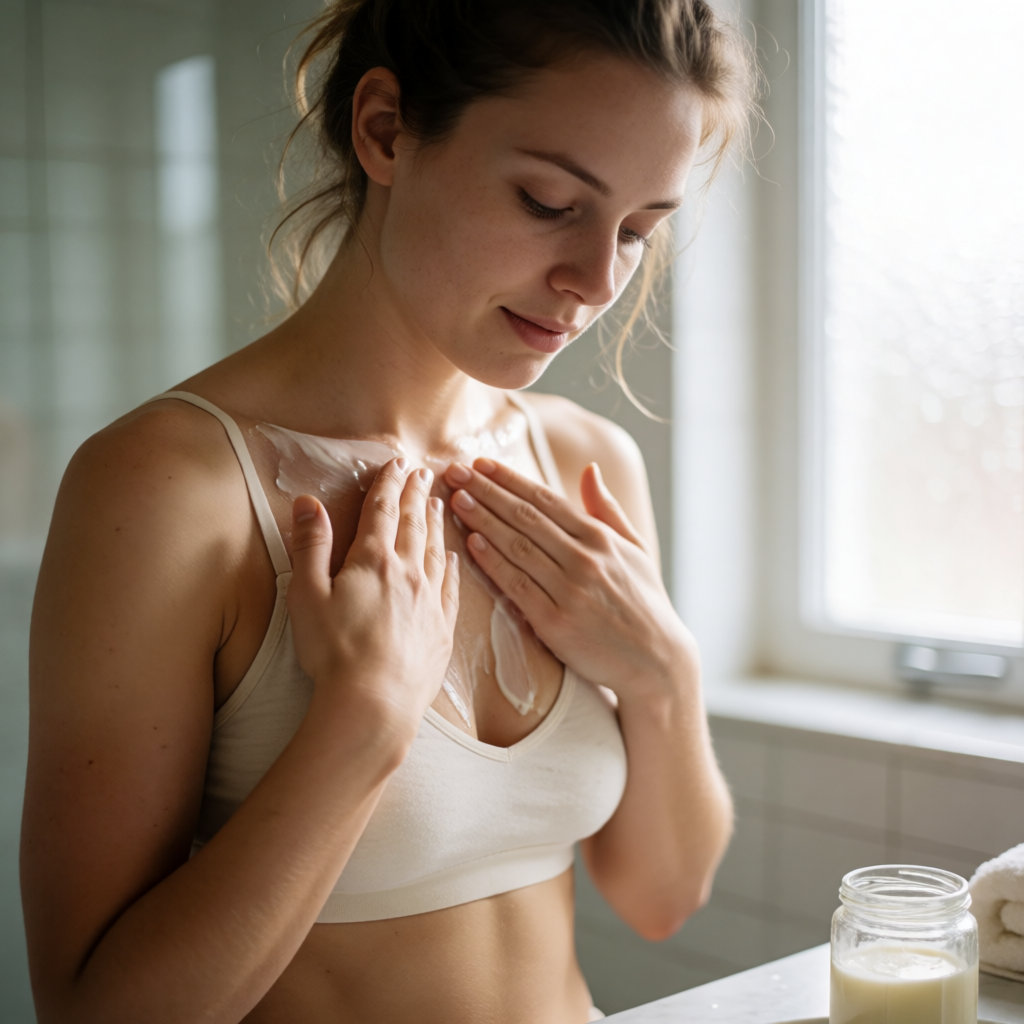
The step that changes everything is photoprotection: a high-factor sunscreen, every morning on the treated areas, for as long as the practitioner recommends. It isn't a guarantee on its own, but it reduces the risk of patches worsening or returning, and it's part of post-procedure advice. A fragrance-free reparative cream, often prescribed for a few days, soothes the skin and supports healing. In terms of formulation, look for a simple texture, few active ingredients, a pump bottle or refillable container rather than a jar you dip fingers into: your more fragile skin doesn't need ten ingredients.
Budget
In the UK, private prices vary widely. As a rough guide, a session for a limited area (cheeks, hands) may start from around £150, while full-face treatment often starts from around £300. A package covering face, neck and décolletage can easily cost more. These prices depend on the practitioner, city, device and number of sessions planned — several appointments are often needed, with no promise of results. So budget generously, and always ask for a clear written quote: there is no single standard price.
Where to get it: at a dermatology clinic or a cosmetic medicine centre. It isn't available in beauty halls or pharmacies. At-home IPL devices (often £100–£500) exist, but their energy is far lower than a medical device: they are not an equivalent, just a maintenance compromise. Photorejuvenation itself is best considered in winter, when the sun is scarce and you can protect your skin without missing out on much. As for your skin? A more even complexion, yes, often — a magic wand, no, never. The real luxury in all this is taking the time to talk it through with a professional before starting.
Sources
- British Association of Dermatologists (BAD) — bad.org.uk, accessed 2026.
- NHS — Conditions and treatments, accessed 2026.
- Medicines and Healthcare products Regulatory Agency (MHRA) — Medical device safety and regulation, accessed 2026.


Comments
Your opinion matters: rate the article, react and reply to comments.
Comments are moderated; AI-assisted comments are flagged. Text emoticons (8-), :-), <3…) are automatically shown as images.