
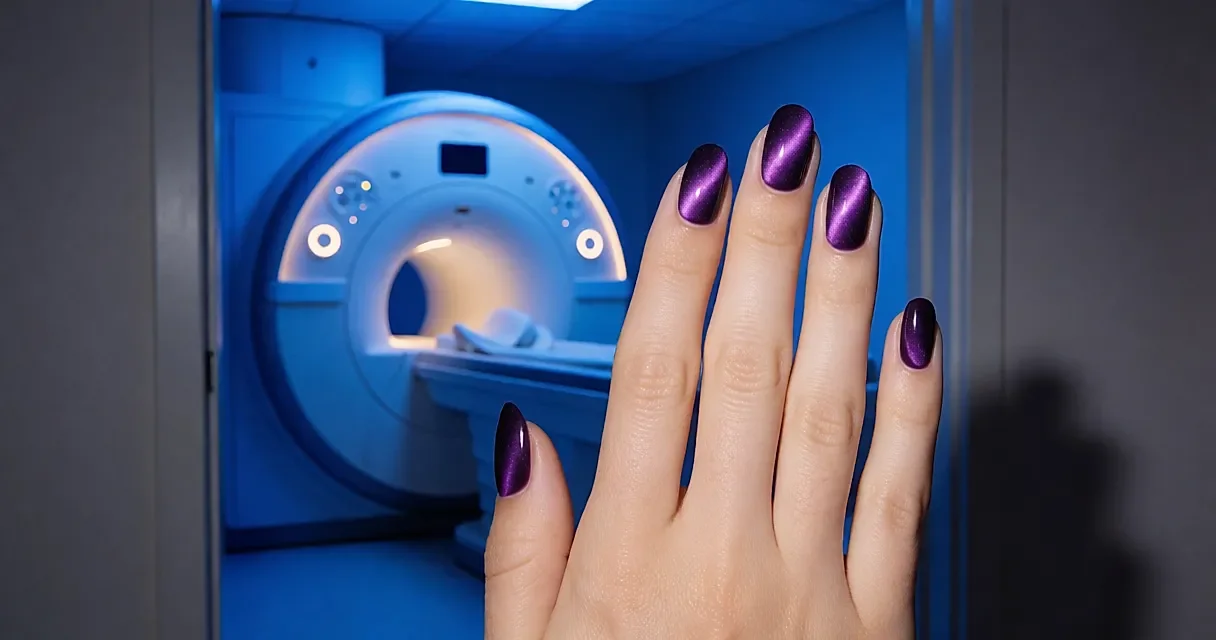
Regular nail polish plays with pigments; magnetic polish plays with iron filings. That distinction lives in the bottle, and it doesn't stay confined to your fingertips. Because the day you have an MRI, that little ridge that makes cat-eye polish so lovely becomes a detail you'd rather have removed.
Welcome to the club of beauty products that travel further than expected: magnetic polish is born on your nails and ends up on the safety forms at a radiology department. Nobody warned you, and it's not a big deal — as long as you know before you walk into the scanner room.
The ridge comes from a magnet, not a brush
The principle is simple, and that's what makes it so nice to look at. You apply a base coat, a layer of polish, then hold a magnet near the edge of the nail before the film dries. The metallic particles in the formula line up, freeze into place, and that line becomes the famous shimmer that shifts as you turn your hand — the cat-eye effect.

Nothing supernatural about it: metallic pigments, often iron-oxide based, and a magnetic field that lines them up. Note too that these particles don't wander around your body: they stay in the polish film, which is also why removing it is enough.
The technique itself takes a steady hand. Base, magnet, set: if you pull away too soon, the shimmer smears; too late, the polish has set and the line won't take. It's the sort of detail that explains why some DIY manis look like abstract art.
On MRI day, take it off and speak up
An MRI is a giant magnet, and its field doesn't stop at the door of the scanner room. Hence the common-sense rule: magnetic nail polish should be removed before the scan, and you should tell the department you were wearing it — or that you have gel or semi-permanent nails with a metallic effect. The gesture costs one cotton pad and a few minutes; the opposite wastes an appointment slot for everyone.

In practice, plan to remove it the night before: it's easier than doing it in the car, a soaked cotton pad balanced on your knee. And if your nails are gel, tell them when you book, because removal takes time and equipment — a radiology department is not a nail salon.
Does that mean giving up cat-eye? No, you just need to know how to take it off. I won't claim every department asks for the same thing: protocols vary, teams assess case by case, and some formulas are considered safe. What I do know is that the question now comes up — so you tell them, you take it off, and you don't make the call on the radiographer's behalf.
Before an MRI, the three-step reflex: remove magnetic polish (same for metallic gel, chrome effect or metallic foil); tell the department about any cosmetic containing metallic particles; ask them what to do if in doubt. It's not for you to decide whether the scan can go ahead: the department decides, not the bottle.
Classic, gel, magnetic: know what's on your nails
Regular polish contains pigments and solvents; it has no particular reason to react to a magnetic field. Magnetic polish owes its shimmer to its metal content — and once applied, it looks like any other polish. That's the trap: a cat-eye that has lost its ridge doesn't stand out at a glance.

At a salon the question is the same, with a time twist. Magnetic gels and metallic semi-permanents have to be soaked off, not wiped away with a cotton pad. In other words, a gel manicure done on Saturday for a wedding isn't incompatible with an MRI on Tuesday — but you need to plan the removal, not discover it in the radiographer's chair. Same goes for chrome effects and metallic foils: when in doubt, treat them like cat-eye.
Budget
Magnetic polish is everywhere, which is good news if you're curious: expect to pay around £10 to £20 at a beauty retailer, supermarket or online for a bottle with its magnet. DIY gel kits, complete with lamp, climb higher — you don't take that on for a single weekend.
At a salon, expect around £40 to £60 depending on the city and the length for a magnetic gel set, and £15 to £25 for removal on average. On ingredients, look for formulas without toluene or formaldehyde, a glass bottle and a refill where one exists. On this particular point, no 'organic' label will get you out of removing your polish before the scan: the whole point of magnetic polish is its metal content. That's the trade-off, and it's worth knowing.
The one thing left to do, when you've got five minutes and no time for detail: get out the remover, put on the cotton pad, and ring the department to let them know. The shimmer can wait — your cat-eye will still be there for you.



Comments
Your opinion matters: rate the article, react and reply to comments.
Comments are moderated; AI-assisted comments are flagged. Text emoticons (8-), :-), <3…) are automatically shown as images.