
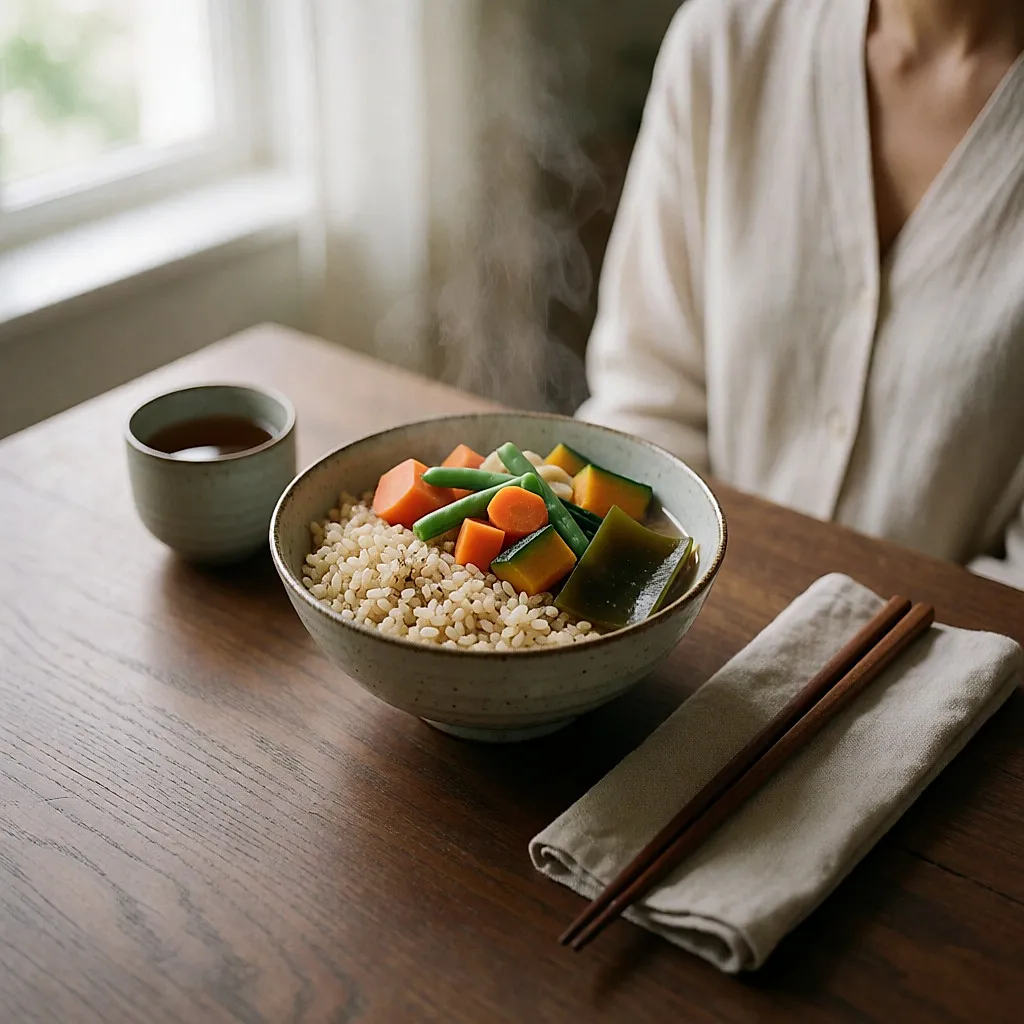
There are questions that tend to surface over dinner, with a spoon of miso in hand: “So what do you actually eat?” Short answer: wholegrain rice, vegetables, seaweed, and a fair amount of patience. Longer answer: a way of building a meal that comes from Asia, where what’s in the pan matters as much as how you cook it. We’ll walk you through it, no gurus, no promises.
A Japanese story before it reaches the plate
The word first. Georges Ohsawa (1893–1966), born Nyoichi Sakurazawa, is the figure who popularised the term in the 20th century to describe his dietary system; this Japanese thinker set out a system that was both philosophical and dietary, intended, he believed, to harmonise body and mind. He didn’t start from nothing: he belonged to an older Japanese tradition, shaped in part by the work of the physician Sagen Ishizuka. His compass came down to two words: yin and yang, the complementary forces used in East Asian thought to describe the world.
In this framework, no food is bad in itself. Each sits on an axis: leafy greens and fruit towards the yin end, expansive and light; roots, salt and long cooking towards the yang end, dense and warming. Cooking shifts the balance — a vegetable eaten raw and crunchy does not play the same role as the same vegetable simmered for two hours. You then adjust according to season, climate and the person. Whether you buy into it is up to you: at the very least, this framework offers a way to read cooking that isn’t just about calories.

What’s actually on the plate
Nothing especially exotic, in fact. At the bottom of the bowl are whole grains — brown or semi-polished rice, millet, barley, sometimes quinoa — taking up the largest share. Around them are seasonal vegetables cut into even pieces, steamed, stir-fried or simmered. Then come pulses, often adzuki beans; seaweed (wakame, kombu) for their savoury flavour and iodine content; and a spoonful of something fermented: miso, tamari, lacto-fermented vegetables. Fish is occasional, meat very rare, and dairy and refined sugar are off the table.

How far it sits from our habits
Let’s be honest: the gap between this and a typical British plate is real. The cheese left out after dinner, the birthday cake, the creamy casserole: that’s where macrobiotics can trip you up if you practise it as an absolute rule. And in reality? Many people inspired by it keep deliberate exceptions — that’s not an admission of weakness.

Be cautious, though, with the strictest versions. Very restrictive diets, especially those built on grains alone, make it hard to get all the nutrients you need; health professionals generally advise against following them without support. Moderation beats purity. As for research into the links between a macrobiotic diet and health, it remains limited and the results are mixed: we won’t promise you prevention or a cure here.
Don’t take this lightly: a restrictive diet shouldn’t be started alone if you are pregnant or breastfeeding, if there are children at the table, or if you have an eating disorder or diabetes, or if you are receiving treatment. Brown rice and seaweed are no substitute for professional advice: speak to your GP or a registered dietitian, and never change prescribed medication on your own.
Start with one bowl
There’s no need to clear out your cupboards tonight! The simplest approach is one dinner a week: brown rice cooked in water, seasonal vegetables stir-fried in sesame oil, a spoonful of miso dissolved off the heat, as tradition dictates. Taste it, notice how you feel in the following hours, and adjust.

Sources
- World Health Organization — Healthy diet: fact sheet.
- NHS — The Eatwell Guide.
Food supplements do not replace a varied, balanced diet and a healthy lifestyle.



Comments
Your opinion matters: rate the article, react and reply to comments.
Comments are moderated; AI-assisted comments are flagged. Text emoticons (8-), :-), <3…) are automatically shown as images.