
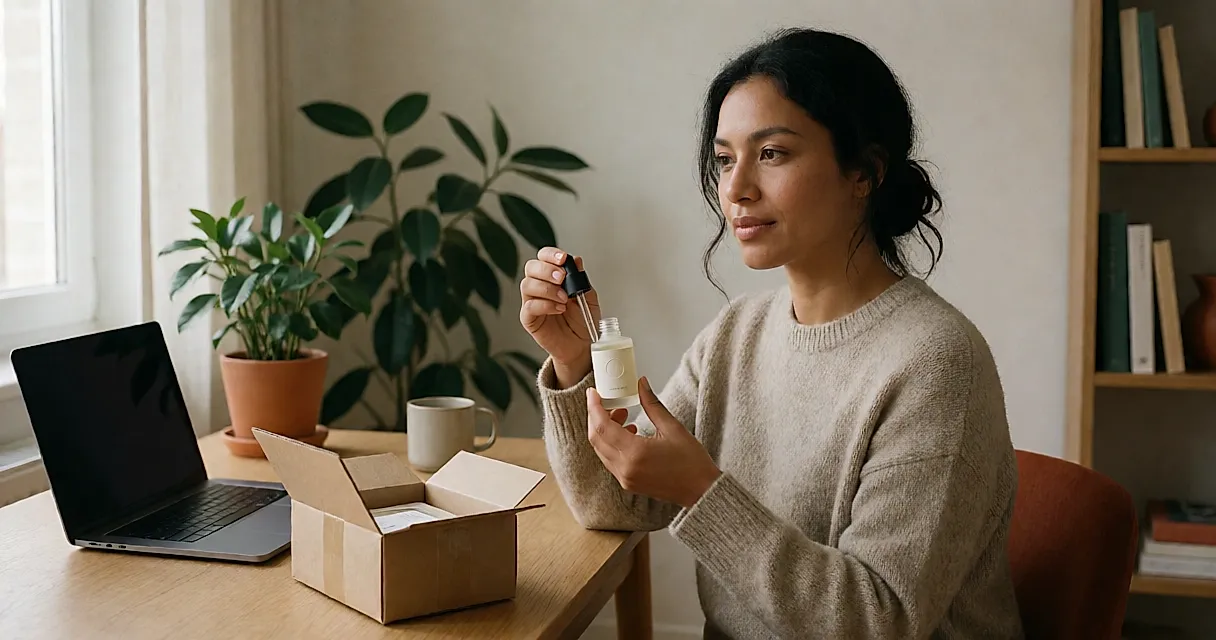
The Korean corner of the department store — its faintly sticky testers, its adviser who knew every texture by heart — hasn't disappeared. It has moved into your phone. Which leaves a question that's less about cosmetics than it looks: who is choosing for your skin, you or an algorithm?
The counter has a new address
For years, K-beauty sold itself by touch. You pushed open the door of a salon or a concession, dabbed three testers with the tip of a finger, and walked out with an essence and the illusion of having cracked the mystery of the seven-step ritual. That era is quietly closing, somewhere between two delivery notifications.
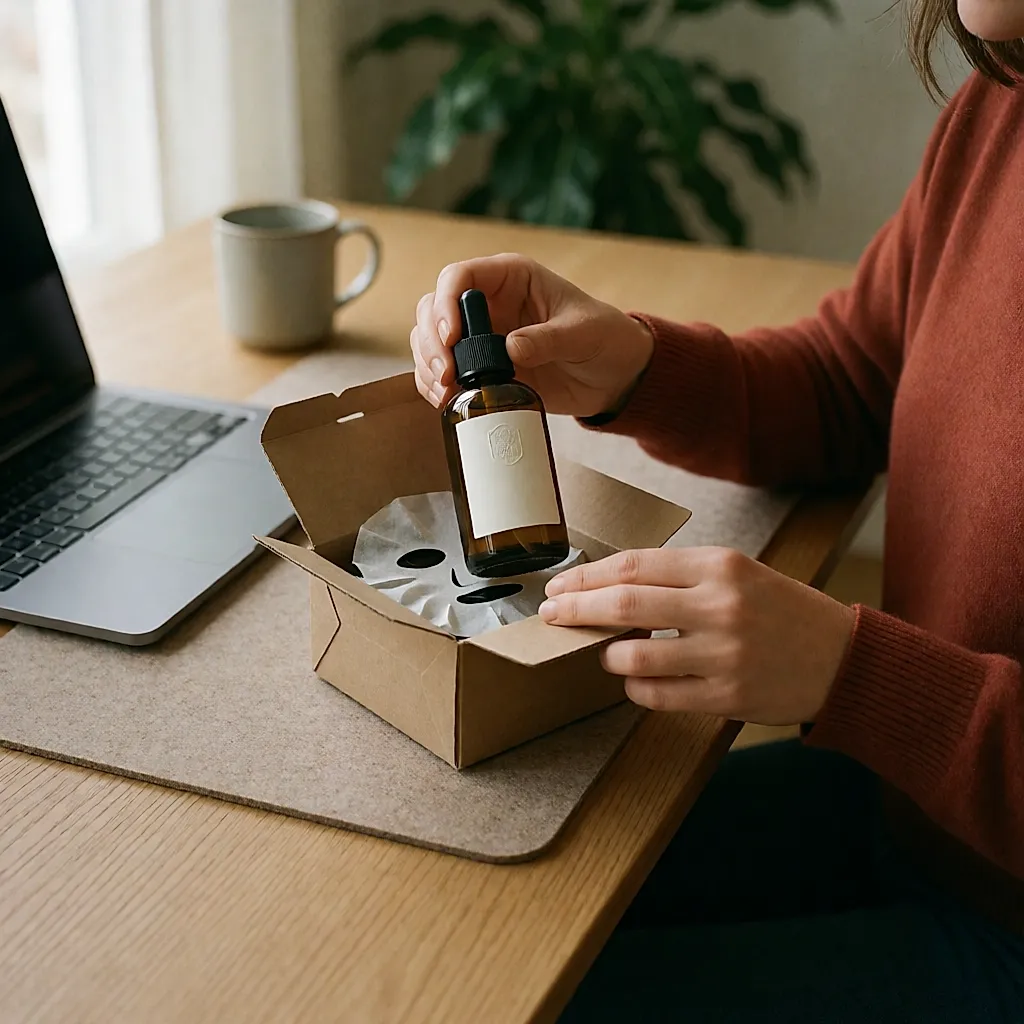
The shift shows in a distribution model closer to Shein's: the manufacturer talks almost directly to the platform, which talks to the parcel, which talks to you. No adviser, no intermediary stock, no 'come back when your skin has calmed down'. Korean and Chinese platforms target Europe and the US directly, in small quantities, often by air. The result is unbeatable on choice and on entry price. It is also entirely silent: nobody along the chain will tell you that this texture is tacky.
The algorithm has never met your skin barrier
Automated curation, meanwhile, seems to be gaining ground across several aisles, beauty included. In practice, whatever sits at the top of the page is no longer necessarily chosen by a buyer who has smeared the cream on their wrist, but by a system that has read clicks, baskets and whatever is trending that week. It's fast, often right, and faintly disorienting when you're used to being asked about your skin type before anyone sells you anything.
The catch is that the algorithm knows your basket, not your skin barrier. It doesn't know your face flared up after a serum loaded with niacinamide, and it doesn't know you still mix up serum and ampoule (no judgement: half the aisle trades on the confusion). Automated curation is excellent at spotting what's climbing; it is short-sighted about what suits you. That isn't a betrayal, it's a blind spot — and filling it is your job.
What the parcel won't tell you
A cosmetic bought from outside the UK doesn't necessarily arrive with the labelling UK rules require for products sold here. The INCI list stays readable if you're used to it, but the warnings, the directions and the names of the actives may be missing, or still in Korean. For a first encounter with an active, it's better to pick a bottle whose ingredients you can read — and to patch test on a small area before putting it anywhere near your whole face.
Another blind spot: the route. Between a brand's own site, a reseller and a marketplace, the paths cross, and a bottle can travel for a long time before it lands with you. Nothing catastrophic in most cases, but uncertainty over a £35 serum isn't the best way to start. Then there's the household scenario: the parcel that turns up the morning you leave for a week away, obviously.
The price on the page isn't the price you pay
Think in rough ranges rather than promises: somewhere around £15 to £30 for an entry-level essence or serum, £18 to £40 for a cushion compact, £7 to £18 for a sheet mask, depending on the brand. Gaps between platforms are enormous, and a discount isn't always a good deal once postage goes on.
Then comes the line nobody reads. On imports from outside the UK, VAT, any customs duty and a courier's handling fee can be added, depending on the order. Hence one simple habit: group your orders instead of firing off lots of small ones. Your budget gains, and so does the cardboard — one combined delivery uses less packaging than three separate parcels for the same cream.
The check before you confirm a basket from outside the UK
- Is the INCI list legible, with the actives named?
- Is the site the brand's own, or a clearly identified reseller?
- What will postage, VAT and any handling fee add?
- Has your skin met this active before, or is this a first date?
The part that stays yours
This isn't a complaint about progress: buying an essence from Seoul without leaving the sofa is a freedom nobody would have handed back ten years ago. But let's be honest — nobody knows how these algorithm-run aisles will look in three years, or how they'll choose between an established brand and a well-optimised newcomer. No one knows, which is exactly why it's worth keeping a hand on the wheel.
What's still possible, even without a shop assistant, is the useful kind of slowness: read a composition, patch test, group the order, and remember that a ten-step routine has never rescued a Sunday night in November. The only step that matters when you've got five minutes? One layer, the right one, and close the tab. Your skin couldn't care less about the ranking.

Comments
Your opinion matters: rate the article, react and reply to comments.
Comments are moderated; AI-assisted comments are flagged. Text emoticons (8-), :-), <3…) are automatically shown as images.