
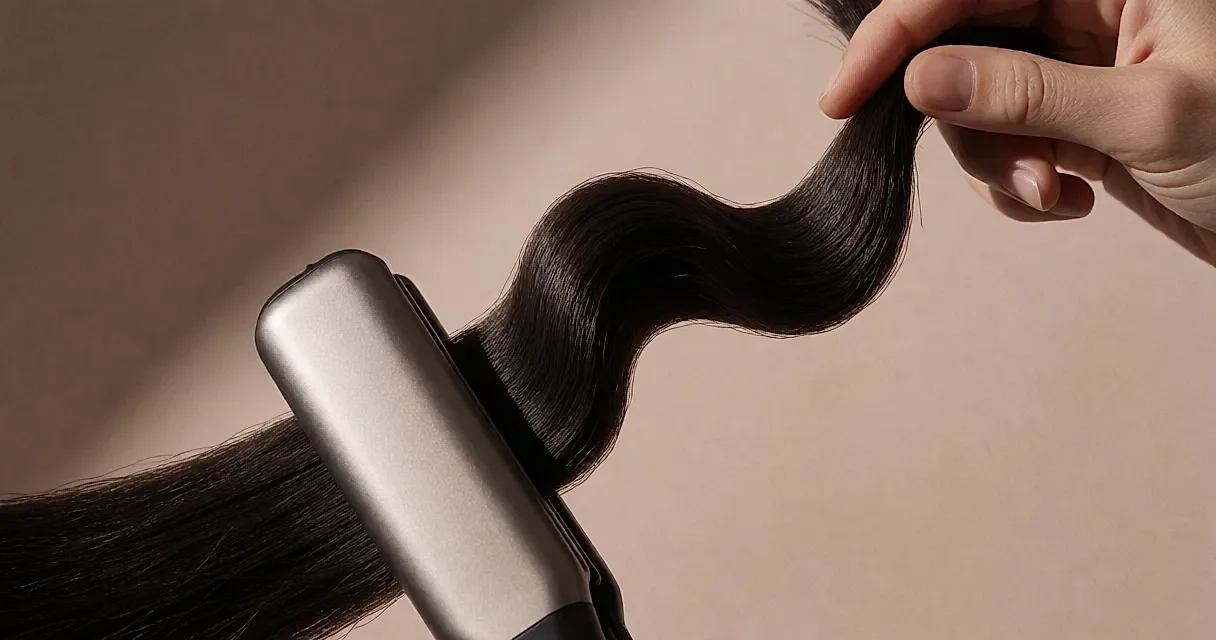
A ridged straightener doesn't curl hair: it pleats it. Two toothed plates close over the section and press in an accordion wave, flat and even, the 1980s with a modern edit. The tool carries a reputation for dry, crunchy crimping, a hangover from the rough passes it was put through in the 2000s. Used well, though, it does something curling tongs often struggle to hold on fine hair: a defined wave, volume at the root and no frizz. So why has it been left at the back of the drawer?
How to do it, section by section
Start with dry, brushed hair: on damp hair, water heats up inside the plate and hair fibre doesn't like it. Separate sections three to four centimetres wide, no more. If a section is wider, the plate doesn't bite into the middle, and you end up with a wave at the edges and a straight line down the centre. Pinch close to the root, hold for the time recommended for your tool, adjusting it to your hair, release, move down a notch and repeat to the ends. To join the waves, place the plate where the previous wave stops.
And here comes the beginner's temptation: run your fingers through, shake, brush. Wait. Let the section cool completely first. Cooling is what sets the shape; brushing it while warm undoes your own work before you have even finished the head. Once all the hair is done, go over it with a soft brush, never a fine-tooth comb, and the ridged pattern will relax into waves.
How the ridge spacing changes the pattern
No two ridged straighteners draw the same thing. Tight teeth give a tight pattern: a dense, almost waffled wave that holds very well on a bob or short hair. Wider teeth and longer plates give a fuller wave, closer to a classic waver; that is the format to look for on long or thick hair, otherwise you will be going over the same section ten times. Look at the depth of the teeth as well as the number: taller teeth make a stronger mark. Which one should you choose? The one that matches the length of your hair, not the picture on the packaging.
One detail people forget: wrist direction. If you always pinch from the same side and move down steadily, you get parallel, clean, almost graphic waves. Alternate the direction on each section and it goes everywhere. That can look lovely in a messy bun, much less so in a neat ponytail. Pattern is geometry, not magic.
Heat and hair condition
Our practical rule at the magazine remains caution: start on the lowest setting your tool has, even if that means going up one notch if the hair doesn't respond, especially on fine hair. On thick or resistant hair, a medium setting is often enough. Beyond that, the risk of damaging the hair increases without necessarily giving a better hold, and an overcooked wave cannot be rescued. A heat protectant applied before styling, on dry hair, is the minimum. Avoid repeated passes: going over the same section again doesn't carve a better wave, it cooks it.
After a ridged pass, hair is more battered than you might think, because each fold is repeated mechanical stress in the same place. Hence our rule: not every day, and never on bleached or already brittle hair without asking your stylist first. We won't promise that this causes no damage at all. What we will say is that, done once and done properly, it puts less stress on the hair than straightening the same section four times in a row.
Why it can replace frantic straightening
You know frantic straightening: one pass, a glance in the mirror, another pass, the section flicking out again, your arm starting to ache, and three passes later hair that is straight and tired. Ridging breaks that loop because it forces one movement and one decision: pinch, count, move down. No negotiating with your reflection.
There is another, less expected benefit: the flat wave gives volume without over-texturising. On fine hair that flattens at the crown, a quick ridged pass at the roots lifts the hair more reliably than a volumising blow-dry that drops at the first rain shower. And for anyone who hates the idea of curls, it is clear: a wave is an accordion, not a spiral.
What to spend
A decent ridged straightener usually costs roughly £20–£45 on the high street or at a beauty retailer, and more like £55–£110 for a model with ceramic plates and precise temperature control, from a specialist retailer or online. In a salon, expect to pay around £30–£70 for crimped waves, depending on hair length and location. It can be worth doing once to see how the finish looks on you before investing.
The greener choice comes down to two words: buy once. A ridged straightener does not wear out quickly if you wipe the cold plates with a microfibre cloth and store the cord without winding it tightly. One tool with adjustable temperature is a better buy than a collection of three-setting gadgets that end up in the drawer.
First test: one section at the front. Take a section at the front, on the lowest temperature setting. Pinch, count without going beyond the hold time recommended for the tool, then wait until it has cooled completely before judging. If the wave holds without leaving a harsh mark, go up one notch for the rest of your head.
And if you don't like the result? Brush it out, add moisture to the ends, try again tomorrow: ridging is reversible and washes out at your next shampoo, which is part of what makes it likeable. The one move worth keeping, when you have only five minutes before you leave, is to pinch three sections around the face rather than straighten your whole head. An intentional wave beats stiffness.



Comments
Your opinion matters: rate the article, react and reply to comments.
Comments are moderated; AI-assisted comments are flagged. Text emoticons (8-), :-), <3…) are automatically shown as images.