
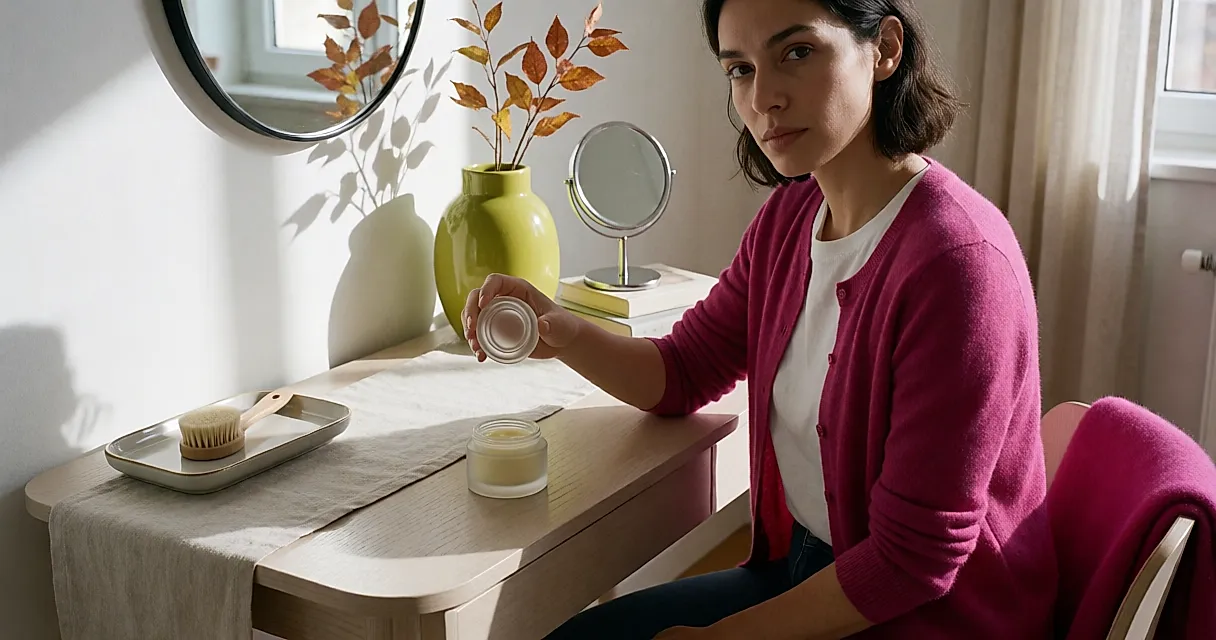
Blusher used to have the light all to itself. Now it climbs to the temples, settles on the forehead and makes its way onto the eyelids. The trick is knowing what order to apply things in, or you will end up with pastry-counter shine when you were after skin that catches the November light.
The glow has moved
The glazed finish popularised by Hailey Bieber comes down to one simple idea: shine is no longer confined to the tops of the cheekbones. The satin finish can run in one continuous sweep, from forehead to temples, with the eyelids picking up the thread in a discreet pearly sheen. No stuck-on halo, no stripe of light: just continuity. That is where the technique changes, far more than the look itself.

For years, we applied light the way you apply jewellery — two dots on the tops of the cheeks, a touch under the brow, done. The glazed finish associated with Hailey Bieber, the model and entrepreneur whose name became shorthand for glazed-doughnut skin, already asked for a different logic. Now it is leaving the blusher zone behind and claiming the whole face. In practice, this is not another product to buy; it is a distribution to rethink. A significant distinction when you consider how long we spend hunting down the right formula.
The real order of layers
It all starts with skincare, on skin that is still damp — that is when it drinks fastest. Leave it a few minutes to sink in. Then foundation, ideally a fluid formula, in two thin layers rather than one thick one, tapped from the centre outwards. Finally the light, last of all, with your finger, on the areas of the face that are still warm: the product warms up and blends better than it does with a brush, in a move that takes seconds.
Where shine works, where it backfires
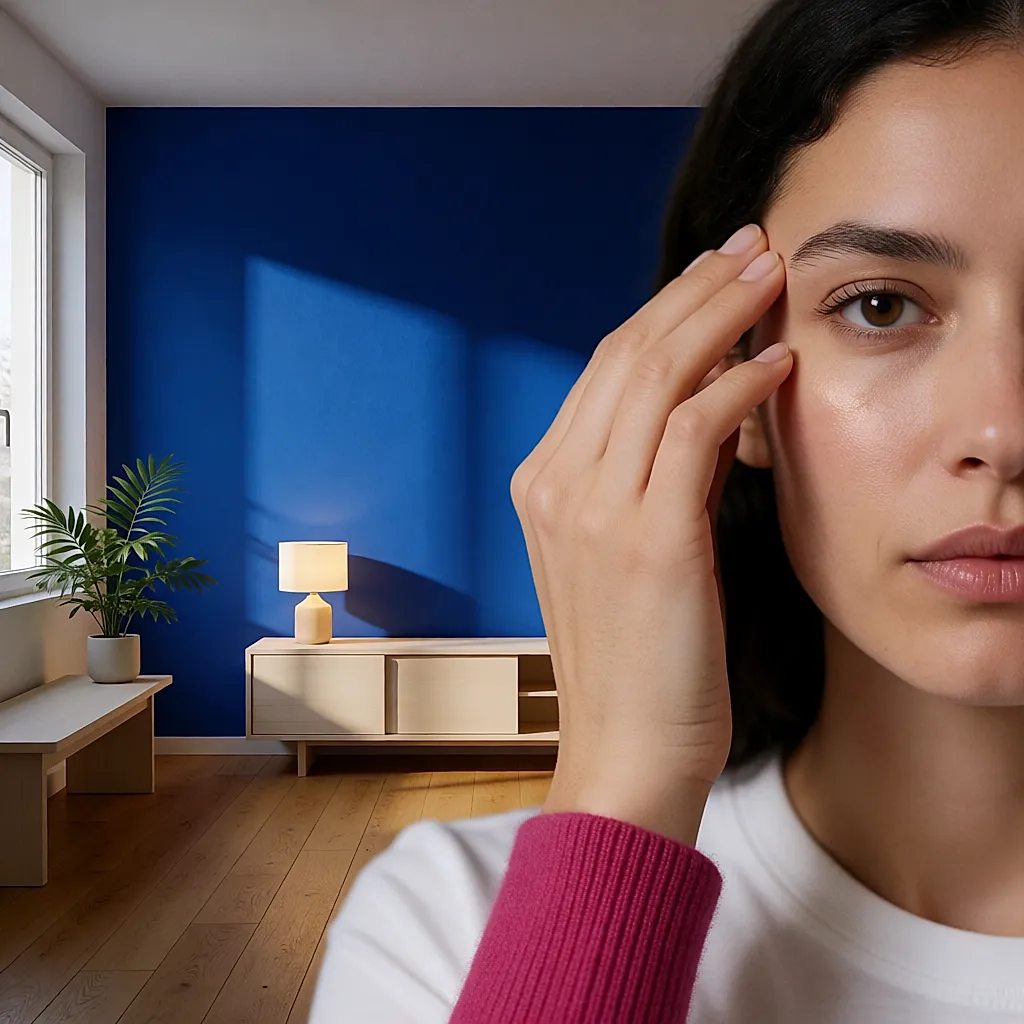
The temples, the top of the forehead and the curve of the brow bone are the glazed finish's best allies: little texture, no grain, and light settles there without a fight. The eyelid works too, provided you apply it in tiny touches — any more and the crease starts to show by the afternoon, turning a glossy eyelid into a greasy one.
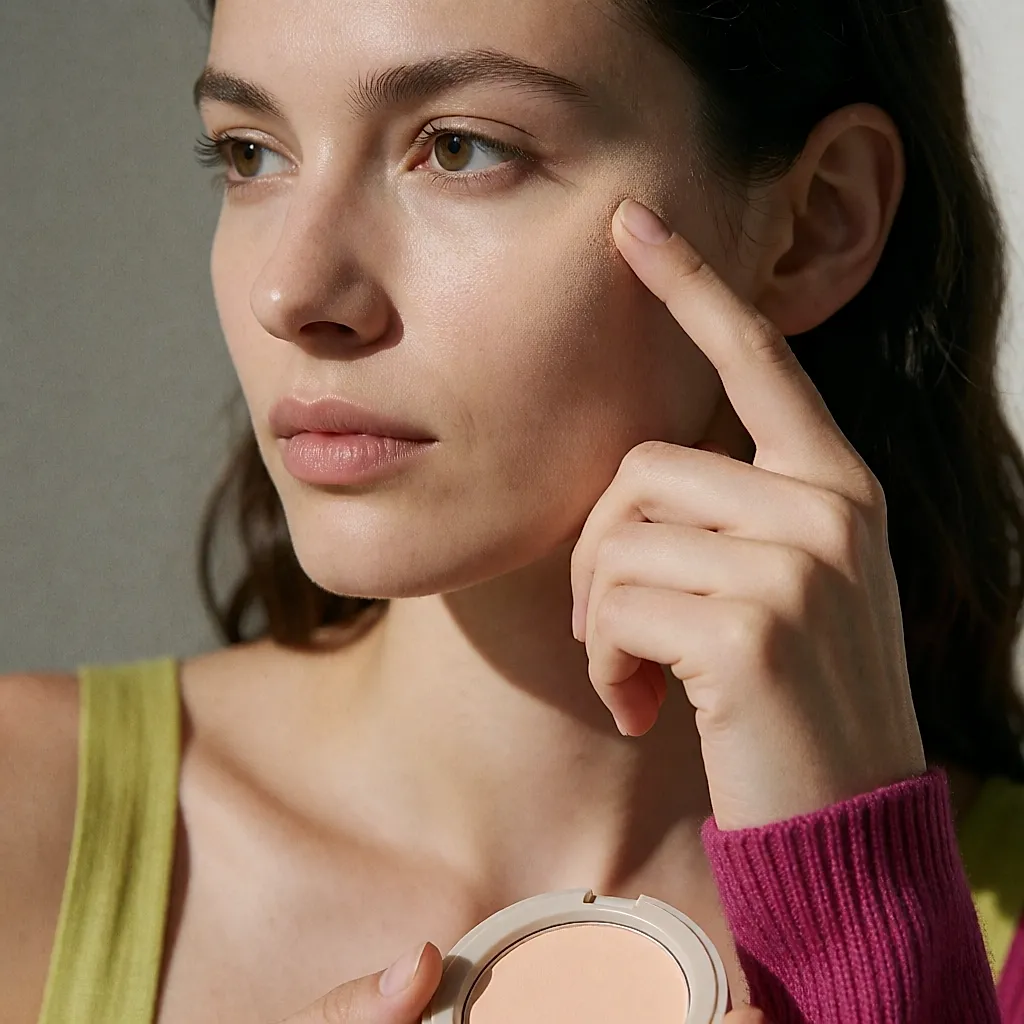
Where it gets tricky is the sides of the nose, the crease between nose and cheek, the chin, and more broadly any area where pores are visible. Raking light picks out every little bump, and make-up turns into a contour map at the first glare of office lighting. The fix is simple: mattify those spots, illuminate the perimeter. Two opposite moves on the same face, and nobody sees a contradiction.
Formulas that last without a greasy finish
With this kind of finish, half the work happens in skincare. Look for hydrating textures built on vegetable glycerine, aloe vera, plant-derived squalane or light oils such as jojoba: they give suppleness without the greasy film of heavy formulas. Certifications have their say — COSMOS Organic, Soil Association or another serious natural-cosmetics standard can indicate a level of rigour on the ingredients list, but not how well a product wears. An important distinction: a certified product is not automatically the one that will last best on combination skin.
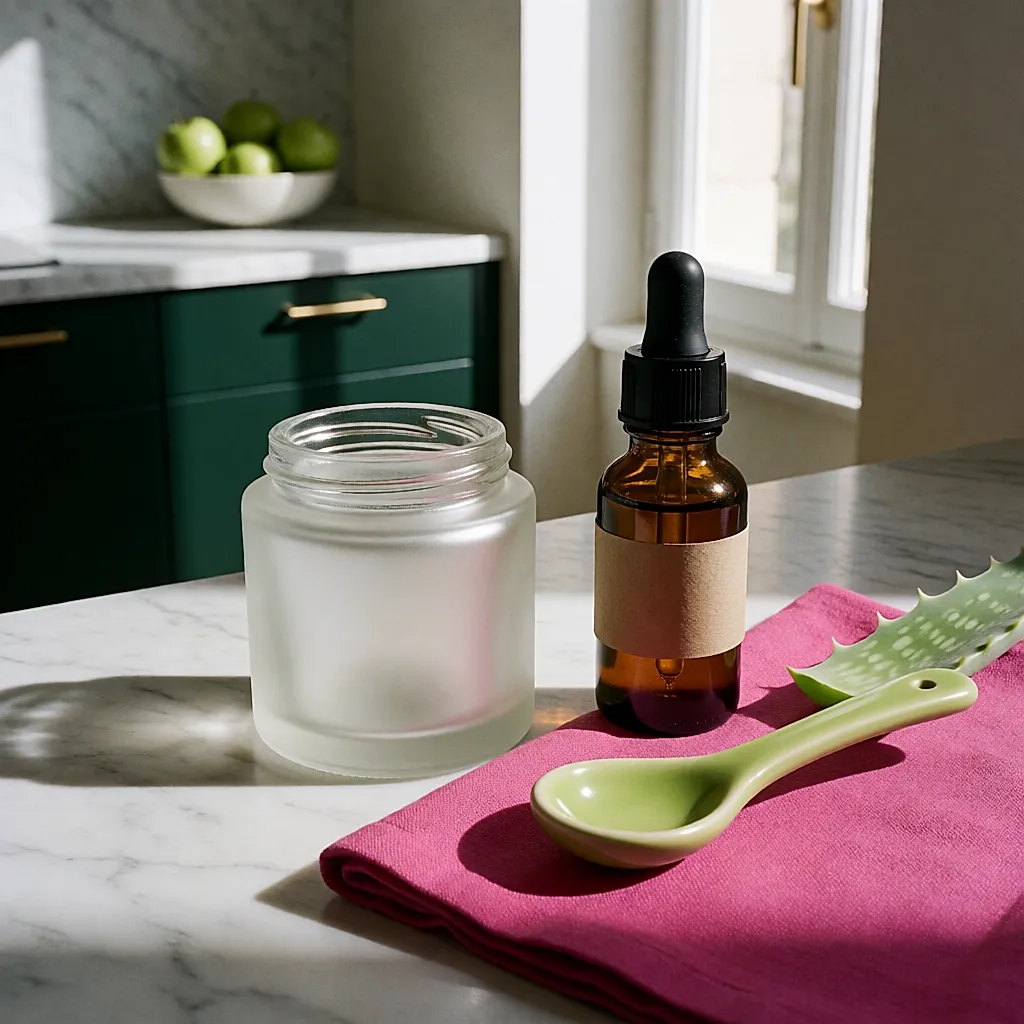
On the subject of longevity, let us admit a limit. A very luminous finish often lasts thanks to a film-forming agent, and you sometimes have to accept a little conventional formulation so the light does not vanish by midday. The most sensible compromise: a natural skincare base, ideally in refillable or glass packaging, and a more conventional formula for the final touch. And if you have not tried a product yourself, be wary of reviews promising ten-hour wear: nobody measures it the same way.
The step that keeps shine in place: before you add any light, blot. Run a blotting paper or a clean finger over the sides of the nose and chin; the shine you apply afterwards stays where you put it instead of travelling.
Add light with a plan
Go back to your Sunday-night routine and add one question: where does the light stop on my face? If the answer is 'everywhere', mattify the recessed areas. If it is 'nowhere', start with skincare on damp skin. The rest — temples, forehead, eyelids — will follow on its own, and you will not have bought anything extra.



Comments
Your opinion matters: rate the article, react and reply to comments.
Comments are moderated; AI-assisted comments are flagged. Text emoticons (8-), :-), <3…) are automatically shown as images.