
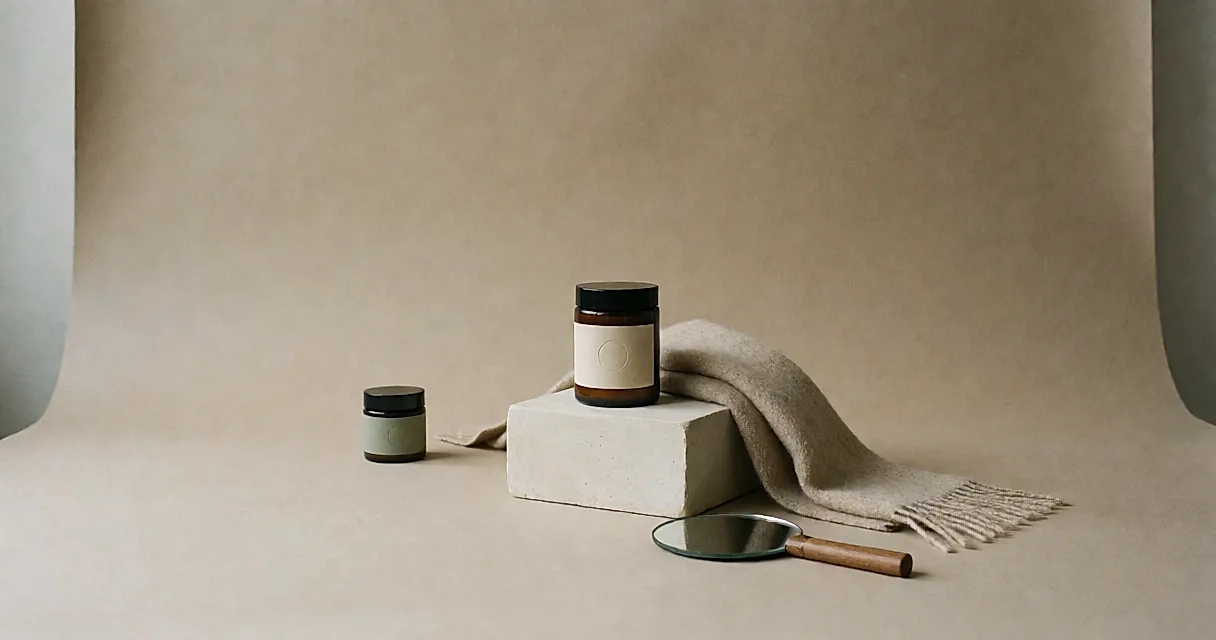
The 'neck cream' jar exists on the shelf, with its label, price tag and promise. It has even carved out a place between face cream and décolleté cream, as if there were a missing link in the chain. Except the area it covers can be looked after in three seconds — and those three seconds are exactly the ones we tend to skip.
The imaginary cliff
In the evening, face cream covers forehead, cheeks, nose and chin. Then your hand stops dead, as if the jaw were a cliff edge you don't dare lean over. Below it, the nape, the skin around the ears and the upper chest are waiting for a follow-up that never comes.
This isn't laziness; it's a blind spot. We look at ourselves face-on and see a face; the neck is something we notice in profile, in a passing mirror, in a photo someone else took, or at the hairdresser's when they ask whether you want your nape tidied. And then it hits you. The neck is exposed to sun and weather, and it can feel tight or dry while the face feels comfortable — reason enough not to leave it in limbo, without buying it a jar of its own.
Because that's where the trade-off lies. An extra bottle isn't just the money it costs: it's shelf space, another step to remember, and a third texture to make room for alongside the other two. Have you ever tried to layer three products without losing one along the way?
Behind the earlobe, nobody's looking
There's a spot even the most meticulous among us forget: the hollow behind the ear, the lobe, that small strip of skin that meets a collar. Yet it's the bit that rubs against a wool scarf, carries slightly heavy earrings and catches the perfume you spray in its general direction. It works hard, and often gets far less care than it deserves.

The nape, meanwhile, suffers from a different misunderstanding: we assume hair protects it. But hair gets lifted, tied back and cut, and a coat collar is no defence against April sun. The result is skin that feels tight at the sides while the rest of the face feels comfortable, and that odd sensation, when you take off a scarf, of having two different textures on the same person.
So do you need to reach for the dedicated jar? Honestly, rarely. The extra-pot logic rests on a shaky idea: that neck skin needs a formula it can't get anywhere else. Most of the time, what it's missing isn't an extra active — it's the end of the step you've just cut short at the jaw.
The three-second step
Here it is, with no shopping required. After your face cream, don't put the jar down straight away. Your palms still have a film of product on them: place them flat on the top of your neck, slide them down without rubbing to the base of your neck, then run your fingertips back behind the lobe. Count three seconds on the clock, and you've covered what the dedicated jar claimed to treat.
In the morning, use the same principle with SPF — sun often lands on the neck and chest while you're watching somewhere else. A hat, a high collar, a light scarf: whatever is covered doesn't need coating. And if your face cream is too rich for the area, a lighter texture will do; there's no need to rush out and buy a third formula for a quick sweep.
One exception worth knowing: if your neck is very reactive, itchy or red, that's not a missing jar but a question for a GP or dermatologist. You don't fix intolerance with one more pea-sized amount.
Budget
On price, without pushing you to the till: a face cream can start at a few pounds in a supermarket or pharmacy and rise to tens of pounds in a department store or beauty retailer, depending on the brand, size and formula. A cream specifically labelled 'neck' may work out more expensive per millilitre, especially in a smaller size. If it does, you're paying more for a smaller area — so compare the cost per millilitre, not just the jar on the shelf.
The saving isn't only financial. One less bottle means one less piece of packaging, a product that won't have time to oxidise at the back of a drawer, and a routine you actually stick to because it's short. If you're due to replace your face cream, choose glass packaging where possible, a refill if the brand offers one, or a larger size that lasts — that's where the real environmental choice lies, not in the extra jar.
The overspill test. In the evening, after your face routine, count how long your hand stays on your neck. If it leaves straight away, the habit hasn't stuck yet. A trick that works: keep the jar next to your comb or toothbrush, and do your neck before you put the jar down — with a little regularity, the step becomes automatic. In the morning, your neck comes just after your face SPF, never before.
There will be brands ready to sell you the jar you're missing. The good news is that your hand is already in the right place, with the right product, at the end of a step you do every evening anyway. Three extra seconds cost nothing — and they leave shelf space for what really matters.


Comments
Your opinion matters: rate the article, react and reply to comments.
Comments are moderated; AI-assisted comments are flagged. Text emoticons (8-), :-), <3…) are automatically shown as images.