

You step out of the shower and your skin gets there first, before you've even reached for a towel: tight. Your complexion turns dull, your cheeks flush the moment the heating comes back on, and foundation catches on dry patches you never saw coming. The good news is that you don't need to rebuild your routine or spend three months' salary in a beauty hall — one well-chosen mask, used once or twice a week, and comfort comes back. We've run through five textures, from the most affordable to the most premium, with what's in them, the skin they suit and where they sometimes fall short. A quick note on transparency: we're citing these as market reference points, not as products we've trialled one by one over three months.
Why skin feels tight as soon as the cold sets in
When the air turns colder and humidity drops, the skin barrier loses water faster than it does in summer. The lipids that were protecting it thin out, evaporation speeds up, and that's how normal skin ends up in October with a tightness it never knew it had. Add the constant back-and-forth between indoors and out: heating that dries the air, wind that bites, long hot showers we stretch out without thinking. The result is tightness, redness and a complexion that looks washed out.
Piling rich products onto skin that's already overloaded achieves nothing — we've all made the mistake of thinking one more layer would sort it. In autumn, the right move comes down to two words: hydrate and soothe, without smothering. That's where a mask earns its place: a concentrated treatment, left on for a set time, giving skin what it needs without weighing it down all day.
The express aloe vera mask, for days when you're rushed
Three minutes on, not a second longer. This is the one to keep at the back of the bathroom cabinet for when you have no window at all — between putting a wash on and a meeting that's creeping closer. Aloe vera gel delivers water and an immediate cooling effect, and you'll find it in affordable organic formulas; So'Bio Étic and Aroma-Zone are the easy names to find in France, while on the UK high street it's worth looking for aloe-led masks from Boots or Superdrug.
The useful habit is to check where aloe vera gel sits on the INCI list: the higher it appears, the more the formula contains. An "aloe" mention near the bottom, after the fragrance and preservatives, won't do much for your skin. Standard application: clean skin, a thin layer, rinse with lukewarm water. Simple, effective, no ceremony.
The plumping gel mask, for a quick boost
Gel texture, a chilled feel, a brighter complexion: this is the one for before a night out, the sort you leave on while you decide what to wear. Three minutes is enough to make tired skin look better — and honestly, after a heavy week, it shows straight away.
Formulas built on floral waters and plant extracts — rose, iris, lily — are aiming at soothing and a plumped-up look. On texture, be wary of heavily perfumed gels: a simple, well-balanced formula often does more than a flashy bottle. And if you're unsure about a formula, the back-of-the-hand test is enough: if it stings straight away, it isn't for you. Budget-wise, though, beauty halls climb fast — more on that below.
The soothing mask, for skin that flushes
Reactive skin that heats up, feels tight and looks grey? This is the one for you. Look for a formula without alcohol, without added fragrance, without colourants, with soothing actives such as panthenol, bisabolol or floral waters. Avène and A-Derma both offer options in this vein, designed with sensitive skin in mind.
Leave on for five to ten minutes, then lift off the excess with a cotton pad — no need to rinse if the texture is light. And if it stings, rinse straight away: a mask should never hurt. That's the one non-negotiable rule. In fact, when skin is genuinely in a flare-up, it's often better to space out masks and stick to a barrier cream until things settle down.
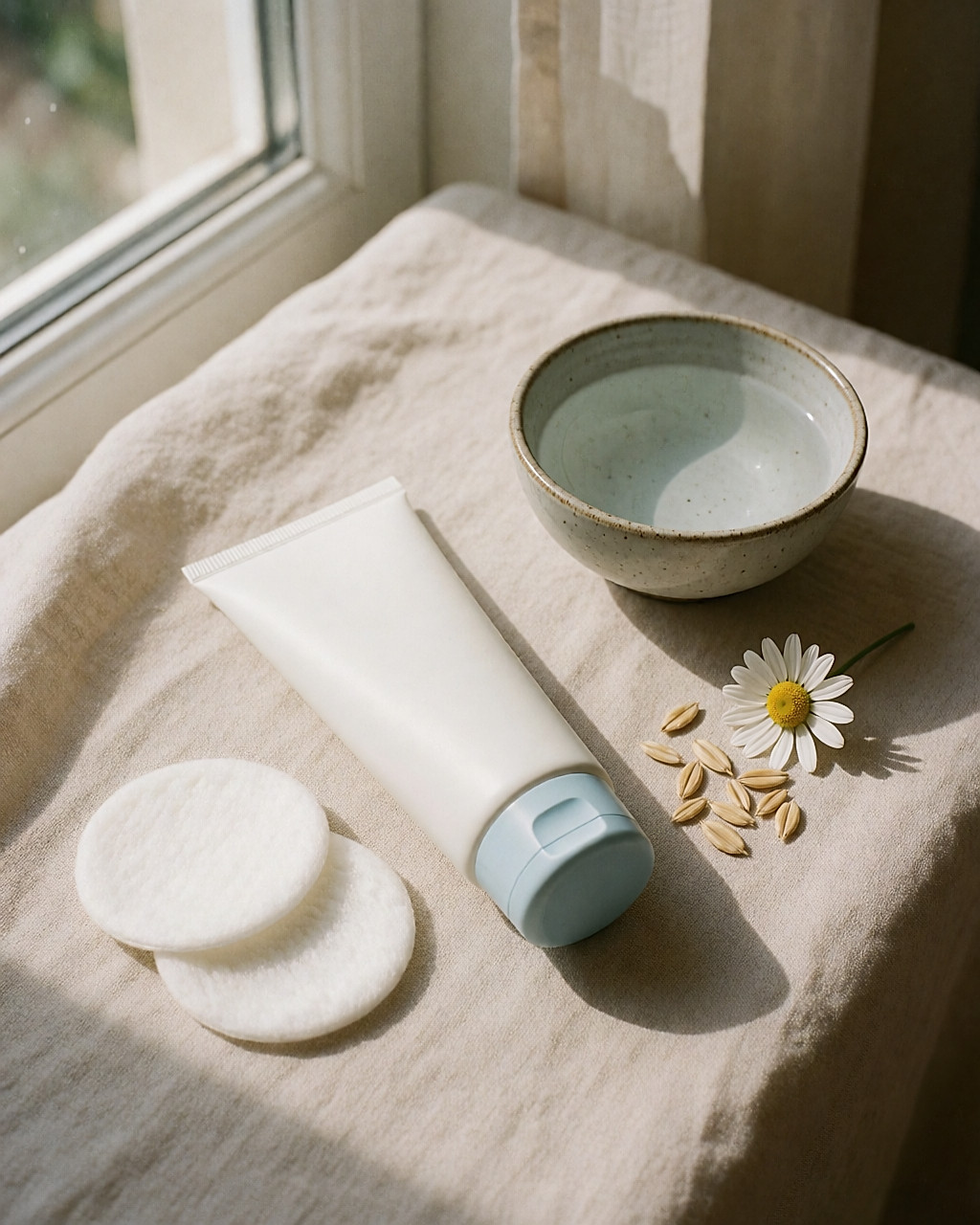
The organic revitalising mask, for tired skin
A richer treatment, left on for around twenty minutes at the weekend, when you finally have time to slow down. Here you're after nourishing plant oils — jojoba, wheatgerm, avocado kernel — and sometimes a little clay to refine the look of pores. Dr. Hauschka remains a benchmark in premium organic skincare on this front.
The Cosmos Organic certification guarantees a proportion of organic ingredients and a specific formulation charter: it's a useful guide when choosing, not a promise of results. An important distinction, because an organic label says nothing about efficacy — only about composition and process. Whether your skin gets on with it is for you to judge. Usually it does: plant oils are generally well tolerated, as long as you don't layer them over skin that's already overloaded.
The cream mask, for dry skin
When skin is really tight, go for a rich cream texture, high in glycerin and ceramides. Caudalie's Vinosource line is a classic here: a thick layer, ten minutes on, or as an overnight mask on the driest patches. It's the Sunday-night comfort ritual, and it needs no equipment at all.
Try applying it at the end of your routine, after serum, so nothing gets in the way of absorption. And if your skin is very dry, you can leave a thin layer on overnight across your cheeks and around the nose — the next morning you'll feel the difference at a touch.
The step that makes all the difference
The test to run before you buy. Apply a small amount behind your ear or in the crook of your elbow, then leave it for 24 hours. If it heats up or itches, you have your answer. A mask is like a perfume: the formula that suits the person next to you isn't necessarily yours. And a texture that pills on your skin is never a good sign.
Budget
Expect to pay around £5 to £12 for a mask in a supermarket or pharmacy, £13 to £30 in a beauty hall, and up to £50 to £70 for premium formulas. What pushes the price up: the concentration of actives, the certifications (Cosmos Organic, Ecocert) and the packaging — glass jar, refill.
Brands that offer refills bring the cost down with each repurchase, and it's often the smartest compromise: keep the jar, buy the formula again. Where to find what? Supermarkets and pharmacies for the affordable versions, beauty halls and brand websites for the rest. Promotions come round regularly, so it's worth keeping an eye out before you commit.
Sources
- So'Bio Étic — organic mask range, official site.
- Aroma-Zone — masks and natural actives, official site.
- Avène — sensitive skin care, official site.
- A-Derma — official site.
- Dr. Hauschka — natural and organic masks, official site.
- Caudalie — Vinosource line, official site.
- Cosmos Standard — certification for organic and natural cosmetics.


Comments
Your opinion matters: rate the article, react and reply to comments.
Comments are moderated; AI-assisted comments are flagged. Text emoticons (8-), :-), <3…) are automatically shown as images.