

A fringe has a rare talent: it makes itself known just when you have run out of hair clips. One gust of wind, one shower, and there it is, deciding to live its own life above your forehead. For spring/summer 2027 it is moving back over the face, but not in uniform. Two camps answer each other: the long, full curtain fringe and the fringe that is barely drawn, almost a pencil line. The choice is yours: which gesture will still hold up on a Monday morning?
Two fringes, two approaches
The first does not do things by halves. It falls low, covers the brows, sometimes grazes the lashes, and needs substance. This is a fringe that structures the face, frames it and adds volume. Worn full, it appears thick, slightly swept to each side, like a curtain someone forgot to close. The good news: it is forgiving on thick hair. The less good news: on fine hair it can quickly look like a stray piece of stage curtain.
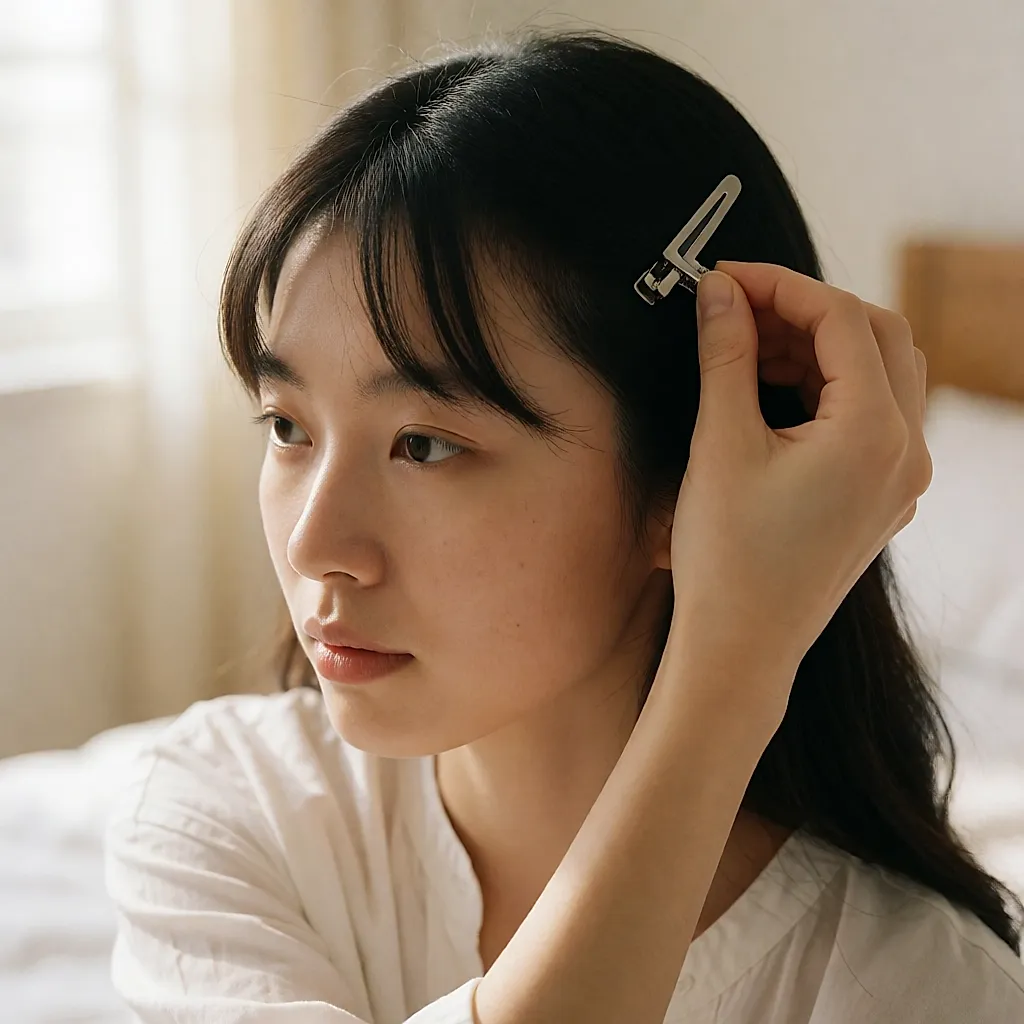
The second keeps things discreet. A few tapered strands, an irregular line, an air of 'I woke up like this'. This is the tapered micro-fringe: it does not cover the forehead, it underlines it. Worn short, it is airy, almost invisible from the front and sharper in profile. The trap? A minimal fringe that is badly cut does not become minimalist; it turns into a TV aerial.
The long fringe is a curtain, not a partition
For a long fringe, the brief at the salon matters more than the styling product. Ask for a curtain fringe that starts at brow level and falls to the cheekbones, with blending strands to avoid a helmet effect. If your hair is straight, say you want movement, not a slab. If it is curly, it is better to have it cut dry or on textured hair: a fringe cut wet can look shorter once dry, especially on curly hair.
For styling, dry the fringe first, before the rest. With a round brush, roll it inwards, let it cool for a second, then smooth it back into place. A pea-sized amount of light wax is enough to discipline the ends; any more and the fringe sticks and picks up dust. And if November rain gets involved? A side-swept hair clip saves the day, as long as you own it as a choice rather than a surrender.
The micro-fringe and the pencil line
The minimal fringe is a matter of millimetres. Ask for a barely-there fringe, tapered at the sides, with a few shorter strands in the centre. The idea is not to cover the forehead but to create a soft, light blur across it. On fine hair it adds lightness; on round faces it breaks the line without masking. If you have a stubborn cowlick, however, discuss it beforehand: a 3 cm fringe does not tolerate improvisation.

To style it, the less you do, the better. Let it air-dry, add a touch of texturising spray at the roots and leave the strands to live. The real maintenance happens at the salon: a maintenance trim needs to be booked regularly — in practice, often every three to four weeks, more frequently than a full cut. That is the price of precision — and the reason some salons charge for it separately.
At the salon, the brief that avoids drama
Arrive with two or three images, but above all with your usual hair. Not the version hastily straightened for a wedding: your real texture, the one you have on a Tuesday. Show where you want the fringe to stop when you frown, and ask for it to be checked once dry. A wet fringe always lies a little; a dry fringe tells the truth. It is hard to know in advance whether your cowlick will agree — which is exactly why you check it dry.
Also ask how long it will take you in the morning. If the answer exceeds your patience, a longer fringe is better, because it is easier to sweep aside. And if you are torn between the two camps? Start with the long version: you can wear it to the side while you get used to it. A minimal fringe, on the other hand, will not magically grow longer.
Before you cut, take a pocket mirror: style your hair as usual, without product, and see whether the fringe holds for ten minutes. If it parts in two, ask for a denser or shorter cut. And keep a photo of a fringe that worked: at your next appointment, it will speak better than you do.

Budget
A full cut with a fringe usually costs between £40 and £90 at a salon, depending on the city, the length and the type of salon. A maintenance trim of the fringe alone is more likely to sit between £10 and £25, sometimes free between two full cuts — ask when you book, not at the mirror. For a refresh at home, a pair of hairdressing scissors costs between £15 and £40; avoid kitchen scissors, your fringe deserves better.
For products, a light wax or texturising spray can be found at a beauty retailer, supermarket or pharmacy, between £10 and £25. Look at the ingredients: plant waxes, oils, not much silicone; a solid or refillable format is a plus. And if your fringe is very rebellious, a conventional product can still be an effective compromise — we say it plainly.
The move that lasts
A fringe is often a three- to four-week commitment and a little attention in the morning. But it is also a quick shortcut to changing your look without touching the length. So, curtain or micro? Book an appointment with a photo, your natural texture and one simple question: 'Will this work in my real life?'
If the answer is yes, the fringe will do the rest. And if it annoys you after ten days, at least you will know why: too short, too dense, or cut on wet hair. Next time, you will know what to ask for — and what to leave at the salon.

Comments
Your opinion matters: rate the article, react and reply to comments.
Comments are moderated; AI-assisted comments are flagged. Text emoticons (8-), :-), <3…) are automatically shown as images.