
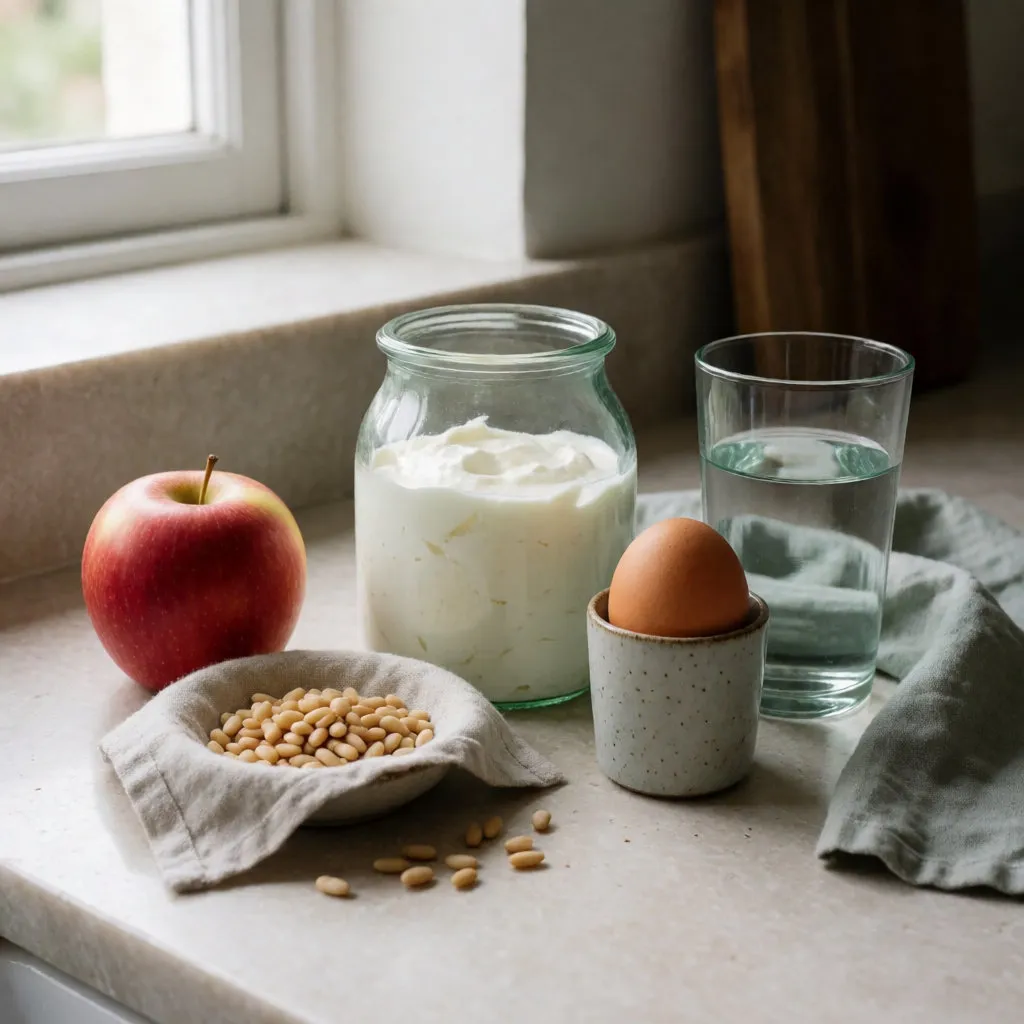
At 5pm, lunch feels a distant memory and your stomach is making itself known. Before you reach for the biscuit packet, there are a few foods worth keeping in your bag. Their common ground: protein, fibre and water. The idea that a food can 'trap' fats and sugars in the stomach, however, doesn't hold up—digestion doesn't work like a filter.

That 5pm craving is not just a whim
It often follows a lunch that was too light, a short night or a stressful day. Current evidence suggests that protein is one of the most satiating nutrients. In practice, a snack that combines protein and fibre keeps you going longer than a sugary bar eaten in three minutes.

Pine nuts, egg white and fat-free fromage frais
Pine nuts are the seeds found in the cones of the stone pine, with a distinctly woody taste. They are particularly high in fat: around 670 kcal per 100g, so keep to a small handful. As a practical marker, 10g already provides about 67 kcal. Egg white provides 11g protein for 50 kcal per 100g, with no fat. If you want organic eggs, check the code printed on the shell: when it starts with 0, it indicates organic production, with certification standards covering how hens are fed and kept. As for fat-free fromage frais, it supplies 7–8g protein per 100g, and a large glass jar recycles better than several small pots.

Agar-agar and konjac: what we know and what we don't
Agar-agar is a gelling agent extracted from red algae. This undigested fibre forms a gel and slightly slows stomach emptying, but it does not capture fats or sugars. Konjac glucomannan has authorised health claims (in the EU register and on the GB nutrition and health claims register), notably for weight loss as part of an energy-restricted diet and for maintaining normal blood cholesterol, subject to dose conditions; other fibres such as pectin may also have authorised claims. The effective amounts are high, and capsules swallowed with too little water have caused oesophageal blockages.

Apple, fish and water: the classics that keep hunger at bay
Apples are about 85% water, provide 2g fibre per 100g and few calories for a large volume: perfect for an 11am craving. Fish combines protein and omega-3; the NHS Eatwell Guide recommends two portions a week, one of them oily, varying the species. A large glass of water before a meal may slightly reduce how much you eat, but the effect remains modest and inconsistent across studies. Above all, don't skip the next meal: regularity is better than compensation.
If your cravings come with a loss of control, guilt or a difficult relationship with food, speak to your GP or a registered dietitian: these situations need support, not a diet sheet. And medicinal appetite suppressants should never be bought online; the MHRA regularly warns about falsified and illegal weight-loss medicines, including GLP-1 analogues.
In practice, keep this in mind
A snack is a protein plus a fibre: an egg and an apple, or fromage frais with a few pine nuts. Eat sitting down, without screens, and give your body time to register fullness. Water helps, but it does not replace a meal.

Cost
In the UK, expect to pay roughly £1.50–£3 per kg for apples, £3–£5 for organic, and £2.50–£4.50 for six organic eggs. Fat-free fromage frais is around £1.50–£3 per 500g, often cheaper per kilo in a large tub. Pine nuts remain the biggest expense: £35–£60 per kg, so about £0.70–£1.20 for 20g. Add £2–£4 for 200g konjac noodles, and £10–£25 a month for a supplement. These figures vary with the label (organic, Red Tractor, MSC for fish), origin, season and where you shop: market, supermarket, health food shop or online.
Sources
- NHS, The Eatwell Guide.
- NHS, Fish and shellfish.
- NHS, 5 A Day: what counts?
- Great Britain nutrition and health claims register (glucomannan); EU register of nutrition and health claims (glucomannan).
- MHRA, warnings on illegal GLP-1 weight-loss medicines and falsified products.
- Food Standards Agency / Defra, egg marking and labelling guidance.
Food supplements do not replace a varied, balanced diet and a healthy lifestyle.



Comments
Your opinion matters: rate the article, react and reply to comments.
Comments are moderated; AI-assisted comments are flagged. Text emoticons (8-), :-), <3…) are automatically shown as images.