
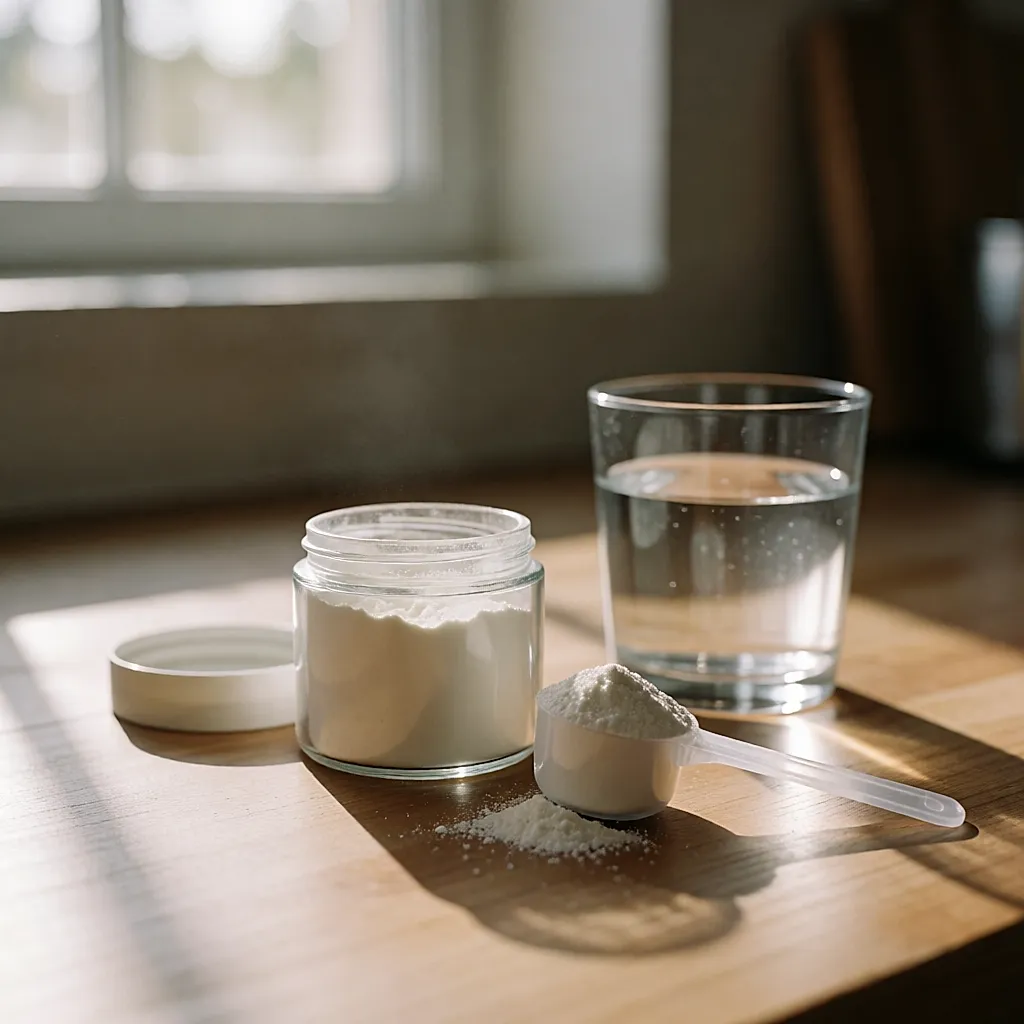
Creatine: muscle, not the number on the scales
The tub is tiny, the label austere, and the name is a mouthful late at night. Yet creatine is one of the best-studied supplements in the world — far better studied than the powders that promise a wasp waist. What women who take it are usually after has nothing to do with the scales: strength, and the ability to recover without being wiped out for three days.
A molecule that is nothing exotic
Your body makes its own creatine from three amino acids and stores it mainly in the muscles, where it acts as an immediate energy reserve. It is also found in meat and fish: if you eat animal protein, you already consume some, in smaller amounts.

A supplement does only one thing: fills the tank a little more. In the muscle cell, creatine is converted into phosphocreatine, an instant-access battery used during a sprint, a heavy set or a dash up the stairs that is faster than sensible. That is why the vocabulary around it is strength, power and short bursts — and why the word 'slimming' is absent from serious research. Nothing in the current evidence supports an effect on fat mass.
What we know, and what we do not yet know
In men, the literature is substantial. In women, it is growing but from a much lower base: for a long time, trials were conducted mainly in men. Current data suggest the mechanisms are the same, but on the comparison between women and men the data remain limited: some analyses suggest women might benefit at least as much, yet nothing is settled. The conditional still applies.

The use studied most often is alongside resistance training: the gains described remain modest, and concern mainly compound lifts, when intake accompanies regular weeks of training. For recovery, results are more mixed — some studies report less soreness or lower markers of muscle damage, while others find nothing clear. We will not make the call for the researchers, and that is as it should be.
The scales: a harsh judge
Let us be upfront, because this is often where morale dips: creatine can slightly increase your weight, especially at the start, through water retention inside the muscle. Water, as the usual explanation goes — and that is not a dodge. It is drawn inside the muscle cell, not into the soft tissue that concerns us in front of the mirror. The muscle fills up; the ankle stays calm.
So if you weigh every gram on Monday morning, it is better to know that before you open the tub. But if the goal is to lift a little heavier, run a little faster or hurt less after leg day, that is not a failure: it is the price of a full tank.
How to take it, no fuss
The most studied form is creatine monohydrate: a discreet powder, almost tasteless, to mix into water, juice or yoghurt. The micronised version dissolves better, which is not a trivial detail when you have already swallowed one lump too many. Timing matters little; consistency matters a great deal. In practice, the benchmark most often used is around a few grams a day, with or without a loading phase — loading saturates stores faster, at the cost of several daily doses.

Days off count as much as training days: a tank is not filled on Saturday morning; it is maintained. And everyday water remains your best ally, even if it is not exactly glamorous. As for the exact dose and whether to start at all, that is a decision to make with a healthcare professional, not the person on the next bench.
In practice, remember this: consistency beats a dramatic dose, rest days count too, and your water bottle should not be neglected. If you have kidney disease, are taking medication, are pregnant or breastfeeding, speak to a healthcare professional before the first spoonful.
What deserves a conversation, not a changing-room opinion
Generally well tolerated in healthy adults at commonly used amounts, creatine is not harmless for everyone. In pregnant or breastfeeding women, data are still lacking: if in doubt, avoid it. A fragile kidney, current medication, a diet already very high in protein? These are all situations to discuss with a doctor or dietitian, not in a comments thread.

The rest is like anything else to do with training: patience, consistency, and a goal that is not read off the scales. If, a few weeks from now, you are lifting heavier without feeling as though you are fighting your own body, creatine will have done its job — a nudge, nothing more.
Budget
On price, creatine monohydrate remains one of the cheapest supplements on the shelf: expect to pay around £10-£30 for a tub, depending on size (300-500 g), form — micronised or not — and where you buy it. You will find it in pharmacies and health and beauty retailers, sports shops, sometimes supermarkets, and online; the sensible move is to compare price per gram, because the difference is mostly down to size and brand. A tub lasts a long time, which keeps the monthly cost down.
Food supplements do not replace a varied, balanced diet and a healthy lifestyle.



Comments
Your opinion matters: rate the article, react and reply to comments.
Comments are moderated; AI-assisted comments are flagged. Text emoticons (8-), :-), <3…) are automatically shown as images.