
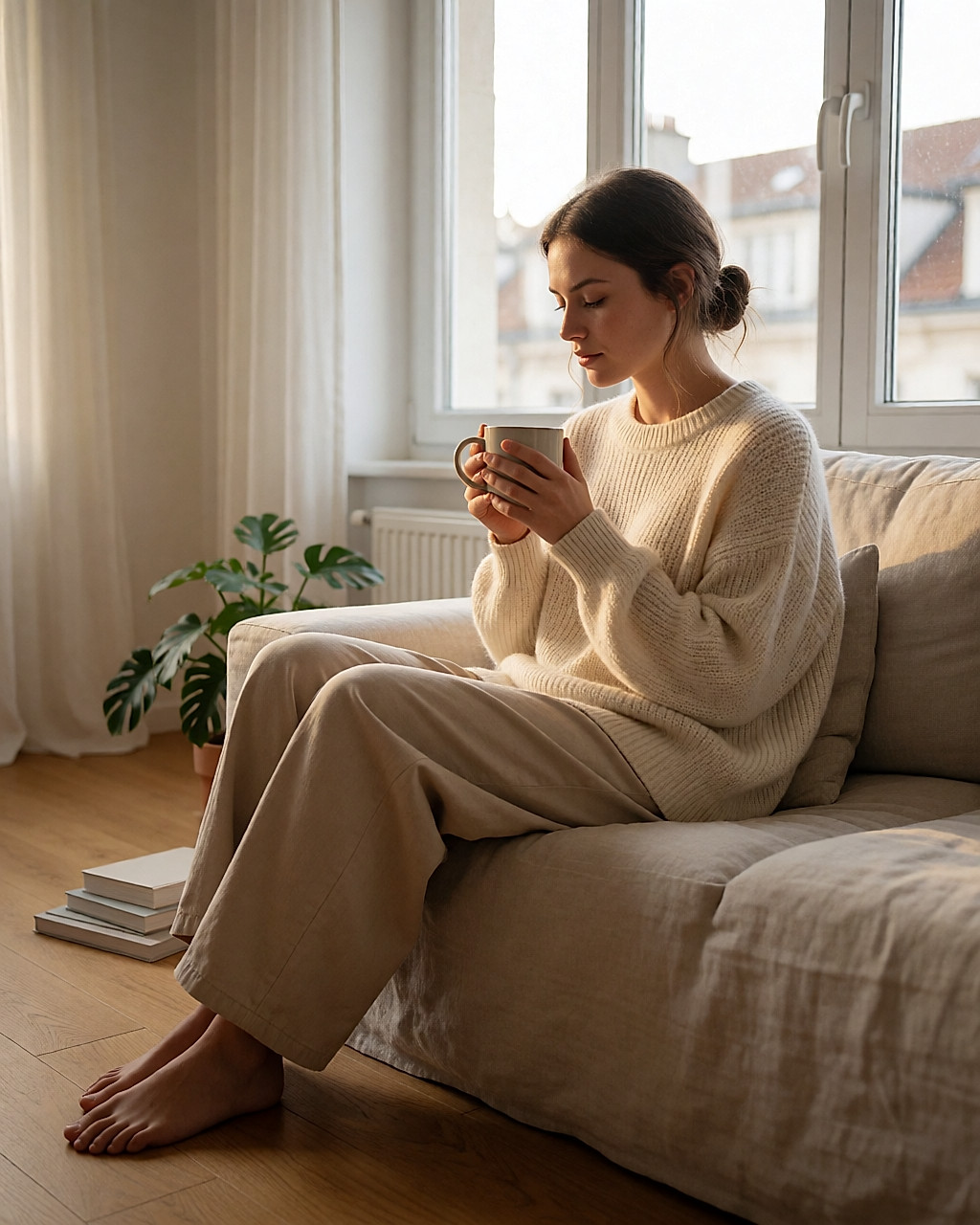
You go home. Alone. No break-up, no drama behind the closing door: just two addresses, two rhythms, and a relationship that holds. Demographers have a term for it — living apart together (LAT) — and the Office for National Statistics has recorded a long-term rise in one-person households in the UK since the 1960s. Your situation is not an anomaly: it even has a name.
The question is what this choice really changes for your wellbeing. Here is what we know, what we don't yet know, and what we're not promising or judging.
You negotiate less, you breathe more
The first advantage is obvious: you do what you want, when you want. An impromptu night out, a Sunday with no plan, a workout at 7 a.m. — none of it needs discussing. In practice, it eases a mental load that is rarely talked about: the everyday micro-negotiations simply evaporate. You are not running away from couple life; you are choosing closeness instead of enduring it.
This freedom has a flip side, and it is worth saying: it takes organisation. You need to be able to say when you need the other person, and when you need quiet. LAT couples who last often lay things out clearly: how many evenings together, who visits whom, how you handle the unexpected. Nothing very glamorous, but it helps avoid unspoken resentments.
Your sleep benefits
It is the joke friends make between themselves, and yet it stands up. Two people rarely share the same rhythm, the same ideal temperature, or the same way of moving in bed. The NHS advises that sleep is personal, and that the stability of your environment matters as much as the number of hours you get.
Current evidence suggests that fragmented sleep can affect mood, concentration and recovery. If your nights are regularly broken, it is not a romantic quirk: it may encourage a fatigue that settles in. When exhaustion lasts, seeing your GP can help rule out a medical cause. Sleeping at your own place is not selfish — it is basic self-care.

Reunions that still feel like dates
Living together day to day is practical, but it can blunt the edge. You no longer see each other; you pass each other. When each of you keeps your own home, shared moments regain their event status: a dinner, a weekend, an evening with no plan. You look forward to them, you savour them, and you are not simultaneously putting on a wash.
Distance also protects your private world. You keep a space, habits and friends who are not simply the couple's friends. This is not individualism: it is prevention against wear and tear. As long as the distance remains a choice and does not become an escape.

Chosen solitude, imposed isolation: the difference that matters
This is the distinction we hear too little about. Chosen solitude means going home because you love your own space, while keeping your connections alive: friends you call, family you see, neighbours you greet. Imposed isolation is the opposite: few contacts, little support, and a growing sense of emptiness. You can be alone at home without being isolated; you can also be part of a couple and still feel very alone.
Why does this distinction matter? Because prolonged isolation is a documented risk factor for mental and physical health. The WHO has set up a Commission on Social Connection, and the NHS provides information on links between isolation, mental health and general health. University research, such as Holt-Lunstad and colleagues' 2015 meta-analysis, associates social isolation and felt loneliness with higher mortality. This does not mean living alone makes you ill: it means regular social connection is a basic need, just like sleep.
In practice, when you each have your own home, keep at least one social commitment a week that does not depend on your couple: a lunch, a class, a walk with a friend. Create contact rituals, even short ones: a message in the morning, a call on your way home. And if you feel sad, anxious or low on energy for several weeks in a row, speak to a professional — your GP, a psychologist — without waiting for it to pass on its own. This is not a diagnosis, just a compass.
Before you settle into this arrangement, three questions are worth asking when you are calm.
- Am I choosing this way of life, or enduring it because I cannot find affordable housing?
- How many times a week do I see my partner, and is that enough for me?
- Do I really have a space of my own, where I can host, work or simply rest?
If any answer makes you uncomfortable, you can talk it through with a professional — your GP, a psychologist, a family planning clinic — or simply lay things out clearly with your partner.
Budget
Let's be honest: two homes cost more than one. For a comparable amount of space per person, expect roughly £130 to £350 more a month (rent, bills, electricity, subscriptions, insurance), with big differences between a large city, a market town and a rural area. The amount depends on the local market, the size of the property, the tenancy and insulation.
Where to look: letting agents and private landlords for a standard tenancy, intergenerational or student residences for gentler rents, and GOV.UK or your local council to check whether you are entitled to housing support. For furnishings, there is no need to buy everything new: second-hand shops, charity shops and refills cut the bill as much as they cut waste. The good news, though: this way of living is not an expensive whim if it is thought through from the start.
Sources
- Office for National Statistics (ONS) — Families and households, UK population data.
- NHS — Sleep and tiredness, advice on sleep and wellbeing.
- NHS — Mental health, information and support.
- World Health Organization (WHO) — Commission on Social Connection, 2023.
- Holt-Lunstad et al. — Loneliness and Social Isolation as Risk Factors for Mortality: A Meta-Analytic Review, Perspectives on Psychological Science, 2015.


Comments
Your opinion matters: rate the article, react and reply to comments.
Comments are moderated; AI-assisted comments are flagged. Text emoticons (8-), :-), <3…) are automatically shown as images.