
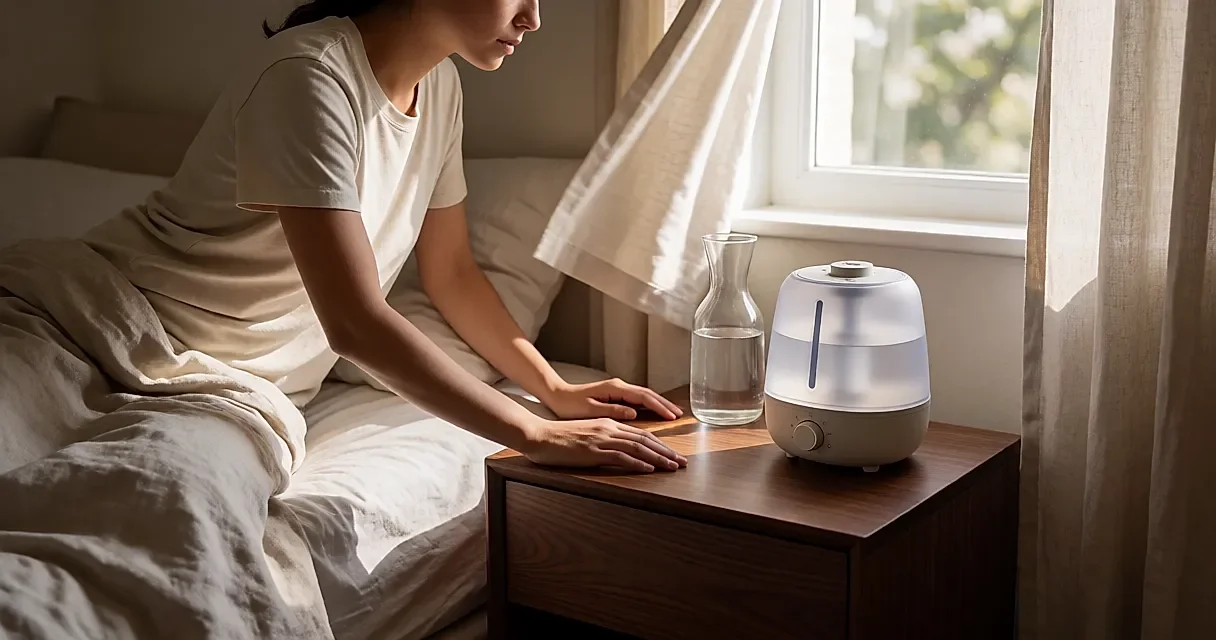
On the chest of drawers, a white film keeps coming back. On books, glasses and the edge of a picture frame: a dry, stubborn deposit that you wipe away and that returns within days. It isn't household dust. It is limescale from tap water, released into the air and settling on everything left out.
The white film has a specific cause
Three broad categories of machine compete for shelf space, and they do not deal with limescale in the same way.
Ultrasonic humidifiers, which are very common, use a vibrating plate to turn water into a fine mist. That mist also carries dissolved minerals, calcium and magnesium. The water evaporates into the room; the minerals settle as a fine white powder. The harder your water, the thicker the film. Warm-steam models boil the water instead: the limescale stays in the tank, which deals with the deposit problem, but they use more energy and get hot, so extra care is needed around children.
That leaves the family we are interested in: evaporative models. A fan blows air through a damp wick; the water evaporates as it passes and the minerals remain trapped in the wick. Nothing is projected, so nothing settles. The limescale does not disappear, it moves: it builds up in the wick, which will need replacing.
The word that matters is in the small print
On product pages, the technology is often pushed to the bottom, into a line of specifications in six-point type that nobody reads. Yet that is where the answer lies.
Look for 'evaporative', 'evaporation', 'cool evaporation' and sometimes 'wick'. Three physical clues confirm it: a filter or wick made from honeycomb cardboard, a wide outlet grille rather than a nozzle that emits visible mist, and airflow you can feel when you put your hand near it. By contrast, 'ultrasonic', 'cool mist' or 'nebulisation' point to the family that leaves the white film.
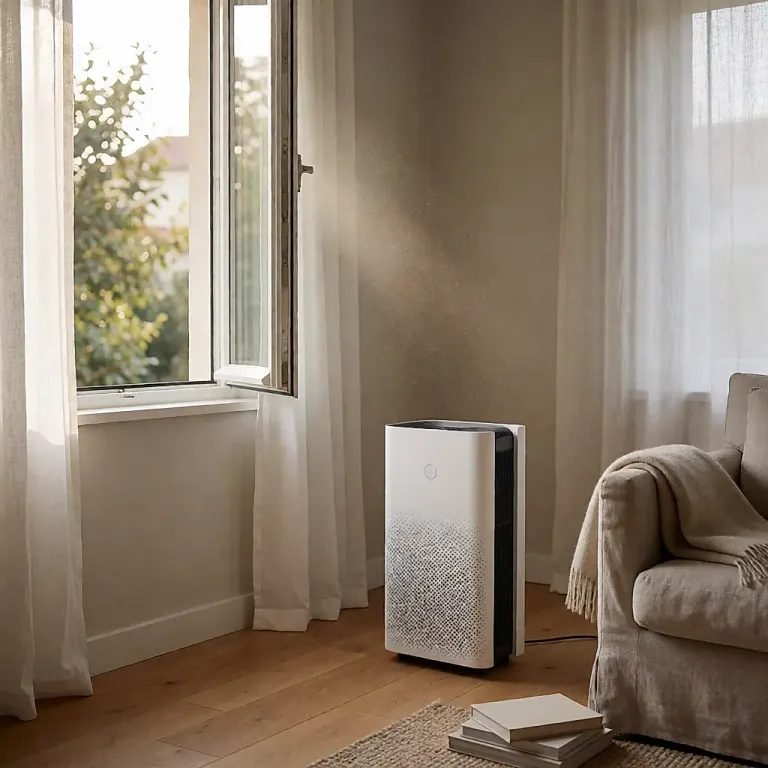
Two vocabulary traps while we are on the subject: a diffuser is for scent, not for humidifying a room; and an air purifier filters particles but does not replace a humidifier. They are two different jobs, which marketing likes to blur on the same box.
What water to use
With an evaporative model, tap water is fine in most cases: because the minerals stay in the wick, there is no reason to pay for demineralised water. That said, the wick will scale up faster in a hard-water area, so keep an eye on it. With an ultrasonic model, demineralised water reduces the white film, but that is a sticking plaster over the symptom, not a healthier kind of water.
A warm, damp tank needs regular care: for rinsing and drying, stick to the instructions in the manual. And do not add essential oils to the tank unless the manufacturer explicitly says you can.
What humidity level to aim for
The one useful extra is a separate object: a hygrometer, a small unit that displays relative humidity. It costs about the price of two coffees and stops you adjusting the machine blind.
It is often said that moderate relative humidity is enough to make the air comfortable. That is a practical guide rather than a health threshold: in practice, aim for moderate humidity rather than trying to push it high. Too much humidity can encourage condensation and mould growth, which is a reason to stay in a moderate range. At the other extreme, very dry air can be uncomfortable; if the discomfort continues, speak to a GP.
The machine does not replace ventilation: a few minutes of airing morning and evening will renew the air better than a night with the machine running. And if the dryness returns every winter, or if dry air is bothering you, that is a conversation to have with your GP, not a promise from a catalogue.
How much to budget
As a rough guide, expect to pay around £30–80 for a basic manual evaporative model, and £80–200 for one with a hygrostat, which switches the machine off automatically at the set level, and adjustable output. Replacement wicks often cost £10–20 and need renewing depending on water hardness and use.
They are sold in hardware shops, DIY stores, electrical retailers and online. A separate hygrometer costs £10–20 and is still useful even if the machine has one built in: the built-in sensor often measures the air right in front of its own grille.
Before the first night: keep the machine away from the wall and furniture so air can circulate, fill it with tap water if it is an evaporative model, and place the hygrometer at the other end of the room, not on the machine. Added humidity never replaces fresh air: opening a window for a few minutes a day remains the basic step.
One figure is worth remembering, and it fits on a small screen: the level shown by the hygrometer. An evaporative machine, a clean wick and a room kept at moderate humidity, and the white film on the chest of drawers should no longer return. If your bedroom still feels uncomfortable despite all this, advice from a GP is worth more than a third appliance.


Comments
Your opinion matters: rate the article, react and reply to comments.
Comments are moderated; AI-assisted comments are flagged. Text emoticons (8-), :-), <3…) are automatically shown as images.