
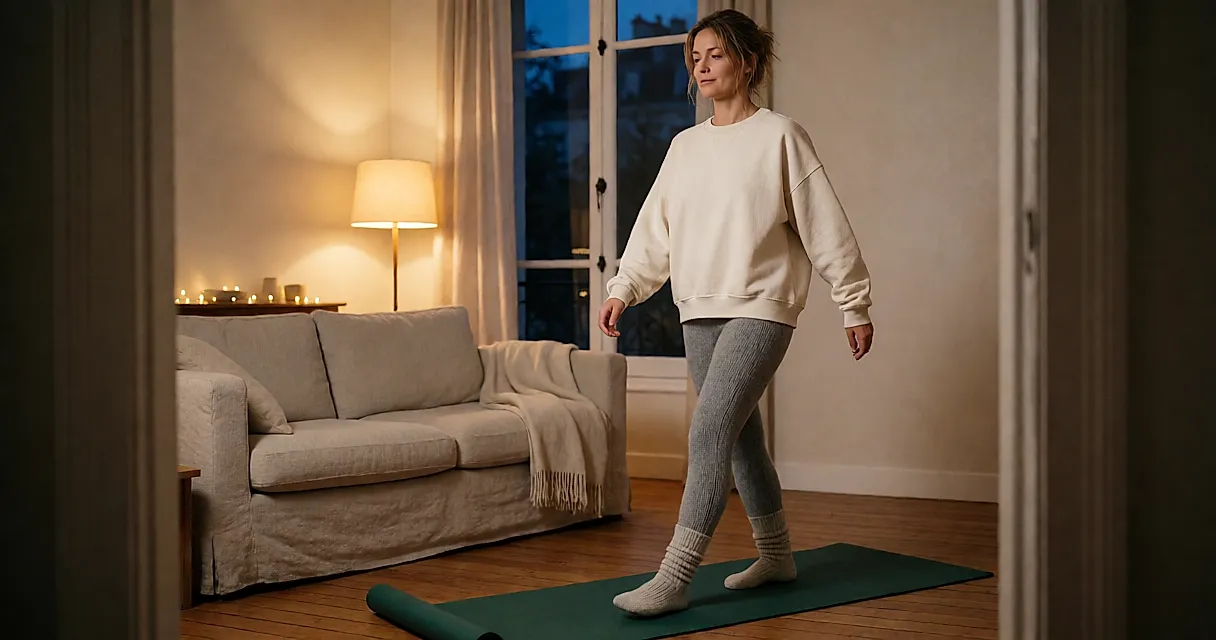
6.47pm, and it has been dark for a while. The blanket has already taken up residence on the sofa. You had planned to move; let's say the intention is in excellent shape. What if there were a version of a workout that asked for no timer, no gym and no competitive streak?
Autumn, when your energy starts to negotiate
Some things need no explanation: the days get shorter, the light is already fading when you leave work, and the urge to move goes on strike more often than it did in June. That is no reason to do nothing. It is a reason not to impose on yourself in November what you would not have imposed in May.
This is where cosy cardio comes in: moving gently, at home, in a warm and softly lit setting rather than aiming for performance. No records, no tracker, no session to make up for. There are only two things to aim for: comfort and consistency — a pairing that holds up much better when it is dark by 6pm.
Short, but often
The first trap is the perfect session postponed indefinitely. An hour, the gym, the bag, the shower, the journey home: at that rate, the sofa wins by default. A short format suits a rainy evening much better: ten to twenty minutes, adapted to how you feel that day — a practical benchmark. A few minutes today are better than an ideal hour that never happens: less heroic, and much easier to keep up.
That said, it does not do away with a few sensible reminders, without turning them into rigid rules: keep some movement in your week and leave room for gentle strength work. A gentle routine can contribute to that, but it does not replace everything — more on this below.
Four moves, almost no equipment
You do not need sophisticated equipment: a mat on the floor is enough, and if you do not have one, your carpet will do. Start with marching on the spot, knees soft, arms swinging, for a few minutes to wake the system up. Then gentle mobility: shoulder circles, pelvic tilts, slow torso rotations, and a back stretch without forcing it.
Add a short spell of calm core work — a knee plank, or simply a wall sit with your knees bent — then finish with slow breathing, one hand on your belly. The thread running through the session is this: you should be able to talk while you are exerting yourself. If you cannot finish your sentence, drop down a notch.
The setting does a lot of the work
This is probably what sets cosy cardio apart from an ordinary session: the surroundings matter almost as much as the movements. Warm lighting rather than a white ceiling light, a room at a comfortable temperature, thick socks, gentle music or a podcast you enjoy. A ritual you enjoy is one you return to.
One small but decisive detail: leave the mat unrolled, the night light plugged in and the playlist ready. Removing the little frictions that stop you starting is worth more than any promise to be more disciplined next week.
What it gives you, and what not to ask of it
Let's stay measured: moving a little, regularly, even at a moderate intensity, is common sense. Nothing spectacular, nothing magical — just gentle movement settling into your week, without requiring you to become an athlete.
What the routine cannot do, however, is replace more vigorous activity. More energetic sessions during the week — brisk walking uphill, cycling, swimming, depending on what appeals to you — can usefully complement the routine. And if pain persists or you become unexpectedly short of breath, it is no longer about atmosphere: speak to your GP or another healthcare professional.
The real test: when taking stock becomes useful
When you feel like taking stock, do it without judging yourself. The useful question is not 'Did I sweat?' but rather: do I come back to it without bargaining for an extra ten minutes? Do I finish without being completely out of breath? Do I want to do it again tomorrow?
If so, the routine is holding. If boredom sets in, change one parameter only — the order of the movements, the music, the time of day. And if your body is asking for more, increase the intensity gradually rather than changing everything at once.
When to stop and seek advice: chest pain, unusual breathlessness that does not settle at rest, dizziness, palpitations, or persistent joint pain. These signs should not be managed at home and need medical advice. More generally, if you are returning after a long break, are pregnant, have had surgery or live with a chronic illness, a GP or another healthcare professional can help you work out where to start.
Food supplements do not replace a varied, balanced diet and a healthy lifestyle.

Comments
Your opinion matters: rate the article, react and reply to comments.
Comments are moderated; AI-assisted comments are flagged. Text emoticons (8-), :-), <3…) are automatically shown as images.