
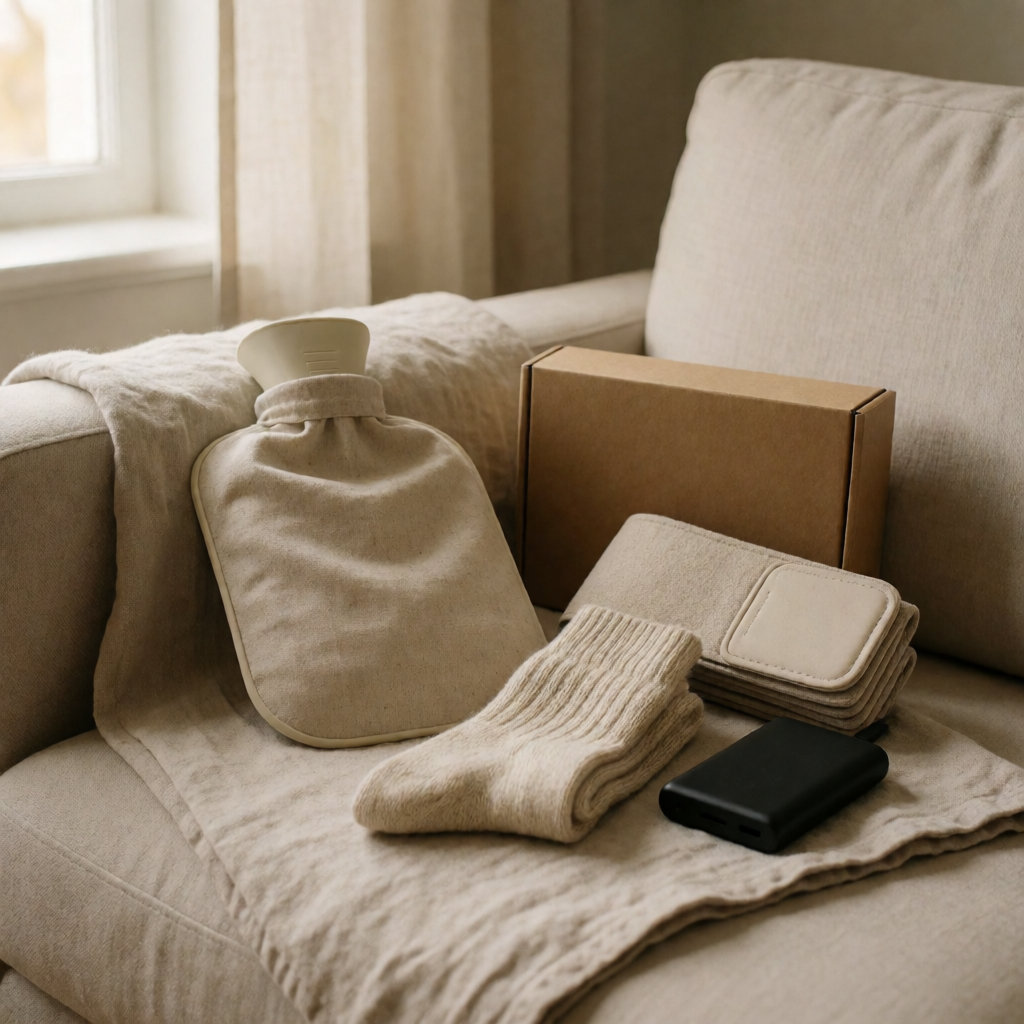
There are October evenings when you tell yourself you're not going to put the heating back on — and yet you end up shivering under a throw, feet like blocks of ice despite two pairs of socks. Don't panic, and don't nudge the thermostat up to 22: most of the time, three well-chosen bits of kit are enough to see the evening through in comfort. The trick is knowing which ones, in which materials, and how to keep them going for more than a season. Here's the full kit.
The hot water bottle: long-lasting warmth
Two families share the shelf, and they don't do the same job. The water bottle — natural rubber or PVC — gets filled from the tap and gives off gentle heat for one to two hours. The dry version, filled with linseed, wheat or cherry stones, goes in the microwave: it doesn't stay warm as long, but there's no damp and no risk of leaks.

On size, allow 1 to 2 litres for the water version: 2 litres sits nicely against the lower back when you're seated, while a smaller model curls up against the stomach. The grain-filled bottle is more like 20 to 30 cm and slips into a washable cover — which changes everything, more on that below.
The step that matters: fill two-thirds full, push the air out by pressing gently, screw the stopper on, then check it's watertight before putting it against you. For the grain version, stick to the time the manufacturer specifies and shake the bag — heat is uneven from one corner to another. Either way, always test on your forearm before applying it elsewhere.
And care? The cover goes in the machine; the filling never does. A grain-filled bottle that takes on moisture can go mouldy: store it somewhere dry. Rubber, meanwhile, cracks over the years — a quick look each autumn is enough, and replace it as soon as it hardens or turns white. A detail we forget all too often, and which ends up as a leak on the sofa.
Organic linen and French-grown grains make little difference to comfort, but a lot to traceability. Look at how sturdy the seams are and whether the cover is detachable: that's what lasts.
Merino socks: the wool that doesn't cool you down
Merino wool has a real trick up its sleeve: it's fine, it breathes, and it holds warmth even when damp. That's exactly what cotton doesn't do — once it's wet with sweat, it chills, and you end up with frozen feet within the hour. For winter at home, it's the staple that changes everything.

Watch out, though, for a common mix-up: recycled merino can come from production offcuts, and the Global Recycled Standard guarantees the share of recycled material — not where the wool itself came from. If that matters to you, look for certified organic wool or a traced specification, even if it costs a little more. On fit, mid-calf for indoors, thicker and taller for outdoors. And if you wear tight shoes, go for a knit without a pronounced toe seam.
For care, wash at 30 °C on a wool cycle, no fabric softener, dry flat. Between wears, a simple airing is often enough — and that's all the better for the life of the pair.
The heated belt, for the lower back
It plugs into a USB power bank or the mains, and is worn over a thin layer of clothing. The criterion that really counts isn't the stated wattage or the number of heat settings: it's a removable, replaceable battery. That's often the first part to go, and a belt whose battery can't be changed ends up in the cupboard after a season. Worth a second look at the point of purchase.
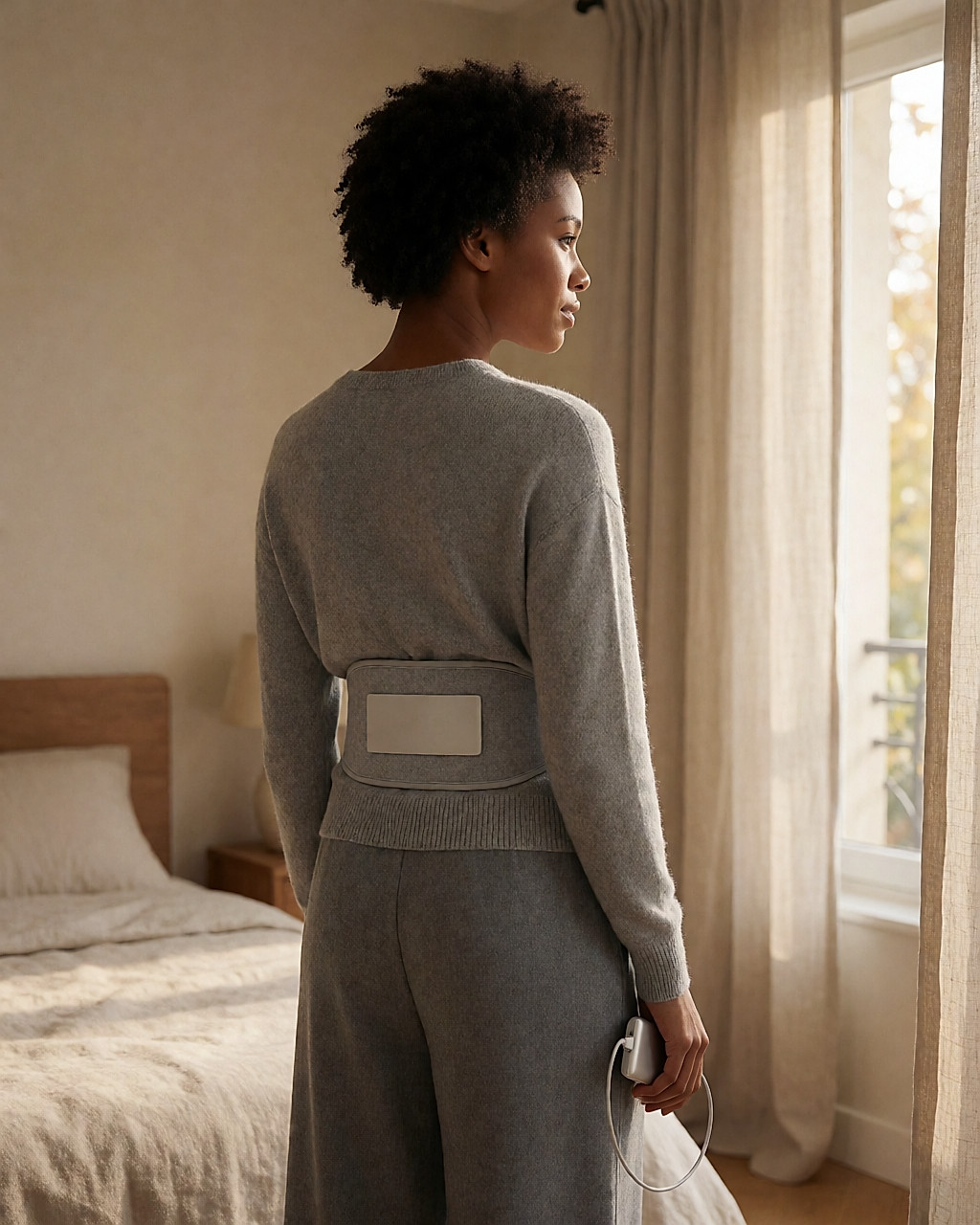
The routine, then: short sessions, following the manufacturer's instructions, never directly on the skin, and not while sleeping. The charged battery is stored separately, away from the folded belt.
What we know, and what we don't yet: heat may bring temporary comfort for passing muscle discomfort, but it isn't a substitute for medical advice if the pain settles in. Lower back pain that persists, or comes with other symptoms, isn't treated by heat alone — diagnosis is down to a healthcare professional, and that's who to see.
Heat and skin don't always get on. With diabetes, neuropathy or reduced sensation, the perception of heat is altered: ask a healthcare professional before using a prolonged heat source. And if your skin reddens for a long time or burns, stop and show it to a professional.
Budget
Allow around £8 to £20 for a water bottle from a pharmacy or supermarket, and £20 to £35 for a model with a sewn-in cover. A grain-filled bottle sits between £10 and £25 for a standard version, £25 to £45 in organic linen made in France.
For socks, the range goes from £10 to £20 a pair at entry level, £20 to £40 in traced or recycled merino, £20 to £35 for a thicker walking model. Prices rise with the fineness of the fibre, the origin of the wool and European manufacturing.
The heated belt, finally, runs from £25 to £60 for a supermarket own-brand, and £60 to £120 for a branded model with a replaceable battery, automatic shut-off and washable cover. Where to find them? Pharmacy and health shops for bottles, outdoor shops for socks and belts, eco stores, haberdashers and zero-waste shops for heat linen, marketplaces and brand sites for wider ranges. On those platforms, check the CE marking and the reviews about the battery — that's often where the problem lies.
And there you have it, the full kit. Nothing miraculous in there, and that's a good thing: a well-filled hot water bottle, a pair of merino socks that breathe, a belt you can repair rather than bin — three sensible buys that will win you a few precious degrees without touching the thermostat. All that's left is to pick your corner of the sofa.
Sources
- UK Health Security Agency — Cold weather and health guidance, accessed 2026.
- NHS — Staying well in winter, accessed 2026.
- Energy Saving Trust — Recommended home heating temperatures, accessed 2026.
- Office for Product Safety and Standards — Product recalls (hot water bottles, heat pads), accessed 2026.
- Textile Exchange — Global Recycled Standard and Responsible Wool Standard frameworks, accessed 2026.



Comments
Your opinion matters: rate the article, react and reply to comments.
Comments are moderated; AI-assisted comments are flagged. Text emoticons (8-), :-), <3…) are automatically shown as images.