

A boot heel laid flat on the table never lies: the sole has sloped away like a ski run, the outer corner has gone the colour of pumice, and the material has hollowed out exactly where you never look. You bought them new, promising to look after them. Two winters later, it's the heel that's giving up while the rest of the shoe is still perfectly sound.
Before you reach for your card, there's one thing worth knowing: how to read the wear. Not to reassure yourself, but to act in time. A heel that wears on the slant can be repaired; once it has worn through, you're no longer repairing, you're salvaging.
What the slant is telling you
Look at the soles of your favourite shoes in daylight, not in a hurry in the hallway. Is the outer corner of the heel more worn than the inner? That's the most common pattern: the foot rolls slightly to the outside as you walk. The reverse — the inner side collapsing — also happens, often with high heels or very soft soles. Professionals use pronation and supination to describe how the foot lands and rolls; these are observation terms, not a diagnosis.
What matters for you: some uneven wear is normal, and it's rarely identical on both feet. We all have a leading foot, a side we load more, a gait built up over years of commuting. But if the slant deepens over a few months rather than a few years, or if it comes with pain, that's the point to speak to a podiatrist or GP — not to order yet another pair in the hope the problem will sort itself out. A shoe is not a corrective device, and a worn heel is not a medical certificate.
Heel tips and sole protectors: your two safeguards
The heel tip — the small piece of leather or rubber at the base of the heel, sometimes called the top piece — takes all the friction. It costs very little, can be replaced in minutes and protects the structure of the shoe. The sole protector, meanwhile, is a thin extra sole fitted under the forefoot: it takes the wear instead of you and can be replaced without touching the original sole.
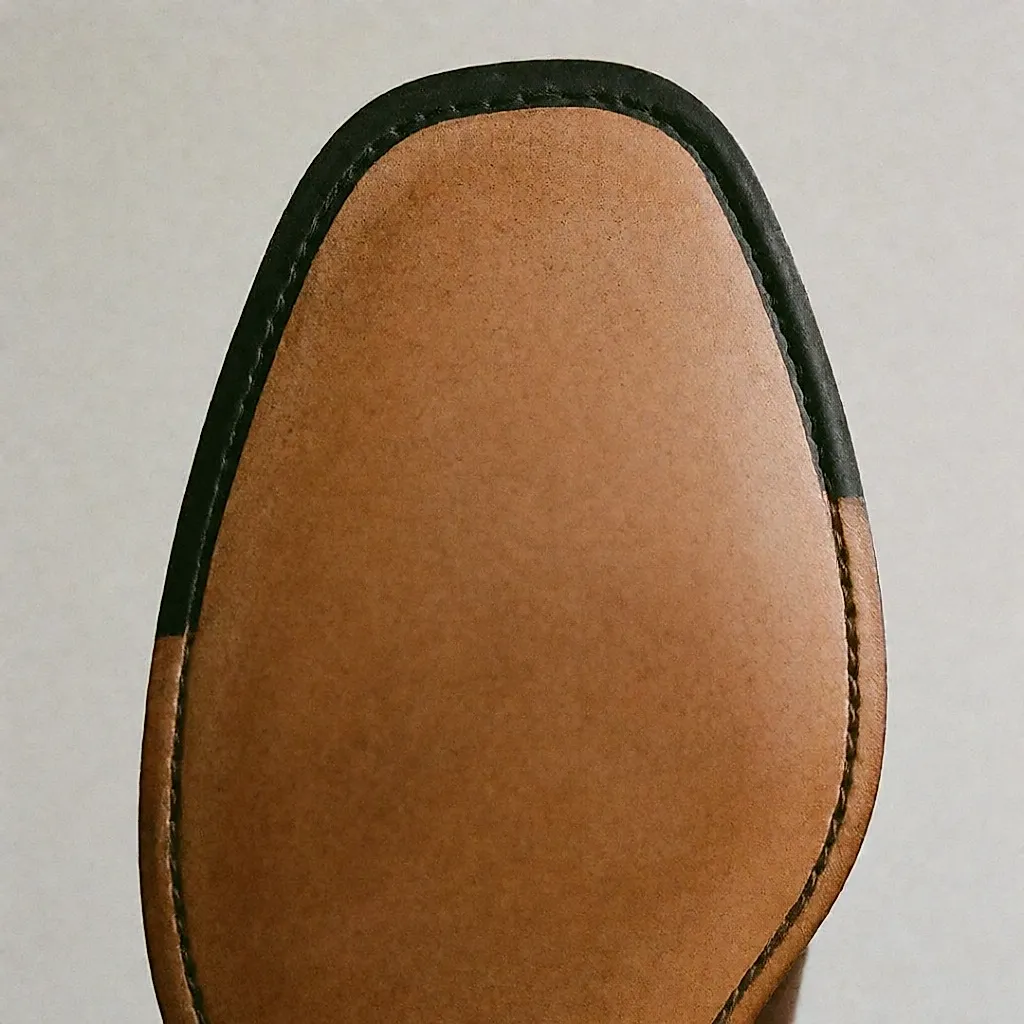
The smart move is to have them fitted before the sole wears — or as soon as the slant appears. Why? Because the original sole can't be recreated exactly. Once the heel has been eaten into, the repair becomes heavier, more visible and sometimes more expensive than buying a pair in the sales.
Fine heels deserve their own paragraph: on a stiletto, it's the little metal tip, or heel tip, that wears first, and saves the rest. A stiletto whose tip has gone means the heel covering goes next, then the heel itself starts to fray. It can be repaired, but better not to let it get that far.
When repair no longer makes sense
There is an honest threshold. If the heel has worn through, if water has got into the sole, if the lining has given way at the back, repair becomes a sticking plaster. A cobbler will tell you plainly: sometimes they refuse the job, not for want of willingness, but because they know it won't last the season.
A new pair isn't always the right answer either. A leather shoe with a stitched sole can be repaired ten times; a glued pair with a moulded sole, much less. Before you buy, check how much synthetic fibre is in it and how the heel is attached: stitched is an investment; glued is a consumable. This is the only point in the article where we ask you to read a label.
The weekend-home test: put both shoes side by side, heels facing you. If the wear differs sharply between left and right, your walk is doing the talking. If it's the same corner twice, it's the heel covering rubbing — and that's the shoe to keep an eye on, not you.
What it costs
Expect around £10–£25 for a pair of heel tips fitted by a cobbler, £15–£40 for a sole protector depending on surface and city, and £5–£15 for a stiletto heel tip. Stick-on preventive sole protectors, sold on a roll or pre-cut, often come in under £15: handy for trying the principle, less durable than a workshop job.
And the big spread on shoes: £60–£120 for a pair of boots with a stitched, repairable sole, against much less for a disposable pair that won't see a third winter. The calculation isn't moral, it's arithmetic — and it clearly leans one way, doesn't it?
A repaired heel is a pair that goes back out for two more seasons. A heel worn through is a pair that ends up at the back of the wardrobe waiting for a good Samaritan. So tonight, turn your soles over: the slant still has time to be a gentle slope rather than a hole. And if your local cobbler has a slightly dusty window, that's often a good sign.



Comments
Your opinion matters: rate the article, react and reply to comments.
Comments are moderated; AI-assisted comments are flagged. Text emoticons (8-), :-), <3…) are automatically shown as images.