
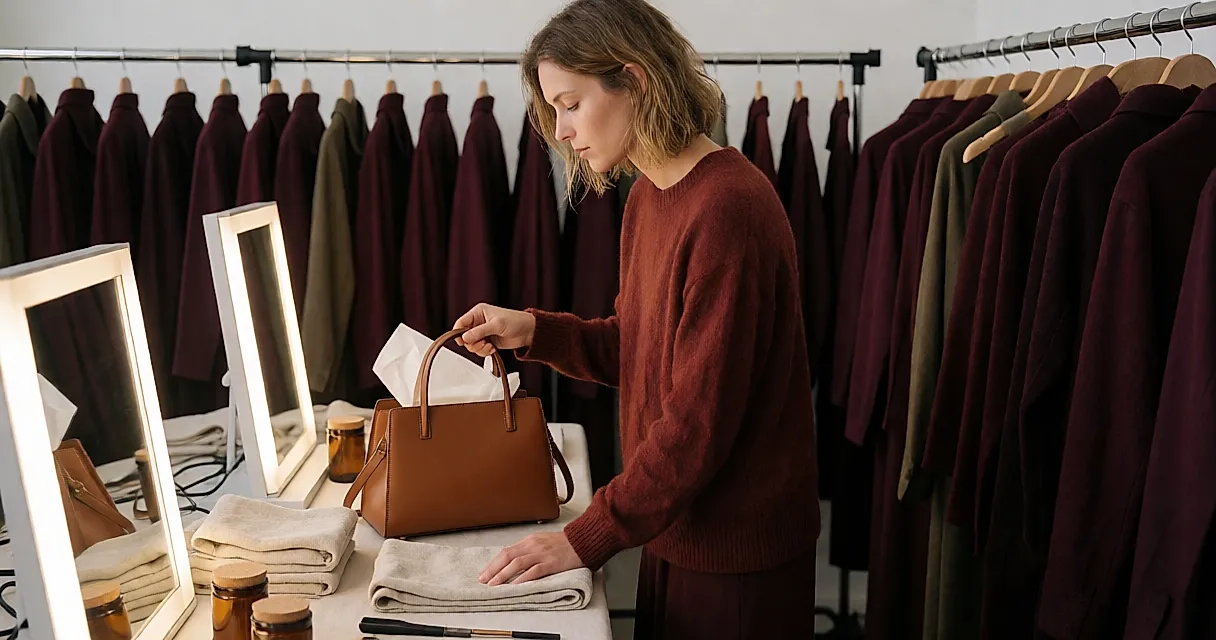
On the top shelf, a bag's handle stands up on its own, perked like a rabbit's ear. Nobody has carried it for six months, and yet it has kept the exact curve of a crooked elbow. Leather forgets nothing — least of all the position you last left it in.
An empty bag is never really resting. With nothing to hold its body, it slumps, the sides hollow out, the lining creases. Hence the job in hand, which isn't a purchase: fifteen minutes, twice a year, and a bag that ages well instead of looking tired before its time.
Empty doesn't mean resting
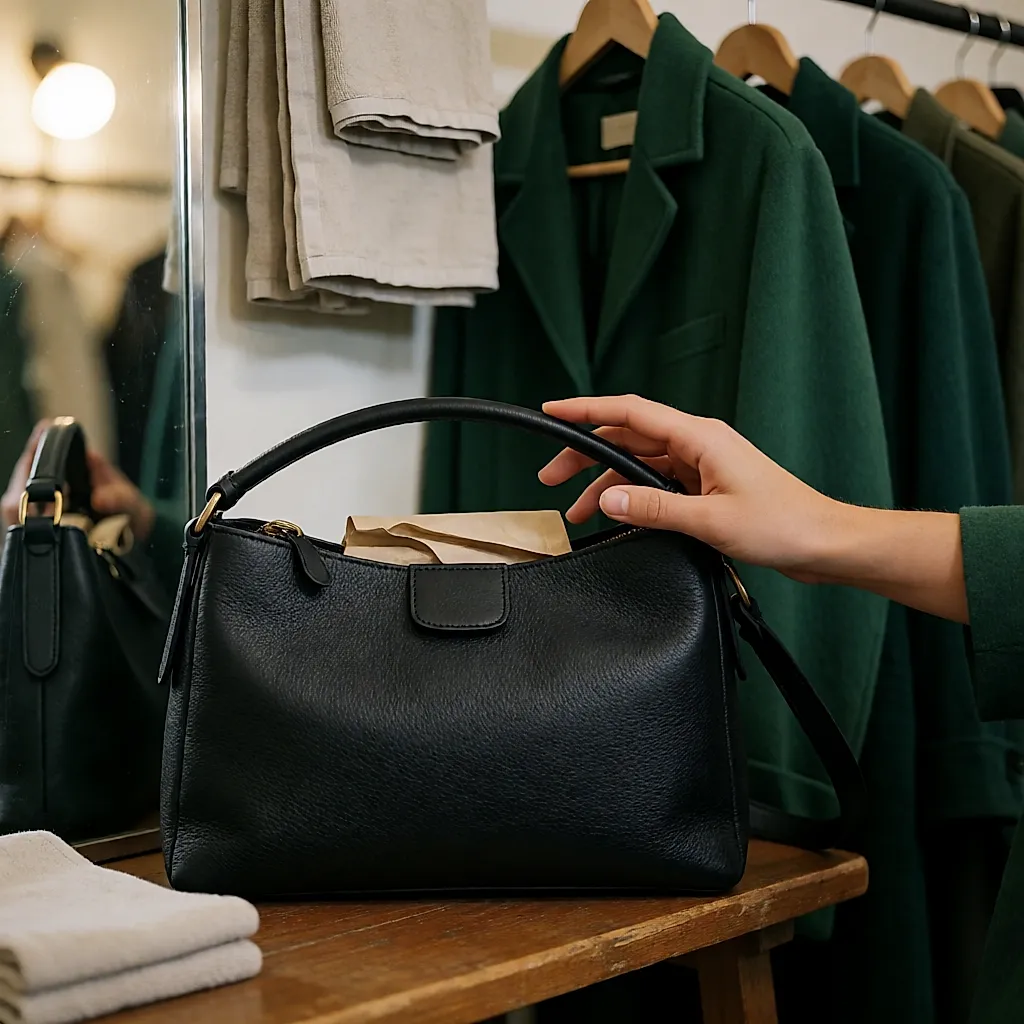
The instinct, when you're putting things away, is to shove the empty bag to the back of the wardrobe, folded in half to save space. Except that fold doesn't come out when you do. Better to pad the body: crumpled tissue paper — lightly scrunched sheets, not a tight ball — slipped in from the base upwards, until the bag holds its own shape without being stretched tight as a drum.
The shape of the bag decides the rest. A structured style gets stored upright, wedged between two neighbours of a similar size; a soft bag lies on its side, with a paper cushion inside. And if the bag is your one everyday companion, there's no need to invent a ceremony for it: the one that deserves the most care is the bag you carry for two weeks a year.
A handle has a long memory
The handle is the most stubborn part of a bag. For months it has moulded to your shoulder, your wrist, your elbow; it has taken on a precise curve, and that curve it keeps. So you lay it down: on its side, following its natural curve, rather than folded in two at the same point for six months.
What do you actually avoid? Leaving the handle standing upright under another bag — that's how you get a right angle where there used to be a curve. Hanging the bag by its handle on a peg for months, with all the weight pulling. And stacking three bags by slotting their handles through one another, which amounts to asking one piece of leather to hold another's posture.
Three neighbours leather can do without
A radiator, a sunny window, a damp wall. Heat and humidity are things leather would rather avoid — and a wardrobe against a heated partition wall is not a good home. Move the bag away, air the room now and then, and never put a bag away still damp after a shower: let it dry naturally, away from any heat source.
As for what it goes into, a cotton dust bag breathes. A plastic one? It traps moisture. Without a dust bag, a cotton pillowcase does the job perfectly for a medium-sized bag. It isn't glamorous, but it's the kind of detail you notice ten years down the line.
When the crease is already there
Should a leather bag that's already creased be stored like a new one? Not quite. Let's be honest: a crease doesn't vanish because you stored the bag properly. What storage changes is what happens next — it stops new ones forming, lets the leather relax a little where it was compressed, and keeps the handle from denting further. In practice, allow a season of careful storage to see a difference on soft leather; on stiff leather the crease stays, and that's part of its character too.
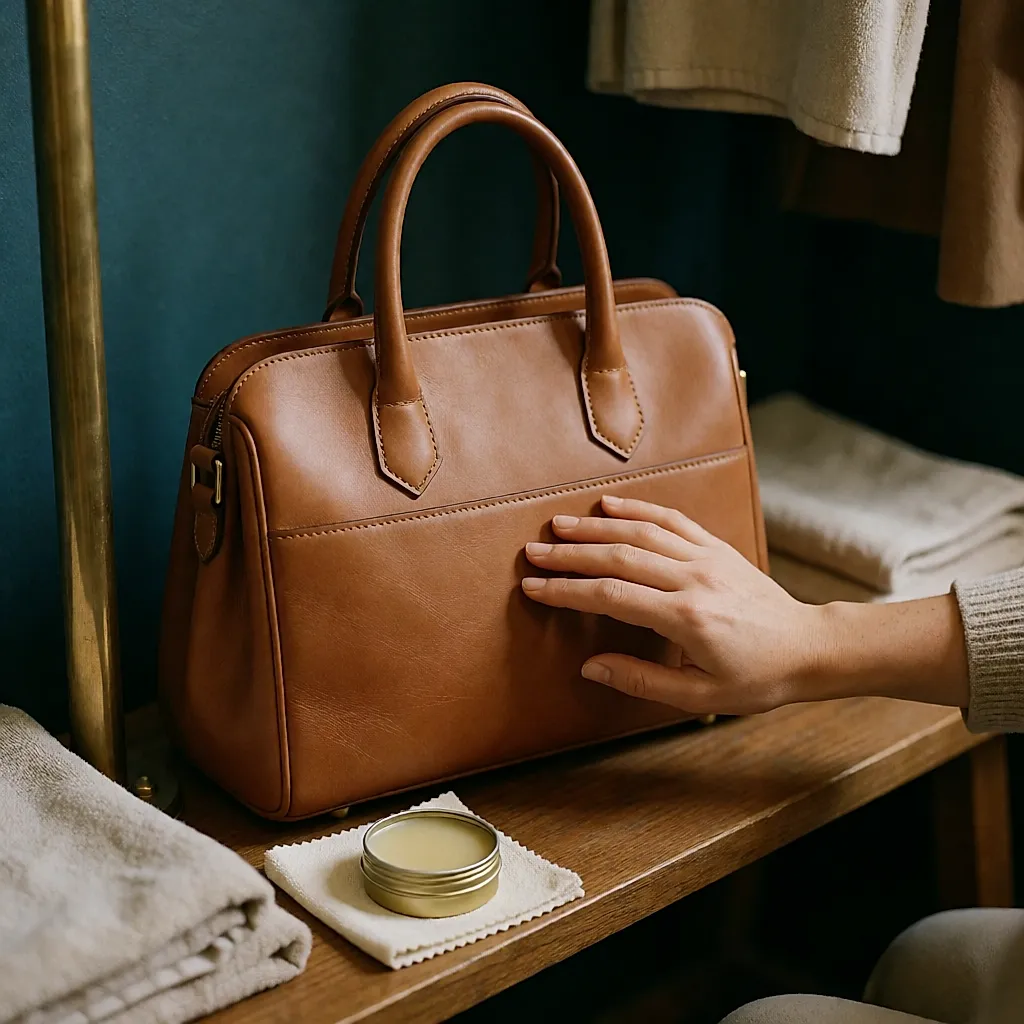
If the crease has actually cracked — the surface crazing, the colour lifting along the line — that's no longer storage, it's repair. A cobbler or a leather specialist will tell you whether the leather can be fed, recoloured, or whether you need to learn to live with it. One thing's certain: you never iron leather.
The cost: next to nothing, and a bit of time
The whole kit fits in a shoebox. Tissue paper: around £5 to £10 a pack from a stationery shop or a haberdashery counter, enough to stuff four or five bags. Cotton dust bags: roughly £8 to £20 depending on size, from a department store, a haberdashery or a homeware shop.
The foam bag inserts sold for storing handbags cost £10 to £30. Honestly? Tissue paper does the same job and moulds better to the shape of your bag than a standard insert. The real expense is time: fifteen minutes, twice a year, at the change of season.
The rotation ritual: at every change of season, take the bags out, air them for 24 hours, re-stuff them, check the fastenings and the stitching where the handles attach. It's also the moment to decide which one goes out for the season.
Then there's the choice, and it's simple. One lovely bag carried every day? A dust bag, a stable shelf, and you leave it at that. Three bags in hibernation? That's where padding and laying the handle down make a difference — for the price of a pack of tissue paper and a pillowcase. Leather doesn't ask for much: just that you don't leave it to decide its own shape.

Comments
Your opinion matters: rate the article, react and reply to comments.
Comments are moderated; AI-assisted comments are flagged. Text emoticons (8-), :-), <3…) are automatically shown as images.