
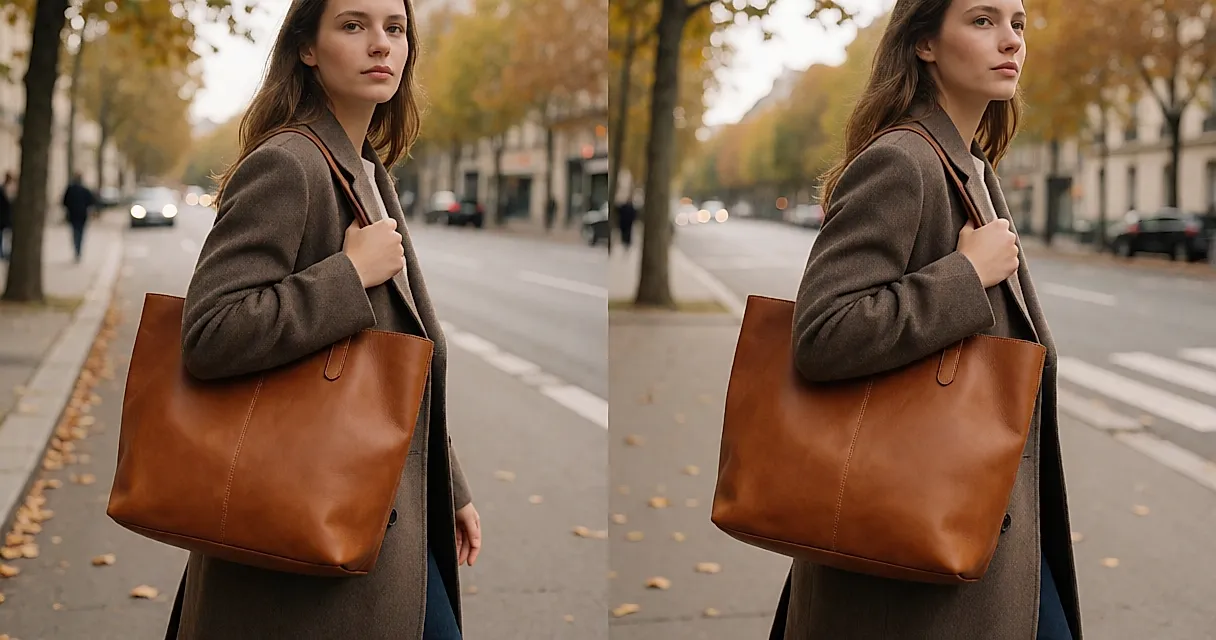
You judge a work bag by its shell first — and by whether it stays carryable once it's full. The rigid tote, the one that stood to attention like the first day of term, has its defenders. Around us, though, the soft one is winning: that's a sense from the pavement, not a poll. It settles onto the shoulder and finally accepts a life that overflows.
The structured tote: charming, but a nuisance to carry
For years the office bag played at being a filing cabinet: sharp corners, visible structure, short handles, and a habit of standing in the middle of the room like a small monument. Charming in a photograph, exhausting in daily life — impossible to tuck under your arm while running for a bus, and always that feeling of carrying a shoebox.
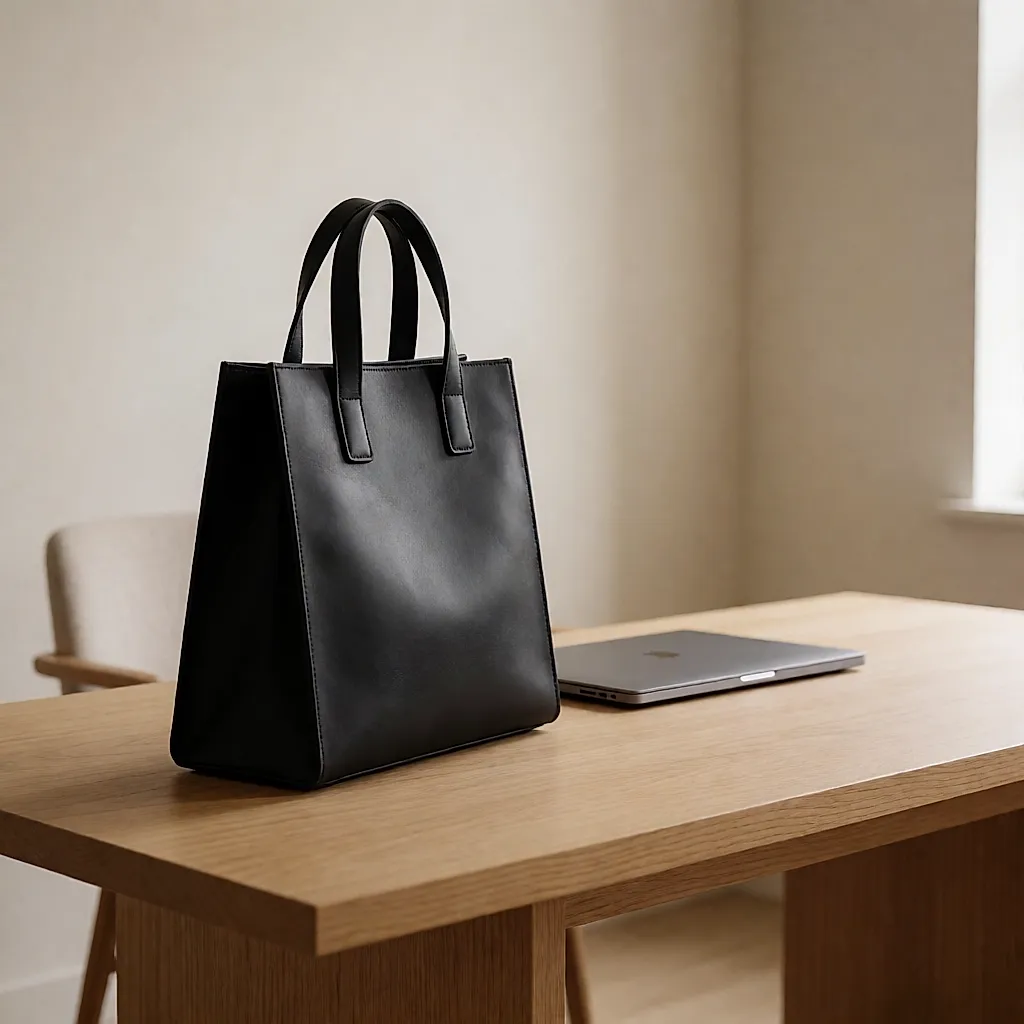
What we actually want is the opposite: a piece that slumps when you set it down, wedges between your knees on a packed train, and doesn't ring hollow when you empty it on a Friday night. Chosen that way, a work bag becomes an accessory that follows the body instead of correcting it, and the look gains in ease whatever it loses in stiffness.
The price doesn't necessarily come down: it often just moves. You're no longer paying for structure so much as for drape — harder to achieve in the workshop, and much harder to judge at a glance in a shop. Which is why it pays to know exactly what you're looking at before you get your card out.
It all comes down to the drape
Soft doesn't mean limp. The whole nuance sits in the thickness of the leather and how it's tanned: full-grain, vegetable-tanned leather creases nicely at the sides, keeps a little body and patinates without losing its shape. Leather that's too thin collapses into accordion folds, the corners go pale, and after a single season the bag looks like it's been to war.
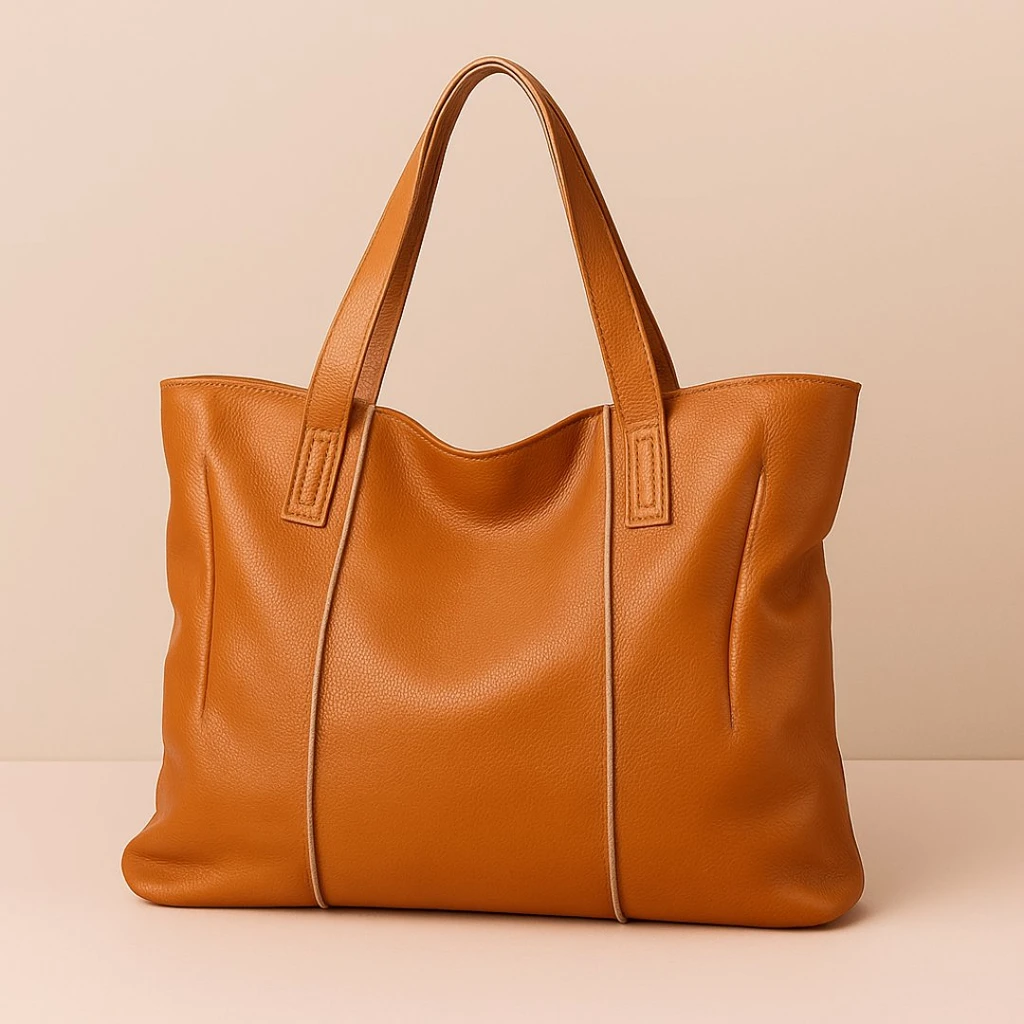
The trick is being able to check that without losing an afternoon to it, in shop lighting that flatters nothing. The gesture that tells you more than any label? Empty the bag, lay it flat on the counter and watch how it drops. If it collapses into nothing, it won't hold anything with a laptop inside. If it stays standing like a cube, you're back to the structured tote. The sweet spot is in between: leather that keeps the fold without keeping the rigidity.
Edges get overlooked. A well-finished raw edge, or one painted with care, usually signals serious work; an edge that frays in the second week, less so.
The base, the lining and the details that count
A 13-inch laptop is light in absolute terms, and heavy after an hour in a bag whose base is a single layer of canvas. A reinforced base — a discreet rigid panel, or simply thicker leather with a lining behind it — spreads the load instead of concentrating it on two seams that will eventually give.
The other thing fittings tend to skip: the lining. A thick lining protects the screen from loose keys, stops the bag losing its shape from the inside, and ages far better than a thin fabric that peels. The share of synthetic fibres is worth a look if natural materials matter to you: on that point, not all bags are equal, and price isn't always a reliable indicator.
Handle drop: check it before you pay
Then there's handle drop, which almost everyone checks too late. It ruins a great many purchases, and gets very little airtime. You want a drop that lets you carry the bag on the shoulder over a November coat without it jamming under the armpit. Too short, and it rides up with every step.
And for carrying it by hand? Judge a short handle with the bag empty, never full: it's once the daily ten kilos are in there that you understand why some handles saw into your palm. The ideal is a double handle — one to carry by hand, one to slip over the shoulder — the tote that doesn't make you choose. A handle a touch too short, and winter turns into an involuntary weights session.
At the counter, two gestures beat a long speech. Put the bag on the floor and press gently on the base with your foot: if it gives, your laptop won't sit well. Then slip the handle over your shoulder wearing the jacket or coat you'll have on in November; if it pulls now, it will pull every day.
Price: a rough guide, handled with care
Now the price. Without an independent benchmark to point to, these ranges stay indicative and far from exhaustive: expect roughly £150 to £300 for a soft tote in cowhide or leather of ordinary quality, £300 to £600 for a well-finished full-grain vegetable-tanned leather, and from £900 upwards at an established house. These figures vary with the city, the range, the finish, the lining and where you buy — brand boutique, multi-brand store, department store, online or pre-owned. The best approach is to compare like with like and ask for the detail of the material. Nothing stops you starting lower: resale platforms often have soft totes at more accessible prices, provided you ask for photos of the base and the corners before you commit.
And to train your eye, two French labels come up again and again: Longchamp and Jérôme Dreyfuss. They're not the only good finds, but they give you benchmarks.
One last thing, at the till: put your laptop in the bag, then the handle on your shoulder. If the base holds, the handle doesn't pull and the leather keeps a little body, you've got a good candidate. Take the time to fill it and carry it before you pay: that's where the real difference lies between a bag that follows your shoulder and one that corrects it.
Comments
Your opinion matters: rate the article, react and reply to comments.
Comments are moderated; AI-assisted comments are flagged. Text emoticons (8-), :-), <3…) are automatically shown as images.