
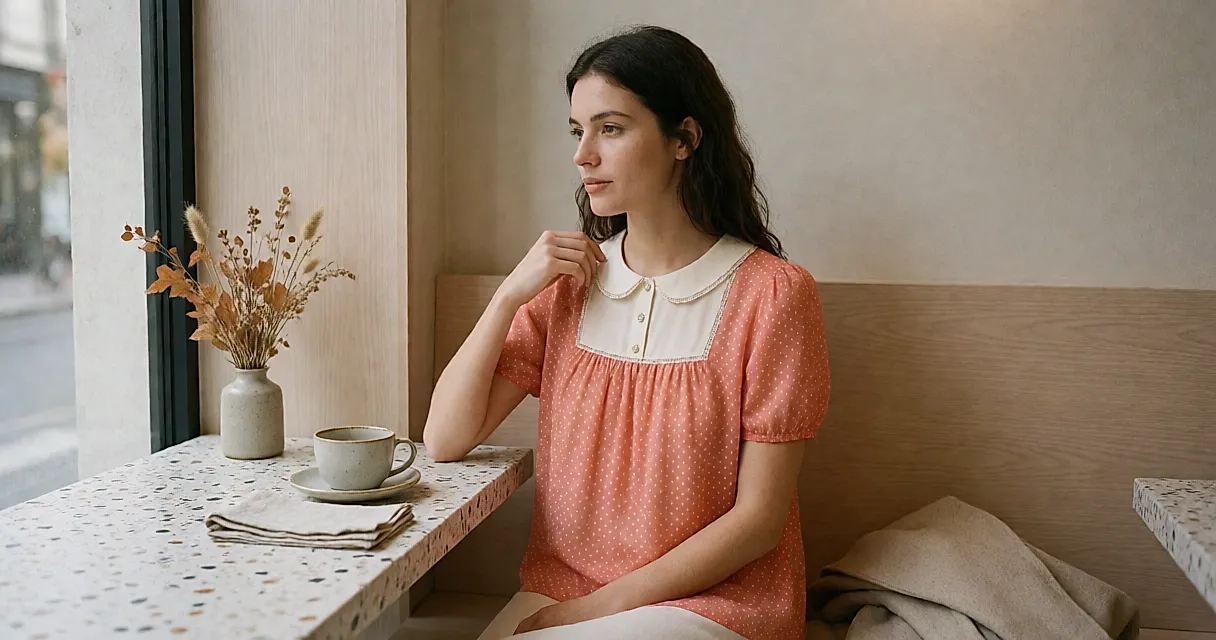
A coral top with white polka dots, a cream collar cutting a clean line at the neckline, and a fabric fine enough to let November's grey light through. That was the silhouette that stopped us in a shop window, between two very sensible coats. The Peter Pan collar, or Claudine collar if you prefer, was once inseparable from the school shirt. It has just changed address.
The collar has changed address
On the rails, it no longer fastens anything at all. It sits on voile tops, fine jerseys and cotton plumetis, and floats above a round neckline instead of being buttoned up to the chin. Does a collar that doesn't fasten anything still count as a collar? Yes, and that is exactly the point: it has become a decorative collar, a detail you add, which no longer structures the garment but gives it its signature. The buttons follow the same logic, as tonal buttons, sometimes pared back to three pearlescent buttons whose only job is decoration. And quite right too.
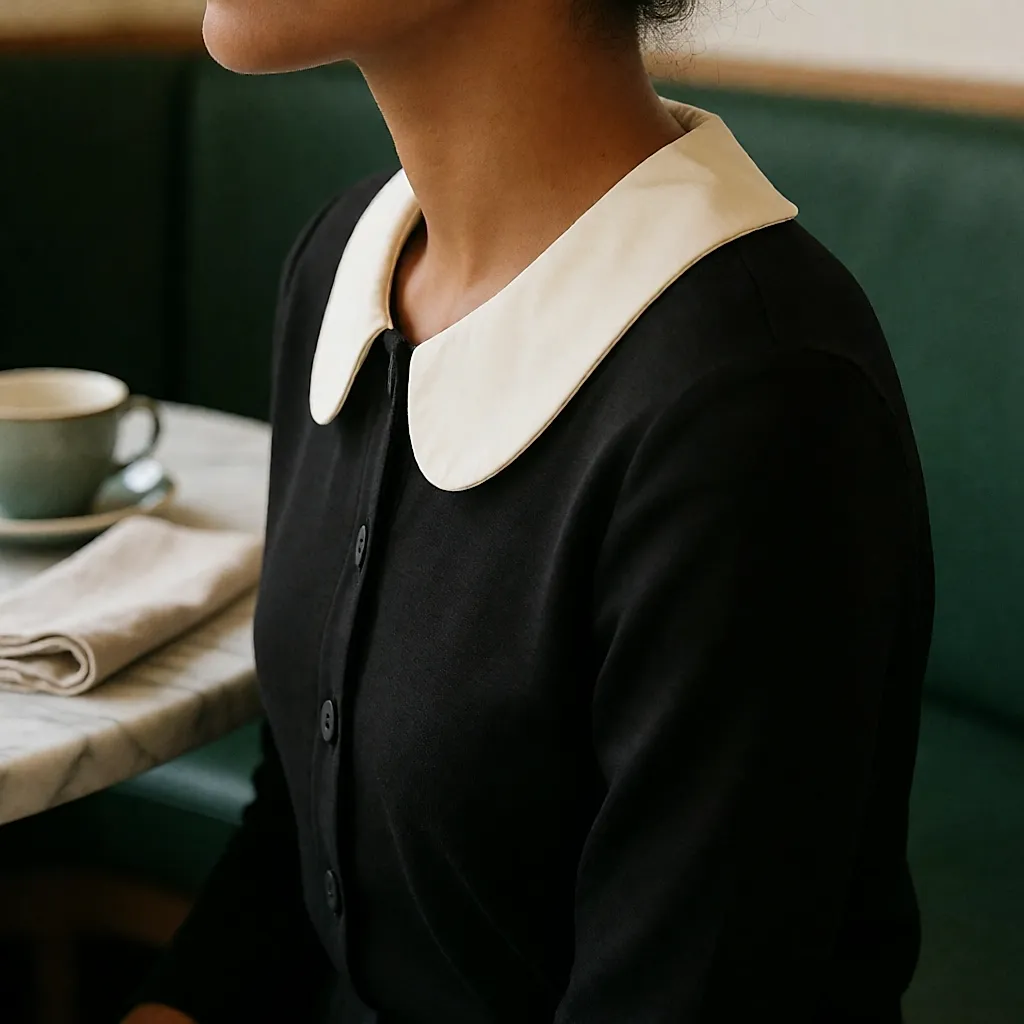
The real difference is in the drape. On a shirt, a collar holds because the whole garment is constructed. On a fluid top, it has to hold by itself: look for a slightly crisp poplin, a linen blend, a lightweight cotton canvas. A collar cut from a soft, floppy voile, however pretty, will end up dropping onto your shoulders before midday, and you'll spend the day putting it back in place. We gave up.
Cream against a bright colour
The coral with white polka dots sets out the formula: bright background, cream collar, print worn with confidence. It is no accident. A collar in the same colour as the top makes the whole thing look uniform, almost schoolish; a cream collar draws a clear line at the neckline, brightens the face and keeps the retro detail on the right side of a wink rather than fancy dress. On bottle green, plum or a strong blue, the same principle works just as well.

Then there's the print question. If the top is polka-dotted, micro-floral or striped, choose a plain, unembroidered collar: two patterns would compete for the same space and the eye wouldn't know where to settle. Conversely, a collar with a contrasting trim or a little broderie anglaise calls for a plain background. The simple rule: only one element should tell a story at the neckline.
Sheer, yes, but over what?
A semi-sheer top with a collar is charming in theory and much less so on the morning commute. The right base is neutral and matte: a cotton camisole, a fine bodysuit, a close-fitting T-shirt, in nude, cream or black depending on the colour of the top. Two layers of sheerness and you end up with a blur that suits nobody.
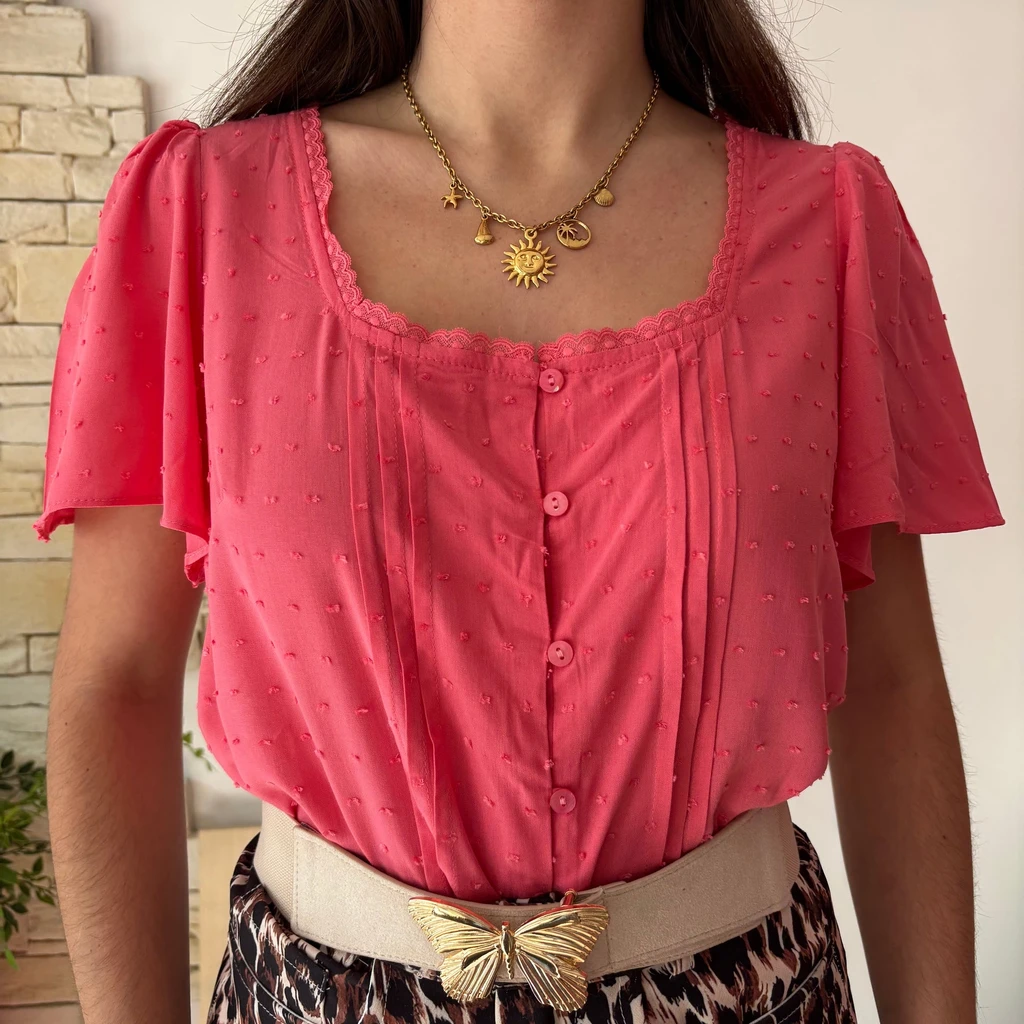
As for shape, a high collar combined with sheerness adds volume across the bust. If you have a fuller bust or broad shoulders, choose an open V collar, or a top where the sheer section starts below the bust. The bottom half can then stay very simple: straight jeans, wide-leg wool trousers, a plain midi skirt. That's where the piece works for you without the whole outfit overdoing it.
Leave the necklace in its box
The trick people forget: with a Peter Pan collar, take off the necklace. The collar is already the ornament, a fabric bib in its own right; add a chain and the neckline starts to look like a jewellery display. Discreet earrings are enough, and if your hair falls over your shoulders, a half-up style or a clip holds it back so the collar can breathe.
Why does this detail work better dressed down? Because retro femininity worn without irony can tip into stage costume: pencil skirt, heels, chignon, and you half expect a recitation. With jeans, slightly battered trainers or a jumper tied over the shoulders, the collar becomes a bit of mischief. It's that precise mismatch that makes it wearable in the office on Monday and at brunch on Sunday. Do note the limit, though: for an interview or a very formal meeting, sheerness muddles the message. Keep the opaque version for those days.
Budget
As a rough guide, expect to pay around £20 to £45 for a decorative-collar top from a high-street or online retailer, £60 to £120 at mid-range labels such as Sézane or Mango, and £150 and up from a designer. The range shifts with the fabric, since cotton plumetis remains more affordable than silk, and with whether the collar is removable or stitched on.
Second-hand is worth a look: Peter Pan collars from the 1990s and 2000s often turn up for £8 to £25, sometimes in a poplin that holds its shape just as well as new. Check the condition of the collar itself, as it's the part that yellows and marks under the iron, and wash at 30°C, inside out, without a tumble dryer: the collar will keep its shape for years longer.
Three seconds in front of the mirror: turn your head to the right, then left, then shrug your shoulders. If the collar gapes at the back or rides up under your chin, the fabric isn't doing its job. Put the top back; it's not you.
This collar asks only for a top and a neutral base. No need to buy the matching skirt or reinvent your whole silhouette: bring it out on a November morning when you haven't decided anything, with the jeans that forgive everything, and see what happens at the neckline. The detail does the work; the rest follows.
Comments
Your opinion matters: rate the article, react and reply to comments.
Comments are moderated; AI-assisted comments are flagged. Text emoticons (8-), :-), <3…) are automatically shown as images.