

Some fitting rooms are a pleasure. Then there is the bodysuit. You know the one: it goes on, looks perfect in the mirror, and then you sit down in the car and it tugs at your shoulder like a reminder to sit up straight. Why does such a simple piece turn into a restriction so quickly? The culprit is almost never the label — not the size, not the brand. It is a matter of centimetres, and three specific points we tend to check too late.
Torso length is the real deciding factor
A bodysuit is cut for a standard torso, just as a skirt is cut for a standard waist — which is to say, for no one in particular. If your torso is long, the straps pull at your shoulders and the poppers ride up; if it is short, fabric bunches at the waist and creases under a jumper. Nothing dramatic, but nothing invisible either.

How can you tell? The test that says a lot takes ten seconds: put on the bodysuit, raise your arms, sit down. If the straps leave marks on your shoulders or the poppers tug as soon as you bend forwards, the torso length is not right for you — going up a size will not fix it. And a bodysuit that hangs loose at the waist will never drape cleanly, even with the best skirt in the world.
Popper placement is the detail you notice too late
It is the point you never look at in the fitting room, and yet it decides whether you will spend the day comfortable. Where should this popper sit? At the gusset, in line with the crotch seam; too far forward, it pulls; too far back, it rubs. Adjustable poppers — two or three settings — are a small safety margin worth having.
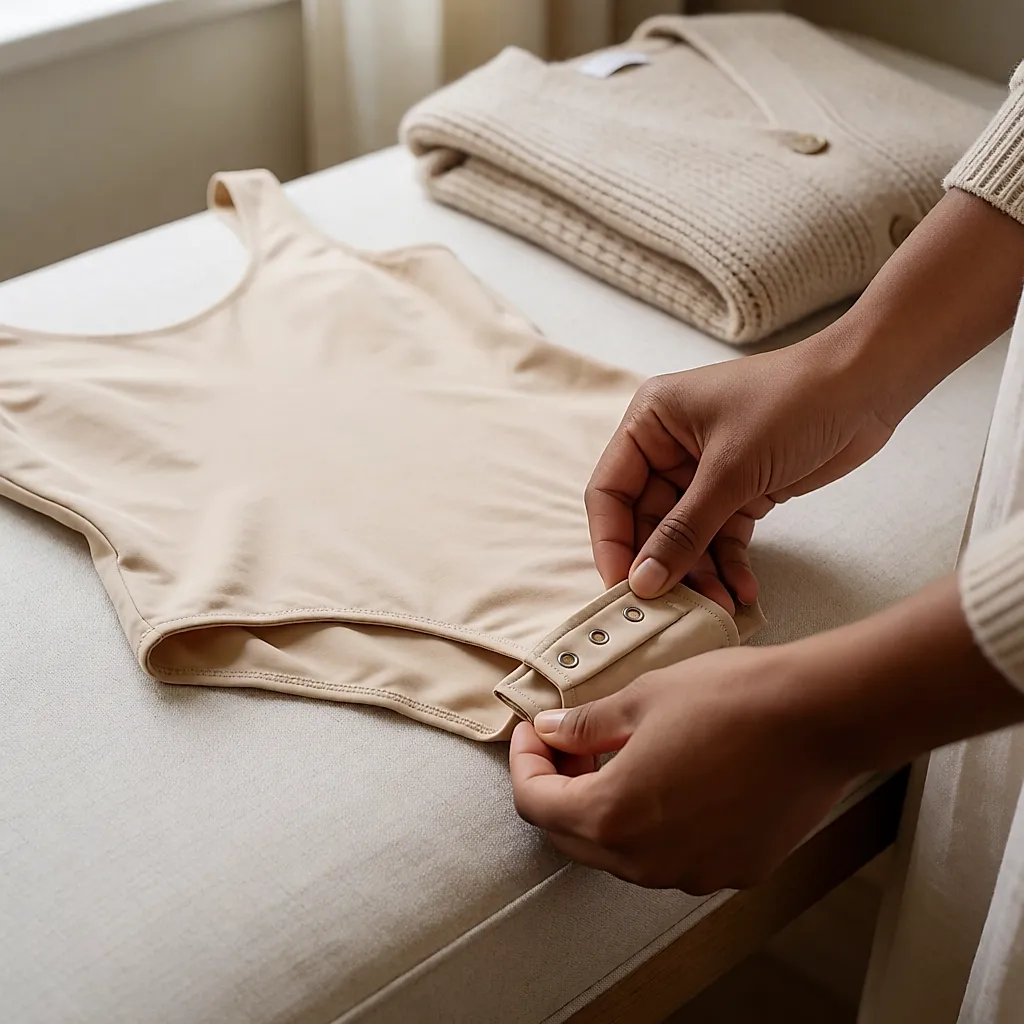
The width of the gusset matters too. A bodysuit whose base is too narrow rides up as soon as you walk; too wide, it creates a bulge under close-fitting trousers. The best reference is your own body: when you are standing, the poppers should stay put without you having to hunt for them with your fingertips.
The leg opening has to pass the splits test
The leg cut changes everything, and not just how it looks. A high-cut leg opening frees movement but shows under a skirt with a slit; a fuller-coverage edge, shorty style, stays in place better but shows through close-fitting trousers. Between the two, a French-cut leg — discreet, neither too high nor too low — is often the most versatile.

What is acceptable? A leg opening that does not roll when you sit down and does not gape when you cross your legs. What is not? A seam that shows through fine fabric, or an elastic that leaves a red mark by the end of the day.
A high-waisted skirt and trousers ask different things of a bodysuit
Under a high-waisted skirt, the bodysuit acts as a top: it needs to stay smooth at the waist, not ride up when you sit down, and drape cleanly over the hips. This is where a slightly thicker cotton, perhaps with a touch of elastane for hold, makes the difference. The leg opening is covered — unless you are wearing a slit or short skirt — so you can afford a freer cut.

Under trousers, the rules change. The leg opening and poppers become the sensitive points: under slightly fitted high-waisted jeans, a badly placed popper makes itself felt with every movement, and a rolling edge creates an unflattering crease. Here, choose fuller coverage, a lightweight but opaque fabric, and flat seams. The bodysuit becomes a layering basic again, not a piece that demands attention.
What to pay
On price, as a rough guide in the UK, expect to pay £15–£30 for a simple cotton bodysuit from a supermarket clothing range or a high-street fashion store, £35–£70 for a better-cut piece in organic cotton or a denser jersey, and £80–£150 for premium lingerie, where the cut and finishing often make the real difference. Prices vary by city, fabric, brand and level of finish — a £20 bodysuit can absolutely do the job, provided you check the torso length before you commit.
Second-hand is still a good way to test a cut without spending £80. On fabric, favour organic cotton or a natural jersey, keeping an eye on the elastane content: a little is needed for hold, a lot makes it less breathable.
Three moves in the fitting room: raise your arms, sit down, take two steps. If the straps pull, the poppers shift or the leg opening rolls, take it off and put it back on the rail. A bodysuit that asks you to stay still is not a bodysuit; it is a restriction.
The right torso length, a well-placed popper and a leg opening that stays put: three details you will not find on the label, but which decide everything. Take time over the fitting, even online — returns exist for exactly that reason — and keep the bodysuit that lets you forget you are wearing one.


Comments
Your opinion matters: rate the article, react and reply to comments.
Comments are moderated; AI-assisted comments are flagged. Text emoticons (8-), :-), <3…) are automatically shown as images.