

Last year, getting my wool scarf out of the wardrobe, I found three moths settled in the folds. The moral: what changes an autumn silhouette isn't the coat, it's what finishes it. A well-chosen collar, a beanie with the right slouch, gloves that hold the hand properly — and an ordinary outfit takes on a different air. So I had a clear-out this season. Here's what really earns its place, and what can wait.

Layering starts at the neck
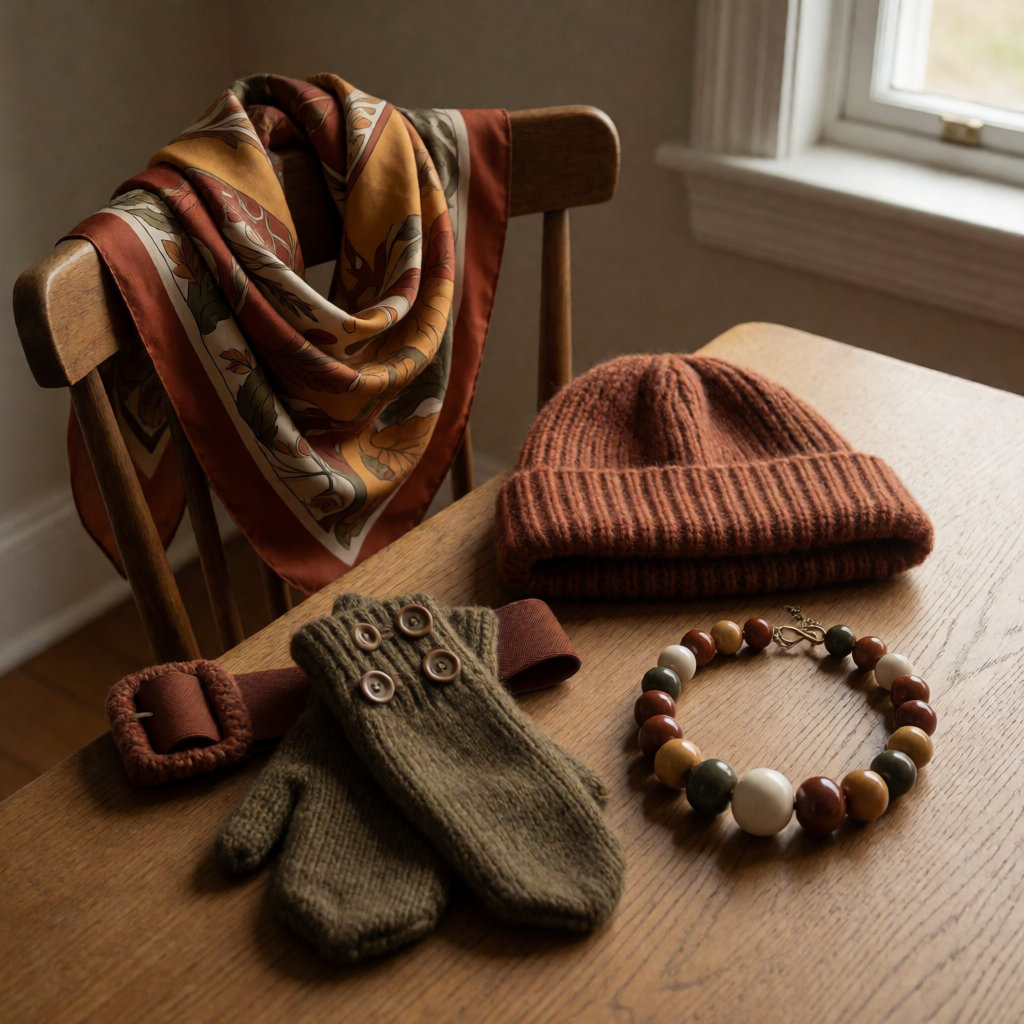
The hardest-working piece in your autumn wardrobe is the scarf. Not the most expensive, the most versatile. A large merino wool scarf, around 180 × 40 cm, can be looped, thrown over a denim jacket, or worn head-to-toe with a straight coat. Cashmere is still unbeatable for drape, but the price climbs quickly.

On materials, read the label before you fall for it. The RWS (Responsible Wool Standard) label covers wool from farms that manage flocks and pastures responsibly. The GRS (Global Recycled Standard) certifies the recycled content and its traceability along the supply chain. These aren't absolute promises, but verifiable markers — far more solid than a '100% natural' claim with no evidence.


A printed silk scarf remains a safe bet for accessorising a dark outfit. A graphic print tied bandana-style over a roll-neck, and the silhouette wakes up at once.


Heads and hands: useful warmth
The beanie is the tricky one. Too tight and it flattens. Too loose and it slips. The right compromise: a mid-length ribbed shape that covers the ears without pressing on them. Ear warmers are back, in a fine version, worn as a headband — over loose hair, or not at all.


For hands, there are two camps. Soft leather gloves remain unbeatable: they slim the wrist and age well. British glovemaking is still alive — Dents, founded in 1777, and Chester Jefferies in Dorset, two historic names. If you'd rather avoid leather, boiled wool or recycled wool fingerless gloves do the job: they leave your fingers free for your phone and are easy to find.


The glove-fit test. Put the pair on, bend your fingers, make a fist. If the leather pulls across the palm or gapes at the wrist, the fit isn't right for you. A well-fitted glove hugs the hand and won't stretch out.

Keeping feet dry
The autumn ankle boot needs to meet three criteria: a non-slip sole, a shaft that rises above the ankle, and a material that stands up to rain. Water-repellent treated suede holds up better than you'd think; smooth leather needs regular care, but gives an impeccable patina.

And give acrylic a miss for mittens: cheaper, yes, but it bobbles quickly and holds heat less well once the cold really sets in.

Care: lips and hands
Autumn is also the season when lips feel tight and hands turn rough. Two habits are enough.
Lips. A balm rich in plant wax — such as carnauba wax — or shea butter is a good reflex for tight, dry lips. COSMOS Organic certified balms have a composition that meets the organic standard: a useful marker when choosing. Keep your stick in your pocket, not in the car — heat softens the texture and makes it harder to apply.
Hands. After every wash, a small amount of cream. Choose a refillable glass or aluminium container: a simple habit to reduce waste.


Budget
Typical UK price ranges; rough guides to adjust for season and range.
| Accessory | Entry level | Mid-range | High end |
|---|---|---|---|
| Wool scarf | £15-£30 | £50-£90 | £120+ |
| Wool beanie | £10-£25 | £35-£60 | £80+ |
| Leather gloves | £30-£50 | £80-£150 | £200+ |
| Ankle boots | £40-£80 | £100-£180 | £250+ |
| Lip balm | £3-£6 | £8-£15 | £20+ |
What moves the price: the material (virgin wool, recycled, blends), where it's made, the finish, and where you buy it. For leather gloves, nothing replaces trying them on — it's an accessory that needs a fitting, not a standard size. For a scarf, online knitwear brands are often more competitive than a multi-brand boutique.
Where to buy: scarves and hats from knitwear brands, high street retailers or online; gloves from British glovemakers; ankle boots from shoe brands; balms from pharmacies, beauty retailers or health food shops.
The advice that stays
One move that changes everything: before you buy anything, empty your wardrobe and sort your accessories into three piles — 'I wear it', 'to repair', 'to donate'. It's often in the third pile that you find the piece you were missing. A darned hat costs nothing and saves a whole season.
For everything else, one rule: material before logo.
Sources
- Dents, British glovemaker founded in 1777 — dents.co.uk
- Chester Jefferies, British glovemaker in Dorset — chesterjefferies.co.uk
- Textile Exchange, RWS and GRS standards — textileexchange.org
- COSMOS Standard, international organic cosmetics standard — cosmos-standard.org



Comments
Your opinion matters: rate the article, react and reply to comments.
Comments are moderated; AI-assisted comments are flagged. Text emoticons (8-), :-), <3…) are automatically shown as images.