
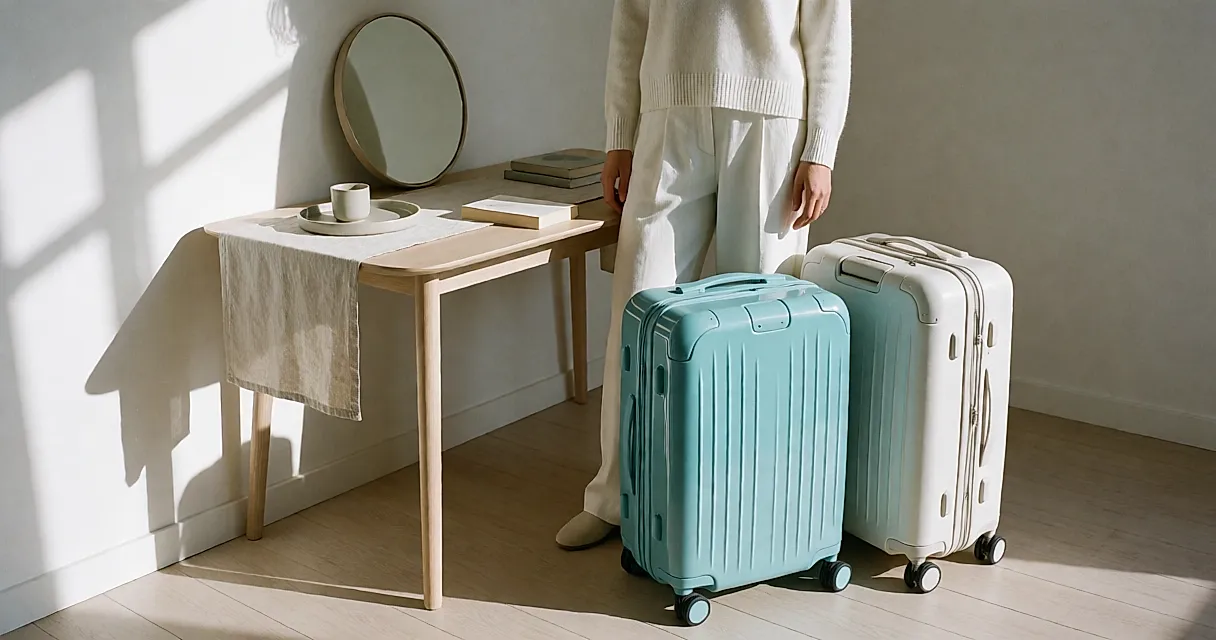
A hard-shell suitcase standing in the hallway looks like a small cube that has no intention of giving way. A soft one slumps as soon as you set it down and seems to be apologising already. Before Christmas, this is not a style question: it is a trade-off between what you put inside and how you travel.
What we actually ask of a suitcase
At the same time, we want it to keep clothes more or less flat, survive the car boot, slide under the bed once Christmas is over and fit in the cabin when we travel light. In other words, a suitcase has to be a trunk, a cushion and a piece of furniture. That's all. So if you have to choose a single case to do everything, which do you pick?
The trap is wanting to win on every front. Each type of luggage has its strong point and its concession: hard-shell cases protect shape better, soft cases squeeze into tighter spots. Which sacrifices what, exactly? That is where the decision gets interesting.
Hard-shell: the shell that reassures
A polycarbonate or polypropylene shell holds its shape and protects the shape of what is inside: a folded jumper arrives folded, a gift box does not end up concertinaed. It also takes knocks at the corners with a certain dignity, which is reassuring when you watch your case disappear onto the carousel. And in a station concourse, it keeps a crisp silhouette.
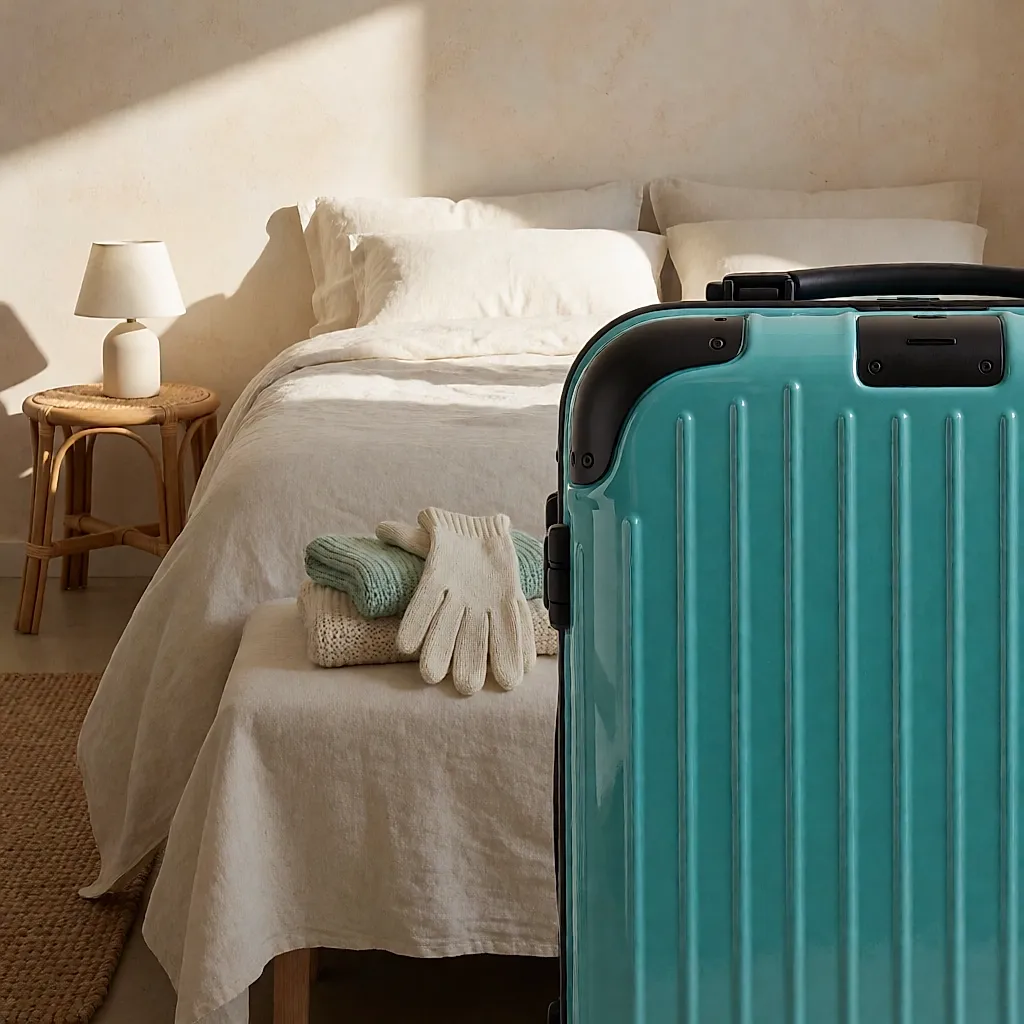
On the other hand, it is often heavier when empty, less flexible when the boot is packed, and it will not compress with a shove of the knee to squeeze in the last present. For storage, it needs a fixed spot: under a low bed, it may simply refuse to go. Pale shells quickly show signs of wear, too. And the price climbs with lightness and wheel quality. Is that a dealbreaker? Not necessarily, but it is part of the compromise.
Soft-sided: the case that bends
A soft suitcase in thick canvas, leather or coated fabric compresses, settles into a boot, slips against a seat and accepts the jumper bought at the last minute. Its flexible walls absorb everyday knocks with more ease than a hard shell, and it squeezes more easily into train luggage racks that are already full. This is the case that forgives slightly improvised trips.

But it protects shape less well: shirts crease, boxes get squashed, and a zip asked to do too much can become its weak point. Pale canvas styles are charming for three trips, then they start showing their age. Finally, when empty, a soft case can take up almost as much room as a hard-shell while offering less protection. So how do you decide?
Cabin, car boot, under the bed: the practical test
In the cabin, a hard-shell has an advantage: its square shape fits the sizers and protects your things. But size and weight rules vary by airline; check them before buying rather than discovering the problem at check-in. A soft case, meanwhile, slips more easily into full overhead lockers, especially if you do not overstuff it.

For the car, a soft case squashes down and follows the bends with less ceremony. For the hold, a hard-shell is reassuring. And for storage, the criterion is simple: if you need to slide it under the bed or into a narrow cupboard, the soft case starts with an advantage. There is nothing more irritating than a suitcase that refuses to go back under the bed after Christmas!
Budget
On price, there is little point aiming at the top end for two trips a year. As a rough guide in the UK, expect to pay around £50 to £150 for a decent hard-shell cabin case, and £40 to £120 for a good-sized soft case; larger cases often run from £80 to £250, especially when the shell is light and the wheels are quiet. Prices vary with size, wheel quality, warranty and where you buy.
Where to buy? Supermarkets, department stores, luggage shops, online and pre-loved for a branded hard-shell. The smart move is to check whether wheels and handles can be repaired, because that is often what decides whether a case stays with you for five years or one return trip. A simple soft case whose zip can be replaced is sometimes better than a shiny hard shell that ends up in the loft.
Before you buy, put the suitcase where it will live: in the hallway, under the bed, in the car boot. If it blocks the way or will not fit, it has already lost. Take a tape measure, too: the stated dimensions do not tell the whole story once wheels and handles are added.
For the festive season, here is how to decide: small budget, a simple soft case; mid-range budget, a well-sized hard-shell cabin case; a larger budget, a light hard-shell with replaceable wheels. If you are flying with fragile presents, the hard-shell remains the most reassuring. If you are driving or short on space, the soft case will do a better job. After all, nobody looks at a suitcase at Christmas: we just ask it not to make life harder.



Comments
Your opinion matters: rate the article, react and reply to comments.
Comments are moderated; AI-assisted comments are flagged. Text emoticons (8-), :-), <3…) are automatically shown as images.