
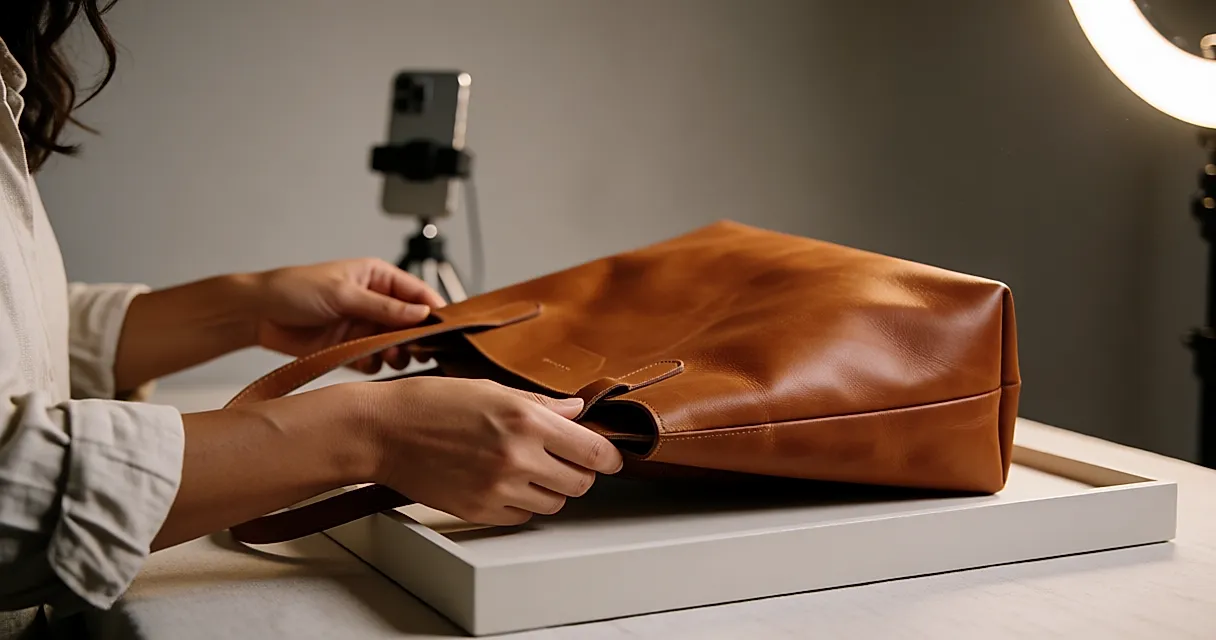
The bag sits on a white tray, the light is soft, the presenter turns it with a practised flick of the wrist and the leather looks as if it is breathing. Two seconds later your thumb is hovering over the buy button. Except that on screen a full-grain leather and a well-lit synthetic look much the same — the camera is not lying, it is simply choosing what it shows you.
What the lighting does to a material
A live sale is a portable studio: front lighting, neutral backdrop, calibrated close-ups. Everything that makes a bag worth having — the grain, the thickness, the suppleness, the way it hangs — comes across flattened. Grain looks deeper than it is, hardware reflections pass for solid brass, and the lining, often the first place costs are cut, stays out of shot. So ask for a close-up of the stitching and the cut edge: that is where the finish reads, not in a sweeping turn.

Another blind spot is weight. A bag weighs nothing on video. Empty weight and real capacity make all the difference between a model you carry happily all Sunday and one that ends up on a chair after two hours. 'Will a 13-inch laptop fit?', 'what does it weigh without the strap?' Two questions typed into the chat and you have information the product page does not always give you.
The chat is the fitting room you do not get
That is the real privilege of a live: you can make the camera do what a packshot never does. The presenter can carry the bag on her shoulder, in her hand, hold it against her body to show the scale. But you have to ask. 'Could you show it worn, with the strap adjusted short?' One sentence and you jump from a retouched image to a believable look.

And while you are there, slip in the awkward questions, politely: where does the leather come from? What proportion is synthetic fibre? Is the lining textile? Is the closure a zip or simply magnetic? A vague answer is information too — sometimes the most useful of the evening.
What the click really costs once you add returns
This is the point that decides whether a purchase stays a good buy or becomes a lesson. Buying at a distance gives you a cancellation right — the 14-day cooling-off period under the Consumer Contracts Regulations — but what often stings is the cost of sending it back: return a £300 bag at your own expense and the deal changes shape. Ask in writing who pays for the return, and to which address. If the seller ships from outside the UK, import charges and handling fees can come to more than the bag.
Look at who is selling, and from where, as well: a brand's own live and a marketplace's live leave you with very different people to deal with when something goes wrong. And keep in mind that the Consumer Rights Act 2015 covers anything new you buy, whatever goodwill the seller shows during the broadcast.
The live gets pieces the shop never sees
An exclusive shade, a run announced as limited, a 'live special' model: the line-up on screen is not always the one on the shop floor. This is not a conspiracy, it is a strategy — but it has one concrete consequence: you will not be able to try the bag first, or exchange it in store if the colour disappoints in real life.
So, a good deal or a stage set? Compare during the broadcast with the regular website. The supposedly special price is sometimes just the usual one, served with a countdown and a backing track.
Checking the numbers
On price, a live blurs your landmarks: the figure on screen is not always the one on the site. Compare both while the stream is running — it is a quick way to see whether the 'live price' is a genuine saving. Watch the delivery charges mentioned out loud, too, and any minimum order thresholds: they can push up the total for a single bag.
Before you click: empty weight, internal dimensions, exact material with fibre percentages, return postage, return address, stated delivery time. Five minutes in the chat beats a miserable return in the middle of a wet week.
A bag you keep is never the one that shone brightest on screen: it is the one that stands up on the chair at dinner, does not cut into your shoulder and goes with three coats out of four. Take the time to ask in the chat, note down your three key facts, and a pretty click turns into a genuinely good buy.



Comments
Your opinion matters: rate the article, react and reply to comments.
Comments are moderated; AI-assisted comments are flagged. Text emoticons (8-), :-), <3…) are automatically shown as images.