
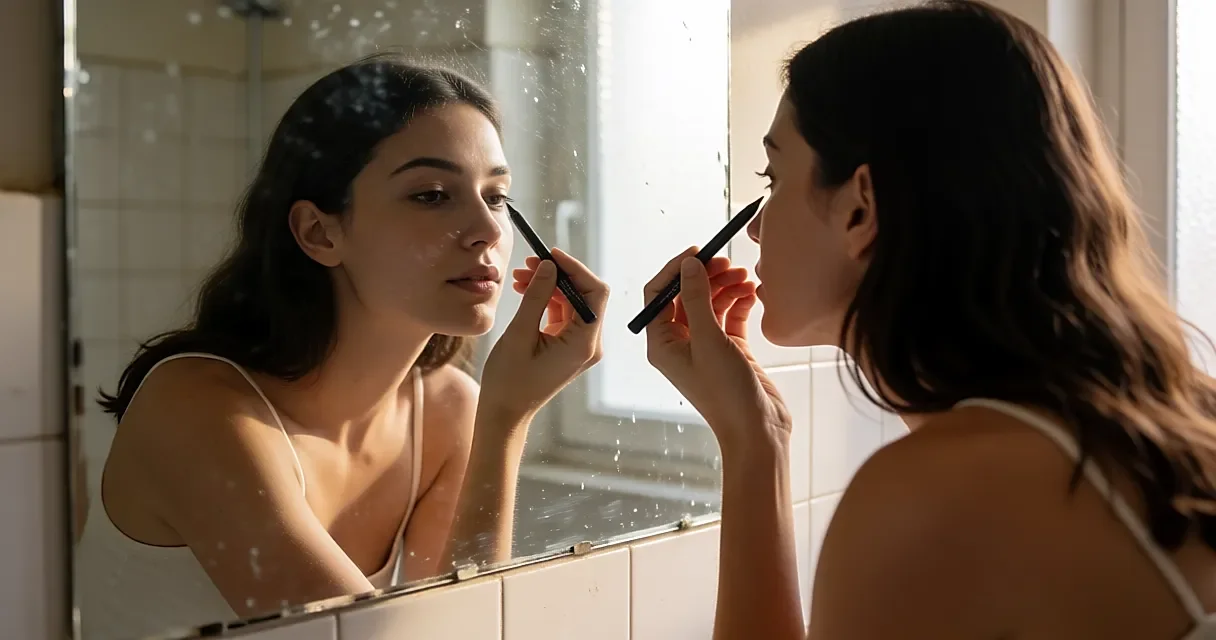
A liquid liner draws a line; a creamy kohl leaves behind material that is still moving. The first dries, sets, and won't be worked again. The second waits for your fingertip to decide its final shape. That's why the same stroke — right at the lash line, drawn out at the outer corner — gives a completely different eye depending on what you pull out of your makeup bag: the softness isn't down to technique, it comes down to the few seconds during which the formula will still take your finger.
What a pencil allows that a liner won't
A creamy kohl is a soft lead, heavy on waxes and oils: more of a paste than a pen. You lay it down and the texture stays open while the warmth of your skin softens it. That's the whole window — a few moments while the material is still workable — in which a finger can pull the stroke out towards the temple, diffuse it across the mobile lid and break the hard line into that "made up without really trying" finish. Leave it too long and the smudge turns into a grey scribble.
A liquid liner works the other way round. The pigment rides on a fluid that dries fast and fixes the line exactly where the nib put it. Hence the precision, genuinely lovely for a graphic flick or a line that has to stay a line. But once dry it won't blur: your finger just pushes the line about and leaves a dirty edge. A liner doesn't forgive an improvised touch-up.
The method: warm, tap, blend
Good news: a soft kohl needs less technique than timing. Warm the tip briefly on the back of your hand before you apply it. Draw three short strokes along the upper lashes rather than one long sweep — you'll have better control over the thickness. Then smudge straight away, with your fingertip, working upwards and outwards. If you want to open up the eye, keep the colour on the mobile lid and the outer corner, and leave the lower lid alone: that's where a soft smudge tips over into a shadow.
Then there's the pencil itself. Too hard and it drags without blending; too soft and it tends to travel as the day goes on. The compromise usually lies with pencils you can sharpen, so you can keep refining the tip. As for wear time, we're not going to pretend we've timed every formula on the market: the difference between one and another is often real, but it's judged on your skin, not on the packaging.
The liner isn't the villain
In fairness: if what you enjoy is a crisp line, a felt-tip nib is still unbeatable. On a Monday when you've got seven minutes left, it does the job with no finger, no blending, no hesitation. It also comes into its own on graphic strokes you want to commit to, and on eyes you rub — a set line survives wayward hands better.
A small tip if you already own a liner and no kohl: some liners can still be worked in the first few seconds. Test on the back of your hand before you try it on your eye; if the line doesn't budge, no finger will save it.
Budget
Expect to pay £5 to £15 for a creamy kohl at a supermarket, chemist or online, and more like £20 to £35 in a department store beauty hall for the more elaborate formulas. Liners climb quickly: £10 to £30 depending on how fine the nib is and the wear time claimed. Add a dedicated sharpener, £3 to £5, which will outlast your pencils.
Price isn't the only criterion. A wooden pencil sharpens right down to the last of it; a liner, on the other hand, sometimes dries out before the last drop and goes in the bin whole. If you like the format, look at refillable liners and unvarnished wooden pencils: that information is rarely on the counter display, but it does exist on brands' own websites. On ingredients, if your eyelids are sensitive, go for a formula with no added fragrance.
The back-of-the-hand test, in three steps: warm the tip, draw a stroke, smudge it. If the stroke stretches cleanly, the pencil is ready for your eye. If it balls up or drags, it's too dry — a turn of the sharpener and start again. It's dead simple, and it saves a lot of messy rushed mornings!
So what's the point of all this? That a smudged eye isn't reserved for expert hands, or for Sundays when you'd have the time. All you need is a pencil that's happy to be touched, and your finger ready before the formula sets. The liner keeps its own role: the line you mean. Nothing stops you keeping both in the bag — real life doesn't ask you to pick a side.



Comments
Your opinion matters: rate the article, react and reply to comments.
Comments are moderated; AI-assisted comments are flagged. Text emoticons (8-), :-), <3…) are automatically shown as images.