
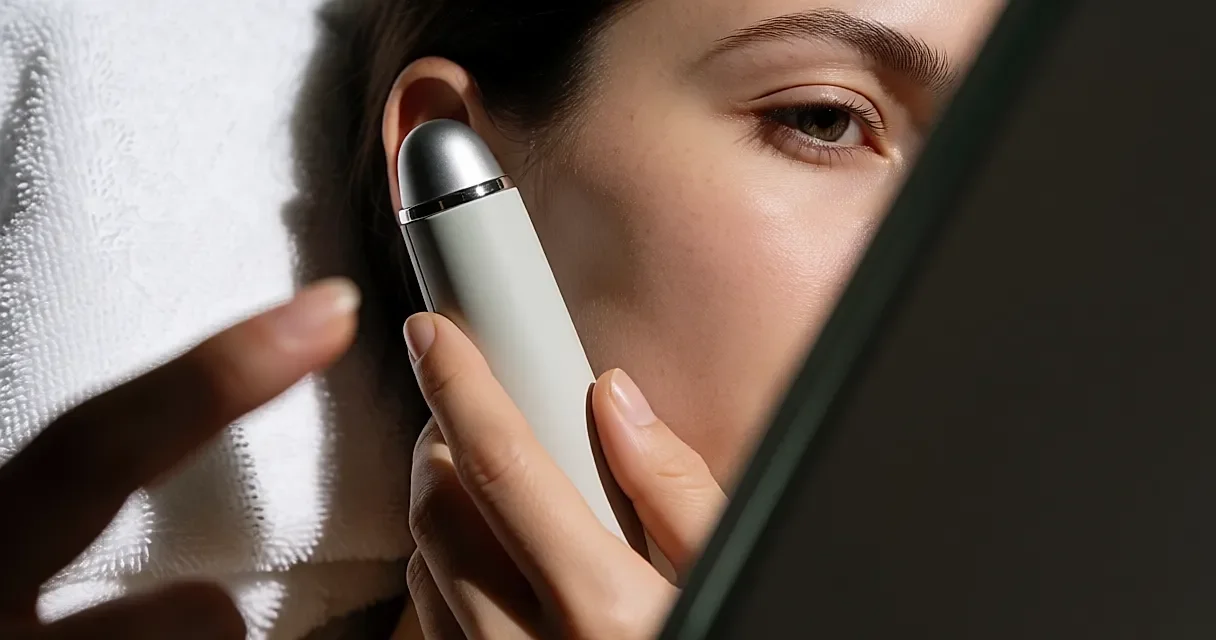
An LED device sitting on a counter looks like a smooth, well-behaved pebble. Pick it up, though, and the weight pulls to one side, the single button makes you cycle through several intensity levels without any idea where you've landed, and the leaflet promises a whole new complexion. That's the moment the purchase is really decided — not in the spec table.
What the spec sheet won't tell you
A product page talks in wavelengths, joules and percentages. It doesn't tell you whether the device gets warm after a few minutes, whether the head drags on slightly dry skin, or whether the cable forces you into contortions in front of the mirror. Yet all of that is what decides whether the thing lives on your shelf or in a drawer under the odd socks.
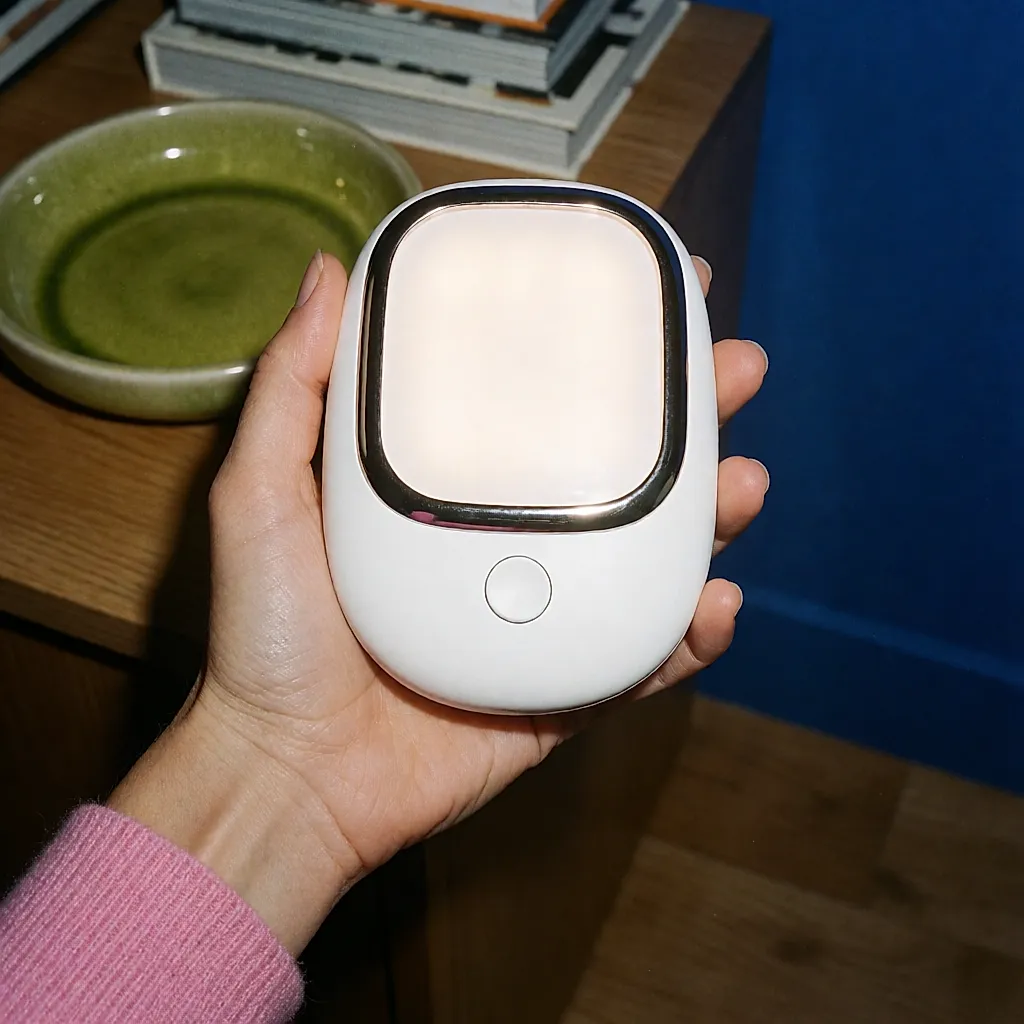
Weight matters more than you'd think. A wide head glides quickly over the cheeks but catches around the nose; a narrow head turns the treatment into precision work. Noise counts too: if the fan whines, you'll skip sessions while the kids are asleep. How often would you honestly get out the one that hums like a hairdryer? None of this is printed on the box.
Three things to check during the demo
Start with intensity. Ask to go from the lowest level to the highest, on your forearm or along the jawline. You're looking for a sensation you can tolerate: clear warmth with LED, a slight tingle with microcurrent. If the lowest level already stings, the device will stay in the cupboard — and you'll have saved yourself a lot of patience.

Next, look at session time. Ask them to time the demonstration. Does the length of a full session — which varies from device to device — fit into your week? The built-in timer, with its beep at the end and automatic shut-off, isn't a gimmick: it saves you counting in your head while scrolling.
That leaves tolerance, the part you can't see immediately. Redness that fades quickly isn't the same as heat that lingers. Walk out with calm skin. And if you have an implanted medical device or you're pregnant, raise it with the healthcare professional who looks after you before you even sit down for the demo: we won't make that call here, and not all devices are equal on that front.
Where to try one in the UK
A simple route is a brand counter in a department store beauty hall, or a larger pharmacy or beauty retailer that offers demonstrations. Set aside enough time for a demonstration, sometimes free, sometimes against a deposit, and at some stockists you'll need to book. Ring ahead before crossing town — it saves a wasted trip to an empty stand.
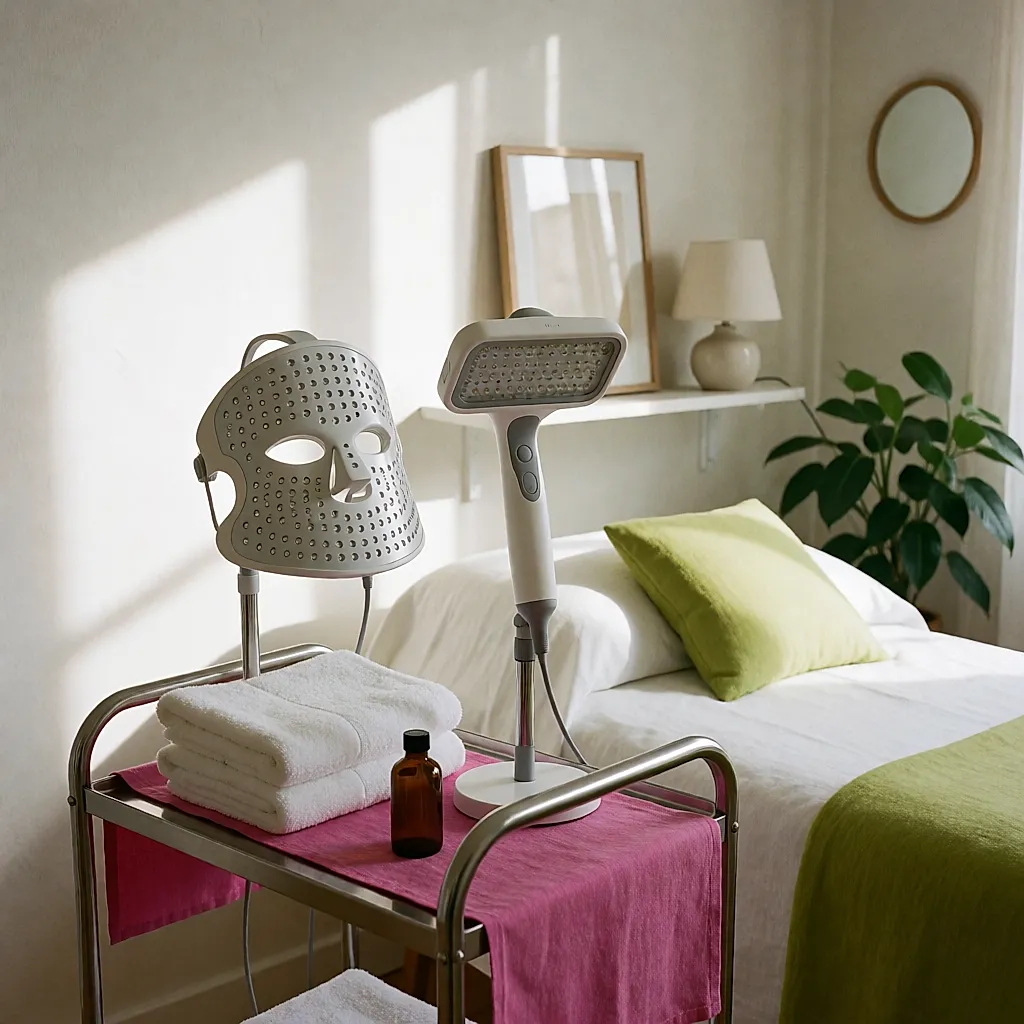
Clinics are another route. Many offer an introductory LED or microcurrent facial: a chance to feel the technique on your face rather than your forearm, and to compare two devices within the same appointment. Two machines, one skin — that certainly helps you get a clearer idea. Some pharmacies run sessions as well; again, ask which machine is being used and what the treatment involves.
Budget
What it costs varies widely depending on the brand, the number of heads and the build quality. As a rough UK guide, expect roughly £40 to £250 for a basic or mid-range LED device, and £300 to £800 for a premium model with several heads; a demonstration at a beauty counter is often free, but some stockists ask for a refundable deposit of around £20 to £50. Introductory LED or microcurrent facials at clinics commonly run from about £45 to £120, depending on the city and the length of the appointment — and sometimes the cost is redeemable against a purchase, so it costs nothing to ask. You'll usually find these devices at department-store beauty halls, larger pharmacies, specialist beauty retailers and online; for a facial, book directly with the clinic.
Before you commit, look at the warranty and at whether parts and consumables are available. A device with a replaceable head and an after-sales service that actually answers is likely to outlast a beautifully packaged model with a sealed battery. There is a second-hand market for these; check the purchase date and whether the warranty transfers before you get carried away.
The three questions to ask the sales assistant: how long does a full session actually take? What should I do if I get redness or discomfort? Can the device be repaired, and at what cost? If any of the answers is vague, that's an answer in itself.
The right device isn't the most powerful one, or the one with the longest list of programmes. It's the one you'll realistically keep using, sitting in the same spot, without sighing. Ask for the demonstration, take your time handling it — and if the sales assistant tries to rush you, let them rush someone else.

Comments
Your opinion matters: rate the article, react and reply to comments.
Comments are moderated; AI-assisted comments are flagged. Text emoticons (8-), :-), <3…) are automatically shown as images.